

followed an Fe-only redox pathway, as suggested from extensive mechanistic
studies published recently [50].
Upon reduction of the corresponding heteroleptic high-spin cobalt-dichloride
complex [Co(Cl) 2 (pdi)], the spin state of the formed species strongly depends on
the substitution pattern at the imine nitrogens. Aryl substituents lead to the low-spin
Co
II antiferromagnetically coupled to a ligand radical, giving the overall S ¼ 0 square
planar d
7 complex Co
II Cl(pdi
À• ). Imino-alkyl substituted systems display spin
crossover to an overall S ¼ 1 state with high-spin Co
II at high temperature
[51, 52]. Dialkyl-cobalt(II) species with pdi are unknown, but the mono-alkyl
derivatives are easily accessible and are best described as low-spin Co
II with a pdicentred radical. The corresponding cationic [Co
I
(N 2 )(pdi)]
+ starting material has
low-spin Co
I with a neutral pdi ligand [53]. Single or two-electron reduction which
occurs at the ligand, with cobalt remaining in the +I oxidation state, leads to the
formation of [Co
I (N 2 )(pdi
À• )] and [Co
I
(N 2 )(pdi
2À•
)]
À , the latter containing a
dianionic diradical ligand fragment. The neutral congener has been reported to
undergo binuclear oxidative addition with aryl and alkyl halides, involving parapyridine substitution [54]. For related Co catalysis on C–C bond formation as
described for Fe (vide supra), the redox-active ligand radical does not seem to
actively participate in the redox-chemistry but does tune the reactivity of the Co
centre [55].
The group of Roşca recently developed bis(imino)pyrazine-based analogs of pdi
and its coordination to Fe
0 precursor Fe(bda)(CO) 3 (bda ¼ benzylideneacetone)
[56]. The resulting diamagnetic complex predominantly showed spectroscopic features that support an Fe
0 oxidation state, which was also supported by DFT calculations. Although the electrochemical reduction at À2.28 V was postulated to be
ligand-centred, the main chemical pathway for reaction discussed was methylation
of the free pyrazine N-donor. The corresponding cationic complex was susceptible
to chemical reduction by cobaltocene, which furnished a dinuclear Fe 2 species via
C–C bond formation at the meta-position of the pyrazine ring.
The Tomson group utilized dinucleating bis(imino)pyridines with alkyl linkers to
connect imino groups, originally prepared by Drew and Nelson in 1982 [57], which
presented a way to create Fe 2 , Co 2 and Ni 2 species for inter alia elegant nitride and
dinitrogen chemistry [58–61]. The role of ligand reduction on the nature of the
metal-metal interaction was studied in detail for the cobalt-cobalt derivative (Fig. 8)
[62]. It was convincingly shown that increased levels of pdi 2 -based reduction lead to
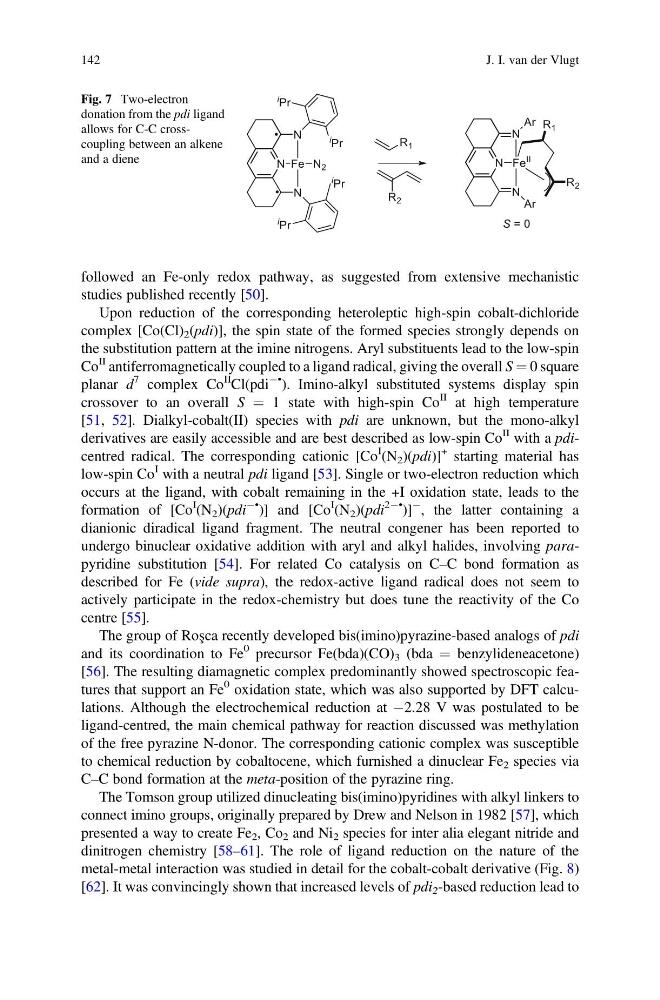
Fig. 7 Two-electron
donation from the pdi ligand
allows for C-C crosscoupling between an alkene
and a diene
142
J. I. van der Vlugt
studies published recently [50].
Upon reduction of the corresponding heteroleptic high-spin cobalt-dichloride
complex [Co(Cl) 2 (pdi)], the spin state of the formed species strongly depends on
the substitution pattern at the imine nitrogens. Aryl substituents lead to the low-spin
Co
II antiferromagnetically coupled to a ligand radical, giving the overall S ¼ 0 square
planar d
7 complex Co
II Cl(pdi
À• ). Imino-alkyl substituted systems display spin
crossover to an overall S ¼ 1 state with high-spin Co
II at high temperature
[51, 52]. Dialkyl-cobalt(II) species with pdi are unknown, but the mono-alkyl
derivatives are easily accessible and are best described as low-spin Co
II with a pdicentred radical. The corresponding cationic [Co
I
(N 2 )(pdi)]
+ starting material has
low-spin Co
I with a neutral pdi ligand [53]. Single or two-electron reduction which
occurs at the ligand, with cobalt remaining in the +I oxidation state, leads to the
formation of [Co
I (N 2 )(pdi
À• )] and [Co
I
(N 2 )(pdi
2À•
)]
À , the latter containing a
dianionic diradical ligand fragment. The neutral congener has been reported to
undergo binuclear oxidative addition with aryl and alkyl halides, involving parapyridine substitution [54]. For related Co catalysis on C–C bond formation as
described for Fe (vide supra), the redox-active ligand radical does not seem to
actively participate in the redox-chemistry but does tune the reactivity of the Co
centre [55].
The group of Roşca recently developed bis(imino)pyrazine-based analogs of pdi
and its coordination to Fe
0 precursor Fe(bda)(CO) 3 (bda ¼ benzylideneacetone)
[56]. The resulting diamagnetic complex predominantly showed spectroscopic features that support an Fe
0 oxidation state, which was also supported by DFT calculations. Although the electrochemical reduction at À2.28 V was postulated to be
ligand-centred, the main chemical pathway for reaction discussed was methylation
of the free pyrazine N-donor. The corresponding cationic complex was susceptible
to chemical reduction by cobaltocene, which furnished a dinuclear Fe 2 species via
C–C bond formation at the meta-position of the pyrazine ring.
The Tomson group utilized dinucleating bis(imino)pyridines with alkyl linkers to
connect imino groups, originally prepared by Drew and Nelson in 1982 [57], which
presented a way to create Fe 2 , Co 2 and Ni 2 species for inter alia elegant nitride and
dinitrogen chemistry [58–61]. The role of ligand reduction on the nature of the
metal-metal interaction was studied in detail for the cobalt-cobalt derivative (Fig. 8)
[62]. It was convincingly shown that increased levels of pdi 2 -based reduction lead to
Fig. 7 Two-electron
donation from the pdi ligand
allows for C-C crosscoupling between an alkene
and a diene
142
J. I. van der Vlugt