

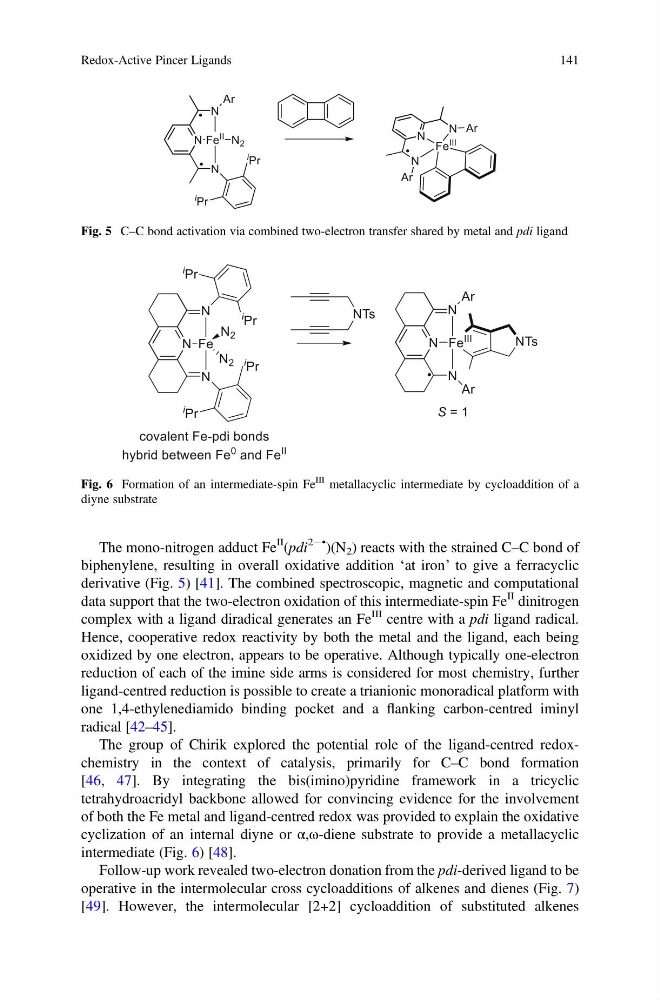
The mono-nitrogen adduct Fe
II (pdi
2À• )(N 2 ) reacts with the strained C–C bond of
biphenylene, resulting in overall oxidative addition ‘at iron’ to give a ferracyclic
derivative (Fig. 5) [41]. The combined spectroscopic, magnetic and computational
data support that the two-electron oxidation of this intermediate-spin Fe
II dinitrogen
complex with a ligand diradical generates an Fe
III centre with a pdi ligand radical.
Hence, cooperative redox reactivity by both the metal and the ligand, each being
oxidized by one electron, appears to be operative. Although typically one-electron
reduction of each of the imine side arms is considered for most chemistry, further
ligand-centred reduction is possible to create a trianionic monoradical platform with
one 1,4-ethylenediamido binding pocket and a flanking carbon-centred iminyl
radical [42–45].
The group of Chirik explored the potential role of the ligand-centred redoxchemistry in the context of catalysis, primarily for C–C bond formation
[46, 47]. By integrating the bis(imino)pyridine framework in a tricyclic
tetrahydroacridyl backbone allowed for convincing evidence for the involvement
of both the Fe metal and ligand-centred redox was provided to explain the oxidative
cyclization of an internal diyne or α,ω-diene substrate to provide a metallacyclic
intermediate (Fig. 6) [48].
Follow-up work revealed two-electron donation from the pdi-derived ligand to be
operative in the intermolecular cross cycloadditions of alkenes and dienes (Fig. 7)
[49]. However, the intermolecular [2+2] cycloaddition of substituted alkenes
Fig. 5 C–C bond activation via combined two-electron transfer shared by metal and pdi ligand
Fig. 6 Formation of an intermediate-spin Fe
III metallacyclic intermediate by cycloaddition of a
diyne substrate
Redox-Active Pincer Ligands
141
II (pdi
2À• )(N 2 ) reacts with the strained C–C bond of
biphenylene, resulting in overall oxidative addition ‘at iron’ to give a ferracyclic
derivative (Fig. 5) [41]. The combined spectroscopic, magnetic and computational
data support that the two-electron oxidation of this intermediate-spin Fe
II dinitrogen
complex with a ligand diradical generates an Fe
III centre with a pdi ligand radical.
Hence, cooperative redox reactivity by both the metal and the ligand, each being
oxidized by one electron, appears to be operative. Although typically one-electron
reduction of each of the imine side arms is considered for most chemistry, further
ligand-centred reduction is possible to create a trianionic monoradical platform with
one 1,4-ethylenediamido binding pocket and a flanking carbon-centred iminyl
radical [42–45].
The group of Chirik explored the potential role of the ligand-centred redoxchemistry in the context of catalysis, primarily for C–C bond formation
[46, 47]. By integrating the bis(imino)pyridine framework in a tricyclic
tetrahydroacridyl backbone allowed for convincing evidence for the involvement
of both the Fe metal and ligand-centred redox was provided to explain the oxidative
cyclization of an internal diyne or α,ω-diene substrate to provide a metallacyclic
intermediate (Fig. 6) [48].
Follow-up work revealed two-electron donation from the pdi-derived ligand to be
operative in the intermolecular cross cycloadditions of alkenes and dienes (Fig. 7)
[49]. However, the intermolecular [2+2] cycloaddition of substituted alkenes
Fig. 5 C–C bond activation via combined two-electron transfer shared by metal and pdi ligand
Fig. 6 Formation of an intermediate-spin Fe
III metallacyclic intermediate by cycloaddition of a
diyne substrate
Redox-Active Pincer Ligands
141