

modest. The corresponding Na
+ encapsulated bimetallic species showed enhanced
activity (based on an initial rate analysis) for stoichiometric nitrite reduction, with
NO 2
À being the anion associated with the sodium cation [37].
Base metals have dominated the coordination chemistry of this pdi ligand type,
which likely relates to the weak field nature of the donor atoms involved, inducing
intermediate- or high-spin states that are easily accommodated by these metals [38]
as well as to the emergence of nonnoble metal chemistry for catalysis. Hence, the
high-lying, filled orbitals of the reduced pdi ligand can act as electron reservoir,
providing access to reducing equivalents required for overall two-substrate activation. The Lewis acidity of the metal is also tuned by ligand-centred redox and the
concomitant spin state changes induced thereby, which enhances substrate binding.
Heteroleptic systems are of more relevance for follow-up substrate coordination
and activation. Much focus has been given to the elucidation of the reaction
chemistry and electronic structure of, e.g. dihalide, (di)alkyl and (bis)dinitrogen
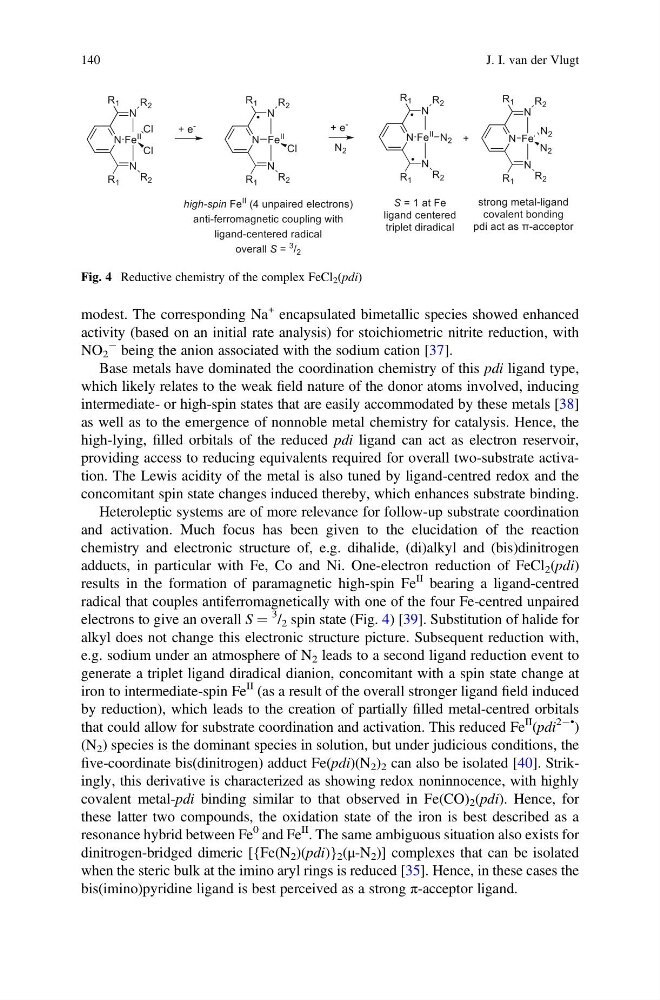
adducts, in particular with Fe, Co and Ni. One-electron reduction of FeCl 2 (pdi)
results in the formation of paramagnetic high-spin Fe
II bearing a ligand-centred
radical that couples antiferromagnetically with one of the four Fe-centred unpaired
electrons to give an overall S ¼
3 / 2 spin state (Fig. 4) [39]. Substitution of halide for
alkyl does not change this electronic structure picture. Subsequent reduction with,
e.g. sodium under an atmosphere of N 2 leads to a second ligand reduction event to
generate a triplet ligand diradical dianion, concomitant with a spin state change at
iron to intermediate-spin Fe
II (as a result of the overall stronger ligand field induced
by reduction), which leads to the creation of partially filled metal-centred orbitals
that could allow for substrate coordination and activation. This reduced Fe
II (pdi
2À•
)
(N 2 ) species is the dominant species in solution, but under judicious conditions, the
five-coordinate bis(dinitrogen) adduct Fe(pdi)(N 2 ) 2 can also be isolated [40]. Strikingly, this derivative is characterized as showing redox noninnocence, with highly
covalent metal-pdi binding similar to that observed in Fe(CO) 2 (pdi). Hence, for
these latter two compounds, the oxidation state of the iron is best described as a
resonance hybrid between Fe
0 and Fe
II . The same ambiguous situation also exists for
dinitrogen-bridged dimeric [{Fe(N 2 )(pdi)} 2 (μ-N 2 )] complexes that can be isolated
when the steric bulk at the imino aryl rings is reduced [35]. Hence, in these cases the
bis(imino)pyridine ligand is best perceived as a strong π-acceptor ligand.
Fig. 4 Reductive chemistry of the complex FeCl 2 (pdi)
140
J. I. van der Vlugt
+ encapsulated bimetallic species showed enhanced
activity (based on an initial rate analysis) for stoichiometric nitrite reduction, with
NO 2
À being the anion associated with the sodium cation [37].
Base metals have dominated the coordination chemistry of this pdi ligand type,
which likely relates to the weak field nature of the donor atoms involved, inducing
intermediate- or high-spin states that are easily accommodated by these metals [38]
as well as to the emergence of nonnoble metal chemistry for catalysis. Hence, the
high-lying, filled orbitals of the reduced pdi ligand can act as electron reservoir,
providing access to reducing equivalents required for overall two-substrate activation. The Lewis acidity of the metal is also tuned by ligand-centred redox and the
concomitant spin state changes induced thereby, which enhances substrate binding.
Heteroleptic systems are of more relevance for follow-up substrate coordination
and activation. Much focus has been given to the elucidation of the reaction
chemistry and electronic structure of, e.g. dihalide, (di)alkyl and (bis)dinitrogen
adducts, in particular with Fe, Co and Ni. One-electron reduction of FeCl 2 (pdi)
results in the formation of paramagnetic high-spin Fe
II bearing a ligand-centred
radical that couples antiferromagnetically with one of the four Fe-centred unpaired
electrons to give an overall S ¼
3 / 2 spin state (Fig. 4) [39]. Substitution of halide for
alkyl does not change this electronic structure picture. Subsequent reduction with,
e.g. sodium under an atmosphere of N 2 leads to a second ligand reduction event to
generate a triplet ligand diradical dianion, concomitant with a spin state change at
iron to intermediate-spin Fe
II (as a result of the overall stronger ligand field induced
by reduction), which leads to the creation of partially filled metal-centred orbitals
that could allow for substrate coordination and activation. This reduced Fe
II (pdi
2À•
)
(N 2 ) species is the dominant species in solution, but under judicious conditions, the
five-coordinate bis(dinitrogen) adduct Fe(pdi)(N 2 ) 2 can also be isolated [40]. Strikingly, this derivative is characterized as showing redox noninnocence, with highly
covalent metal-pdi binding similar to that observed in Fe(CO) 2 (pdi). Hence, for
these latter two compounds, the oxidation state of the iron is best described as a
resonance hybrid between Fe
0 and Fe
II . The same ambiguous situation also exists for
dinitrogen-bridged dimeric [{Fe(N 2 )(pdi)} 2 (μ-N 2 )] complexes that can be isolated
when the steric bulk at the imino aryl rings is reduced [35]. Hence, in these cases the
bis(imino)pyridine ligand is best perceived as a strong π-acceptor ligand.
Fig. 4 Reductive chemistry of the complex FeCl 2 (pdi)
140
J. I. van der Vlugt