

with different substituents in the para-position of the imino-flanked aryl groups,
each derivative showing two reversible 1eÀreductions betweenÀ1.0 andÀ2.0 V,
with ~0.3 V differences between para-F and para-CN [24].
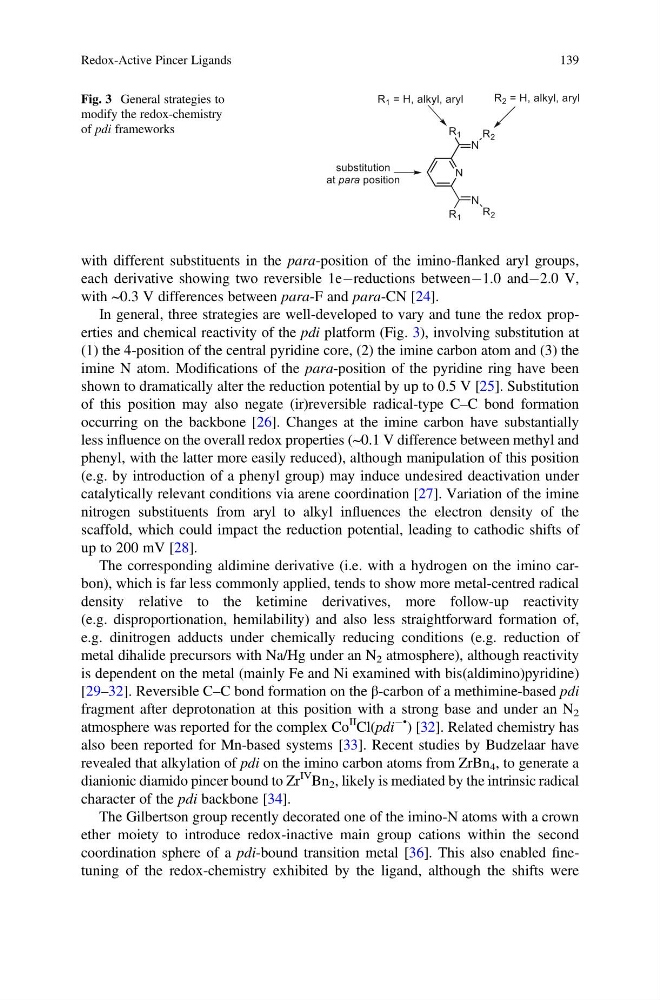
In general, three strategies are well-developed to vary and tune the redox properties and chemical reactivity of the pdi platform (Fig. 3), involving substitution at
(1) the 4-position of the central pyridine core, (2) the imine carbon atom and (3) the
imine N atom. Modifications of the para-position of the pyridine ring have been
shown to dramatically alter the reduction potential by up to 0.5 V [25]. Substitution
of this position may also negate (ir)reversible radical-type C–C bond formation
occurring on the backbone [26]. Changes at the imine carbon have substantially
less influence on the overall redox properties (~0.1 V difference between methyl and
phenyl, with the latter more easily reduced), although manipulation of this position
(e.g. by introduction of a phenyl group) may induce undesired deactivation under
catalytically relevant conditions via arene coordination [27]. Variation of the imine
nitrogen substituents from aryl to alkyl influences the electron density of the
scaffold, which could impact the reduction potential, leading to cathodic shifts of
up to 200 mV [28].
The corresponding aldimine derivative (i.e. with a hydrogen on the imino carbon), which is far less commonly applied, tends to show more metal-centred radical
density relative to the ketimine derivatives, more follow-up reactivity
(e.g. disproportionation, hemilability) and also less straightforward formation of,
e.g. dinitrogen adducts under chemically reducing conditions (e.g. reduction of
metal dihalide precursors with Na/Hg under an N 2 atmosphere), although reactivity
is dependent on the metal (mainly Fe and Ni examined with bis(aldimino)pyridine)
[29–32]. Reversible C–C bond formation on the β-carbon of a methimine-based pdi
fragment after deprotonation at this position with a strong base and under an N 2
atmosphere was reported for the complex Co
II Cl(pdi
À• ) [32]. Related chemistry has
also been reported for Mn-based systems [33]. Recent studies by Budzelaar have
revealed that alkylation of pdi on the imino carbon atoms from ZrBn 4 , to generate a
dianionic diamido pincer bound to Zr
IV
Bn 2 , likely is mediated by the intrinsic radical
character of the pdi backbone [34].
The Gilbertson group recently decorated one of the imino-N atoms with a crown
ether moiety to introduce redox-inactive main group cations within the second
coordination sphere of a pdi-bound transition metal [36]. This also enabled finetuning of the redox-chemistry exhibited by the ligand, although the shifts were
Fig. 3 General strategies to
modify the redox-chemistry
of pdi frameworks
Redox-Active Pincer Ligands
139
each derivative showing two reversible 1eÀreductions betweenÀ1.0 andÀ2.0 V,
with ~0.3 V differences between para-F and para-CN [24].
In general, three strategies are well-developed to vary and tune the redox properties and chemical reactivity of the pdi platform (Fig. 3), involving substitution at
(1) the 4-position of the central pyridine core, (2) the imine carbon atom and (3) the
imine N atom. Modifications of the para-position of the pyridine ring have been
shown to dramatically alter the reduction potential by up to 0.5 V [25]. Substitution
of this position may also negate (ir)reversible radical-type C–C bond formation
occurring on the backbone [26]. Changes at the imine carbon have substantially
less influence on the overall redox properties (~0.1 V difference between methyl and
phenyl, with the latter more easily reduced), although manipulation of this position
(e.g. by introduction of a phenyl group) may induce undesired deactivation under
catalytically relevant conditions via arene coordination [27]. Variation of the imine
nitrogen substituents from aryl to alkyl influences the electron density of the
scaffold, which could impact the reduction potential, leading to cathodic shifts of
up to 200 mV [28].
The corresponding aldimine derivative (i.e. with a hydrogen on the imino carbon), which is far less commonly applied, tends to show more metal-centred radical
density relative to the ketimine derivatives, more follow-up reactivity
(e.g. disproportionation, hemilability) and also less straightforward formation of,
e.g. dinitrogen adducts under chemically reducing conditions (e.g. reduction of
metal dihalide precursors with Na/Hg under an N 2 atmosphere), although reactivity
is dependent on the metal (mainly Fe and Ni examined with bis(aldimino)pyridine)
[29–32]. Reversible C–C bond formation on the β-carbon of a methimine-based pdi
fragment after deprotonation at this position with a strong base and under an N 2
atmosphere was reported for the complex Co
II Cl(pdi
À• ) [32]. Related chemistry has
also been reported for Mn-based systems [33]. Recent studies by Budzelaar have
revealed that alkylation of pdi on the imino carbon atoms from ZrBn 4 , to generate a
dianionic diamido pincer bound to Zr
IV
Bn 2 , likely is mediated by the intrinsic radical
character of the pdi backbone [34].
The Gilbertson group recently decorated one of the imino-N atoms with a crown
ether moiety to introduce redox-inactive main group cations within the second
coordination sphere of a pdi-bound transition metal [36]. This also enabled finetuning of the redox-chemistry exhibited by the ligand, although the shifts were
Fig. 3 General strategies to
modify the redox-chemistry
of pdi frameworks
Redox-Active Pincer Ligands
139