

2 Pincer Ligands That Undergo Reductive Chemistry
There are various bis(1,4-diazadiene) platforms that exhibit fascinating ligandcentred reduction chemistry [15, 16]. This section is dedicated to several illustrious
examples from within this (still expanding) subclass of redox-active pincer systems.
2.1 Bis(imino)pyridine as Redox-Active Pincer Platform
Undoubtedly the most well-established within this category, bis(imino)pyridines
(generally denoted as pdi for pyridine-diimine) were first demonstrated to be
redox-active in 2000, although basic coordination chemistry has been developed
since the 1970s [17] and interesting catalytic applications emerged in the 1990s [18–
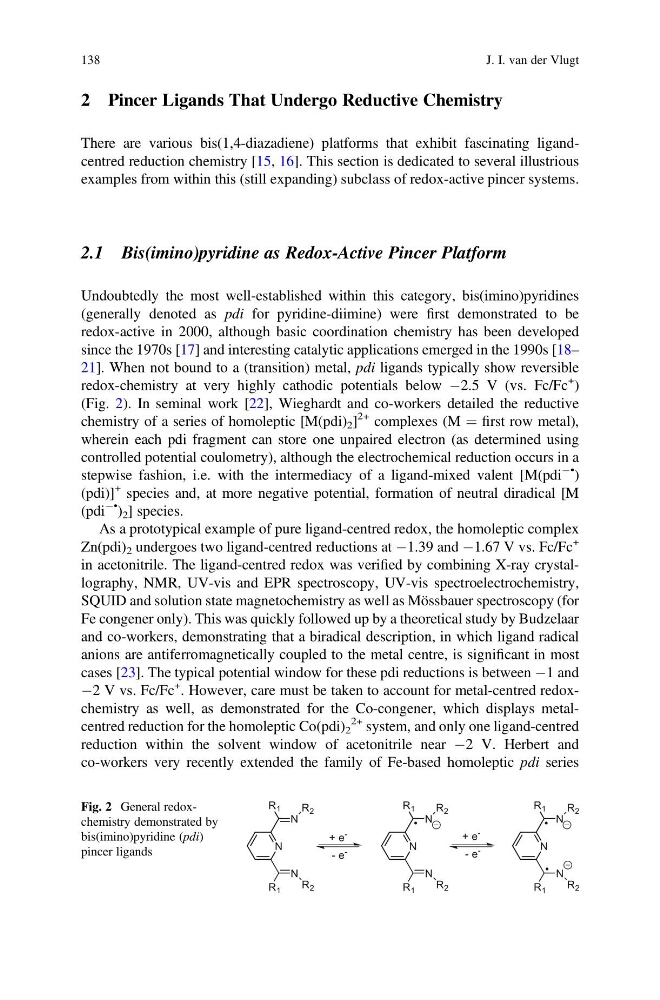
21]. When not bound to a (transition) metal, pdi ligands typically show reversible
redox-chemistry at very highly cathodic potentials below À2.5 V (vs. Fc/Fc
+
)
(Fig. 2). In seminal work [22], Wieghardt and co-workers detailed the reductive
chemistry of a series of homoleptic [M(pdi) 2 ]
2+ complexes (M ¼ first row metal),
wherein each pdi fragment can store one unpaired electron (as determined using
controlled potential coulometry), although the electrochemical reduction occurs in a
stepwise fashion, i.e. with the intermediacy of a ligand-mixed valent [M(pdi
À•
)
(pdi)]
+ species and, at more negative potential, formation of neutral diradical [M
(pdi
À• ) 2 ] species.
As a prototypical example of pure ligand-centred redox, the homoleptic complex
Zn(pdi) 2 undergoes two ligand-centred reductions at À1.39 and À1.67 V vs. Fc/Fc
+
in acetonitrile. The ligand-centred redox was verified by combining X-ray crystallography, NMR, UV-vis and EPR spectroscopy, UV-vis spectroelectrochemistry,
SQUID and solution state magnetochemistry as well as Mössbauer spectroscopy (for
Fe congener only). This was quickly followed up by a theoretical study by Budzelaar
and co-workers, demonstrating that a biradical description, in which ligand radical
anions are antiferromagnetically coupled to the metal centre, is significant in most
cases [23]. The typical potential window for these pdi reductions is between À1 and
À2 V vs. Fc/Fc
+
. However, care must be taken to account for metal-centred redoxchemistry as well, as demonstrated for the Co-congener, which displays metalcentred reduction for the homoleptic Co(pdi) 2
2+ system, and only one ligand-centred
reduction within the solvent window of acetonitrile near À2 V. Herbert and
co-workers very recently extended the family of Fe-based homoleptic pdi series
Fig. 2 General redoxchemistry demonstrated by
bis(imino)pyridine (pdi)
pincer ligands
138
J. I. van der Vlugt
There are various bis(1,4-diazadiene) platforms that exhibit fascinating ligandcentred reduction chemistry [15, 16]. This section is dedicated to several illustrious
examples from within this (still expanding) subclass of redox-active pincer systems.
2.1 Bis(imino)pyridine as Redox-Active Pincer Platform
Undoubtedly the most well-established within this category, bis(imino)pyridines
(generally denoted as pdi for pyridine-diimine) were first demonstrated to be
redox-active in 2000, although basic coordination chemistry has been developed
since the 1970s [17] and interesting catalytic applications emerged in the 1990s [18–
21]. When not bound to a (transition) metal, pdi ligands typically show reversible
redox-chemistry at very highly cathodic potentials below À2.5 V (vs. Fc/Fc
+
)
(Fig. 2). In seminal work [22], Wieghardt and co-workers detailed the reductive
chemistry of a series of homoleptic [M(pdi) 2 ]
2+ complexes (M ¼ first row metal),
wherein each pdi fragment can store one unpaired electron (as determined using
controlled potential coulometry), although the electrochemical reduction occurs in a
stepwise fashion, i.e. with the intermediacy of a ligand-mixed valent [M(pdi
À•
)
(pdi)]
+ species and, at more negative potential, formation of neutral diradical [M
(pdi
À• ) 2 ] species.
As a prototypical example of pure ligand-centred redox, the homoleptic complex
Zn(pdi) 2 undergoes two ligand-centred reductions at À1.39 and À1.67 V vs. Fc/Fc
+
in acetonitrile. The ligand-centred redox was verified by combining X-ray crystallography, NMR, UV-vis and EPR spectroscopy, UV-vis spectroelectrochemistry,
SQUID and solution state magnetochemistry as well as Mössbauer spectroscopy (for
Fe congener only). This was quickly followed up by a theoretical study by Budzelaar
and co-workers, demonstrating that a biradical description, in which ligand radical
anions are antiferromagnetically coupled to the metal centre, is significant in most
cases [23]. The typical potential window for these pdi reductions is between À1 and
À2 V vs. Fc/Fc
+
. However, care must be taken to account for metal-centred redoxchemistry as well, as demonstrated for the Co-congener, which displays metalcentred reduction for the homoleptic Co(pdi) 2
2+ system, and only one ligand-centred
reduction within the solvent window of acetonitrile near À2 V. Herbert and
co-workers very recently extended the family of Fe-based homoleptic pdi series
Fig. 2 General redoxchemistry demonstrated by
bis(imino)pyridine (pdi)
pincer ligands
138
J. I. van der Vlugt