

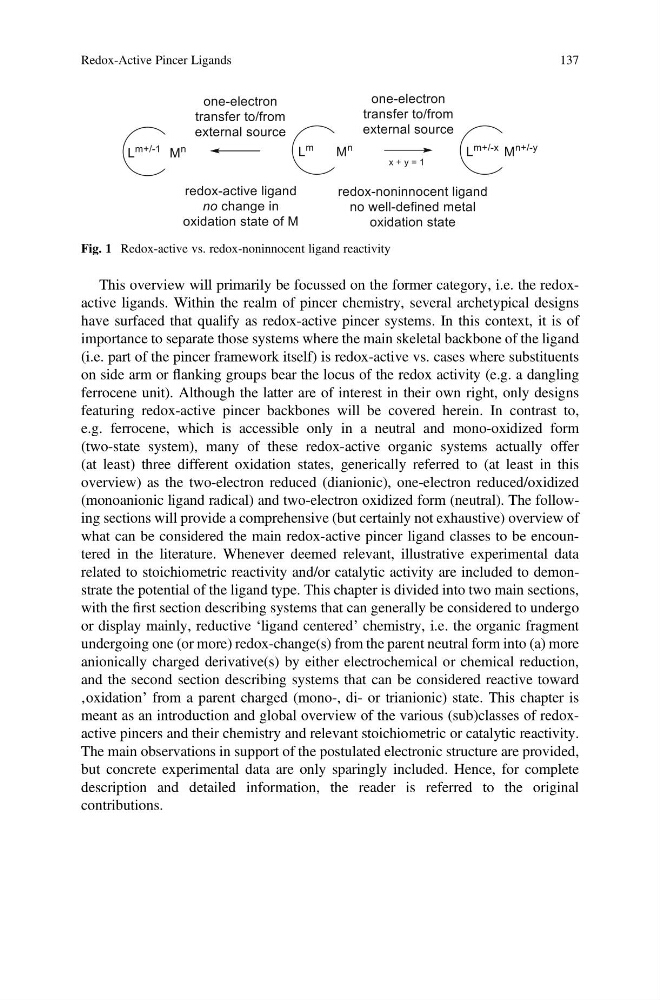
This overview will primarily be focussed on the former category, i.e. the redoxactive ligands. Within the realm of pincer chemistry, several archetypical designs
have surfaced that qualify as redox-active pincer systems. In this context, it is of
importance to separate those systems where the main skeletal backbone of the ligand
(i.e. part of the pincer framework itself) is redox-active vs. cases where substituents
on side arm or flanking groups bear the locus of the redox activity (e.g. a dangling
ferrocene unit). Although the latter are of interest in their own right, only designs
featuring redox-active pincer backbones will be covered herein. In contrast to,
e.g. ferrocene, which is accessible only in a neutral and mono-oxidized form
(two-state system), many of these redox-active organic systems actually offer
(at least) three different oxidation states, generically referred to (at least in this
overview) as the two-electron reduced (dianionic), one-electron reduced/oxidized
(monoanionic ligand radical) and two-electron oxidized form (neutral). The following sections will provide a comprehensive (but certainly not exhaustive) overview of
what can be considered the main redox-active pincer ligand classes to be encountered in the literature. Whenever deemed relevant, illustrative experimental data
related to stoichiometric reactivity and/or catalytic activity are included to demonstrate the potential of the ligand type. This chapter is divided into two main sections,
with the first section describing systems that can generally be considered to undergo
or display mainly, reductive ‘ligand centered’ chemistry, i.e. the organic fragment
undergoing one (or more) redox-change(s) from the parent neutral form into (a) more
anionically charged derivative(s) by either electrochemical or chemical reduction,
and the second section describing systems that can be considered reactive toward
‚oxidation’ from a parent charged (mono-, di- or trianionic) state. This chapter is
meant as an introduction and global overview of the various (sub)classes of redoxactive pincers and their chemistry and relevant stoichiometric or catalytic reactivity.
The main observations in support of the postulated electronic structure are provided,
but concrete experimental data are only sparingly included. Hence, for complete
description and detailed information, the reader is referred to the original
contributions.
Fig. 1 Redox-active vs. redox-noninnocent ligand reactivity
Redox-Active Pincer Ligands
137
have surfaced that qualify as redox-active pincer systems. In this context, it is of
importance to separate those systems where the main skeletal backbone of the ligand
(i.e. part of the pincer framework itself) is redox-active vs. cases where substituents
on side arm or flanking groups bear the locus of the redox activity (e.g. a dangling
ferrocene unit). Although the latter are of interest in their own right, only designs
featuring redox-active pincer backbones will be covered herein. In contrast to,
e.g. ferrocene, which is accessible only in a neutral and mono-oxidized form
(two-state system), many of these redox-active organic systems actually offer
(at least) three different oxidation states, generically referred to (at least in this
overview) as the two-electron reduced (dianionic), one-electron reduced/oxidized
(monoanionic ligand radical) and two-electron oxidized form (neutral). The following sections will provide a comprehensive (but certainly not exhaustive) overview of
what can be considered the main redox-active pincer ligand classes to be encountered in the literature. Whenever deemed relevant, illustrative experimental data
related to stoichiometric reactivity and/or catalytic activity are included to demonstrate the potential of the ligand type. This chapter is divided into two main sections,
with the first section describing systems that can generally be considered to undergo
or display mainly, reductive ‘ligand centered’ chemistry, i.e. the organic fragment
undergoing one (or more) redox-change(s) from the parent neutral form into (a) more
anionically charged derivative(s) by either electrochemical or chemical reduction,
and the second section describing systems that can be considered reactive toward
‚oxidation’ from a parent charged (mono-, di- or trianionic) state. This chapter is
meant as an introduction and global overview of the various (sub)classes of redoxactive pincers and their chemistry and relevant stoichiometric or catalytic reactivity.
The main observations in support of the postulated electronic structure are provided,
but concrete experimental data are only sparingly included. Hence, for complete
description and detailed information, the reader is referred to the original
contributions.
Fig. 1 Redox-active vs. redox-noninnocent ligand reactivity
Redox-Active Pincer Ligands
137