

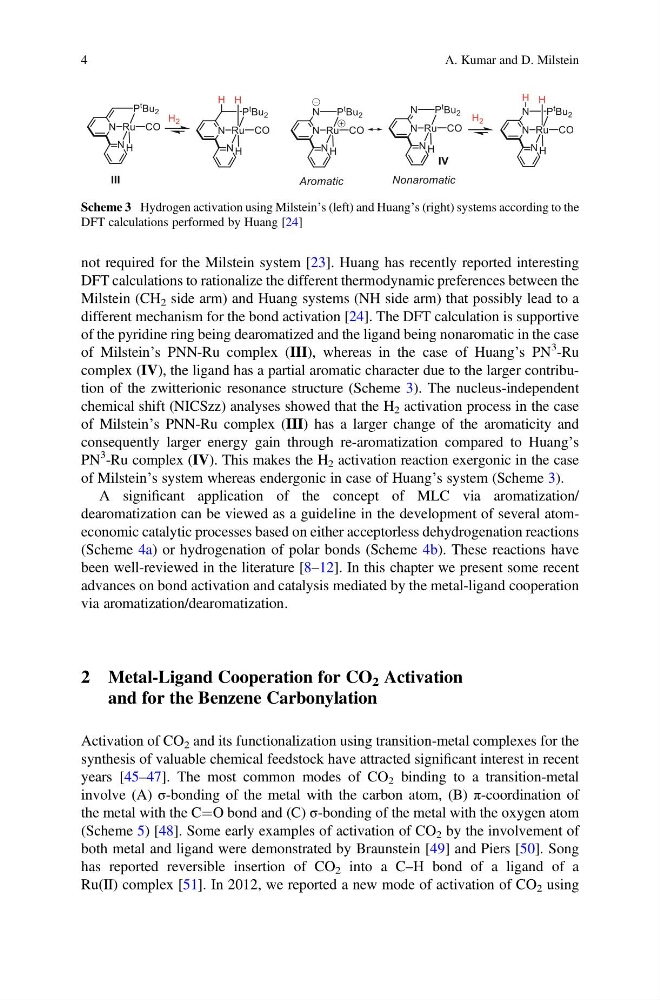
not required for the Milstein system [23]. Huang has recently reported interesting
DFT calculations to rationalize the different thermodynamic preferences between the
Milstein (CH 2 side arm) and Huang systems (NH side arm) that possibly lead to a
different mechanism for the bond activation [24]. The DFT calculation is supportive
of the pyridine ring being dearomatized and the ligand being nonaromatic in the case
of Milstein’s PNN-Ru complex (III), whereas in the case of Huang’s PN
3 -Ru
complex (IV), the ligand has a partial aromatic character due to the larger contribution of the zwitterionic resonance structure (Scheme 3). The nucleus-independent
chemical shift (NICSzz) analyses showed that the H 2 activation process in the case
of Milstein’s PNN-Ru complex (III) has a larger change of the aromaticity and
consequently larger energy gain through re-aromatization compared to Huang’s
PN
3 -Ru complex (IV). This makes the H 2 activation reaction exergonic in the case
of Milstein’s system whereas endergonic in case of Huang’s system (Scheme 3).
A significant application of the concept of MLC via aromatization/
dearomatization can be viewed as a guideline in the development of several atomeconomic catalytic processes based on either acceptorless dehydrogenation reactions
(Scheme 4a) or hydrogenation of polar bonds (Scheme 4b). These reactions have
been well-reviewed in the literature [8–12]. In this chapter we present some recent
advances on bond activation and catalysis mediated by the metal-ligand cooperation
via aromatization/dearomatization.
2 Metal-Ligand Cooperation for CO 2 Activation
and for the Benzene Carbonylation
Activation of CO 2 and its functionalization using transition-metal complexes for the
synthesis of valuable chemical feedstock have attracted significant interest in recent
years [45–47]. The most common modes of CO 2 binding to a transition-metal
involve (A) σ-bonding of the metal with the carbon atom, (B) π-coordination of
the metal with the C¼O bond and (C) σ-bonding of the metal with the oxygen atom
(Scheme 5) [48]. Some early examples of activation of CO 2 by the involvement of
both metal and ligand were demonstrated by Braunstein [49] and Piers [50]. Song
has reported reversible insertion of CO 2 into a C–H bond of a ligand of a
Ru(II) complex [51]. In 2012, we reported a new mode of activation of CO 2 using
Scheme 3 Hydrogen activation using Milstein’s (left) and Huang’s (right) systems according to the
DFT calculations performed by Huang [24]
4
A. Kumar and D. Milstein
DFT calculations to rationalize the different thermodynamic preferences between the
Milstein (CH 2 side arm) and Huang systems (NH side arm) that possibly lead to a
different mechanism for the bond activation [24]. The DFT calculation is supportive
of the pyridine ring being dearomatized and the ligand being nonaromatic in the case
of Milstein’s PNN-Ru complex (III), whereas in the case of Huang’s PN
3 -Ru
complex (IV), the ligand has a partial aromatic character due to the larger contribution of the zwitterionic resonance structure (Scheme 3). The nucleus-independent
chemical shift (NICSzz) analyses showed that the H 2 activation process in the case
of Milstein’s PNN-Ru complex (III) has a larger change of the aromaticity and
consequently larger energy gain through re-aromatization compared to Huang’s
PN
3 -Ru complex (IV). This makes the H 2 activation reaction exergonic in the case
of Milstein’s system whereas endergonic in case of Huang’s system (Scheme 3).
A significant application of the concept of MLC via aromatization/
dearomatization can be viewed as a guideline in the development of several atomeconomic catalytic processes based on either acceptorless dehydrogenation reactions
(Scheme 4a) or hydrogenation of polar bonds (Scheme 4b). These reactions have
been well-reviewed in the literature [8–12]. In this chapter we present some recent
advances on bond activation and catalysis mediated by the metal-ligand cooperation
via aromatization/dearomatization.
2 Metal-Ligand Cooperation for CO 2 Activation
and for the Benzene Carbonylation
Activation of CO 2 and its functionalization using transition-metal complexes for the
synthesis of valuable chemical feedstock have attracted significant interest in recent
years [45–47]. The most common modes of CO 2 binding to a transition-metal
involve (A) σ-bonding of the metal with the carbon atom, (B) π-coordination of
the metal with the C¼O bond and (C) σ-bonding of the metal with the oxygen atom
(Scheme 5) [48]. Some early examples of activation of CO 2 by the involvement of
both metal and ligand were demonstrated by Braunstein [49] and Piers [50]. Song
has reported reversible insertion of CO 2 into a C–H bond of a ligand of a
Ru(II) complex [51]. In 2012, we reported a new mode of activation of CO 2 using
Scheme 3 Hydrogen activation using Milstein’s (left) and Huang’s (right) systems according to the
DFT calculations performed by Huang [24]
4
A. Kumar and D. Milstein