

metal-ligand cooperation by dearomatization/aromatization [52]. The dearomatized
complex [Ru(PNP
t Bu*)(CO)(H)] (1, the dearomatized ligand is denoted by an
asterisk) reversibly reacts with CO 2 (1 bar) at ambient temperature to form the
[1,3]-addition product [Ru(PNP
t Bu-COO)(CO)(H)] that contains new C–C and
Ru–O bonds (2, Scheme 5). DFT calculation suggests that the CO 2 activation occurs
via the concerted addition of CO 2 to complex 1 through the exo-cyclic methine
carbon and the Ru centre. A similar reactivity of CO 2 has also been reported by us
using rhenium [53]- and iron [54]-based PNP complexes. We have recently
a
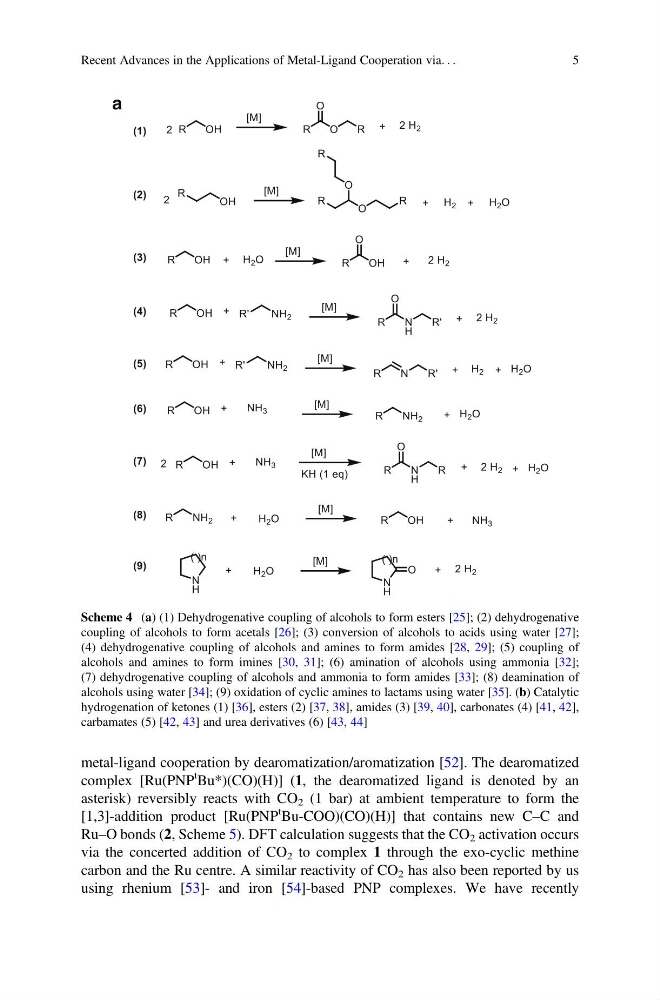
Scheme 4 (a) (1) Dehydrogenative coupling of alcohols to form esters [25]; (2) dehydrogenative
coupling of alcohols to form acetals [26]; (3) conversion of alcohols to acids using water [27];
(4) dehydrogenative coupling of alcohols and amines to form amides [28, 29]; (5) coupling of
alcohols and amines to form imines [30, 31]; (6) amination of alcohols using ammonia [32];
(7) dehydrogenative coupling of alcohols and ammonia to form amides [33]; (8) deamination of
alcohols using water [34]; (9) oxidation of cyclic amines to lactams using water [35]. (b) Catalytic
hydrogenation of ketones (1) [36], esters (2) [37, 38], amides (3) [39, 40], carbonates (4) [41, 42],
carbamates (5) [42, 43] and urea derivatives (6) [43, 44]
Recent Advances in the Applications of Metal-Ligand Cooperation via. . .
5
complex [Ru(PNP
t Bu*)(CO)(H)] (1, the dearomatized ligand is denoted by an
asterisk) reversibly reacts with CO 2 (1 bar) at ambient temperature to form the
[1,3]-addition product [Ru(PNP
t Bu-COO)(CO)(H)] that contains new C–C and
Ru–O bonds (2, Scheme 5). DFT calculation suggests that the CO 2 activation occurs
via the concerted addition of CO 2 to complex 1 through the exo-cyclic methine
carbon and the Ru centre. A similar reactivity of CO 2 has also been reported by us
using rhenium [53]- and iron [54]-based PNP complexes. We have recently
a
Scheme 4 (a) (1) Dehydrogenative coupling of alcohols to form esters [25]; (2) dehydrogenative
coupling of alcohols to form acetals [26]; (3) conversion of alcohols to acids using water [27];
(4) dehydrogenative coupling of alcohols and amines to form amides [28, 29]; (5) coupling of
alcohols and amines to form imines [30, 31]; (6) amination of alcohols using ammonia [32];
(7) dehydrogenative coupling of alcohols and ammonia to form amides [33]; (8) deamination of
alcohols using water [34]; (9) oxidation of cyclic amines to lactams using water [35]. (b) Catalytic
hydrogenation of ketones (1) [36], esters (2) [37, 38], amides (3) [39, 40], carbonates (4) [41, 42],
carbamates (5) [42, 43] and urea derivatives (6) [43, 44]
Recent Advances in the Applications of Metal-Ligand Cooperation via. . .
5