

activation, the complex gains stability due to aromatization and concomitant formation of a coordinatively saturated complex. Overall, there is only a little energy
difference (1–4 kcal/mol for the activation of H 2 ) between the dearomatized and
aromatized form [13]. The unique speciality of the bond activation by the MLC is
that the oxidation state of the metal doesn’t change in the process, unlike the classical
bond activation via the oxidative addition route where the oxidation state of a metal
changes by 2 units. The ligand becomes non-innocent, and the synergy between
metal and ligand plays an important role in the bond activation. As long as we can
accomplish this synergy between metal and ligand, we can tame different metals to
do the same bond activation and catalysis. Indeed, we have been able to make pincer
complexes of several metals such as Ru, Rh, Ir, Re, Fe, Co, Ni and Mn and exploit
them for various bond activations [11, 14].
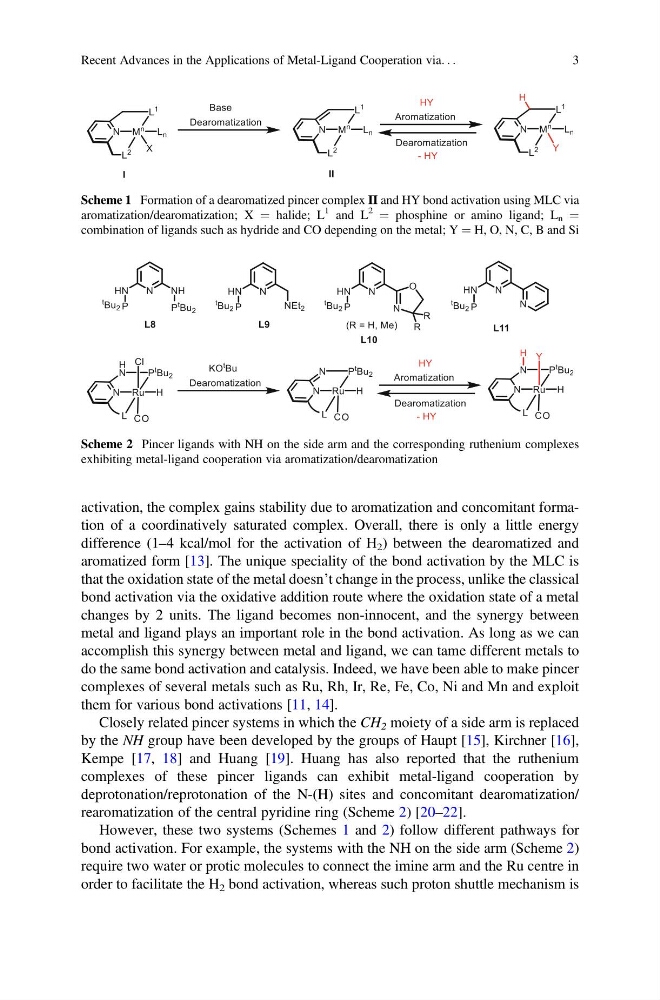
Closely related pincer systems in which the CH 2 moiety of a side arm is replaced
by the NH group have been developed by the groups of Haupt [15], Kirchner [16],
Kempe [17, 18] and Huang [19]. Huang has also reported that the ruthenium
complexes of these pincer ligands can exhibit metal-ligand cooperation by
deprotonation/reprotonation of the N-(H) sites and concomitant dearomatization/
rearomatization of the central pyridine ring (Scheme 2) [20–22].
However, these two systems (Schemes 1 and 2) follow different pathways for
bond activation. For example, the systems with the NH on the side arm (Scheme 2)
require two water or protic molecules to connect the imine arm and the Ru centre in
order to facilitate the H 2 bond activation, whereas such proton shuttle mechanism is
Scheme 1 Formation of a dearomatized pincer complex II and HY bond activation using MLC via
aromatization/dearomatization; X ¼ halide; L
1 and L
2 ¼ phosphine or amino ligand; L n ¼
combination of ligands such as hydride and CO depending on the metal; Y ¼ H, O, N, C, B and Si
Scheme 2 Pincer ligands with NH on the side arm and the corresponding ruthenium complexes
exhibiting metal-ligand cooperation via aromatization/dearomatization
Recent Advances in the Applications of Metal-Ligand Cooperation via. . .
3
difference (1–4 kcal/mol for the activation of H 2 ) between the dearomatized and
aromatized form [13]. The unique speciality of the bond activation by the MLC is
that the oxidation state of the metal doesn’t change in the process, unlike the classical
bond activation via the oxidative addition route where the oxidation state of a metal
changes by 2 units. The ligand becomes non-innocent, and the synergy between
metal and ligand plays an important role in the bond activation. As long as we can
accomplish this synergy between metal and ligand, we can tame different metals to
do the same bond activation and catalysis. Indeed, we have been able to make pincer
complexes of several metals such as Ru, Rh, Ir, Re, Fe, Co, Ni and Mn and exploit
them for various bond activations [11, 14].
Closely related pincer systems in which the CH 2 moiety of a side arm is replaced
by the NH group have been developed by the groups of Haupt [15], Kirchner [16],
Kempe [17, 18] and Huang [19]. Huang has also reported that the ruthenium
complexes of these pincer ligands can exhibit metal-ligand cooperation by
deprotonation/reprotonation of the N-(H) sites and concomitant dearomatization/
rearomatization of the central pyridine ring (Scheme 2) [20–22].
However, these two systems (Schemes 1 and 2) follow different pathways for
bond activation. For example, the systems with the NH on the side arm (Scheme 2)
require two water or protic molecules to connect the imine arm and the Ru centre in
order to facilitate the H 2 bond activation, whereas such proton shuttle mechanism is
Scheme 1 Formation of a dearomatized pincer complex II and HY bond activation using MLC via
aromatization/dearomatization; X ¼ halide; L
1 and L
2 ¼ phosphine or amino ligand; L n ¼
combination of ligands such as hydride and CO depending on the metal; Y ¼ H, O, N, C, B and Si
Scheme 2 Pincer ligands with NH on the side arm and the corresponding ruthenium complexes
exhibiting metal-ligand cooperation via aromatization/dearomatization
Recent Advances in the Applications of Metal-Ligand Cooperation via. . .
3