

perform Michael reactions forming new C–C, C–O and C–N bonds catalysed by
ruthenium, rhenium and manganese pincer complexes.
Keywords CO 2 activation · Dearomatization/aromatization · Metal-ligand
cooperativity · Michael reaction · N 2 O activation · Pincer · Template catalysis
1 Introduction
The term ‘pincer’ was first coined by van Koten in 1989 [1], and since then pincer
ligands and complexes have found significant applications in synthesis, bond activation and catalysis [2–8]. In the past we have shown that utilizing PNP- and
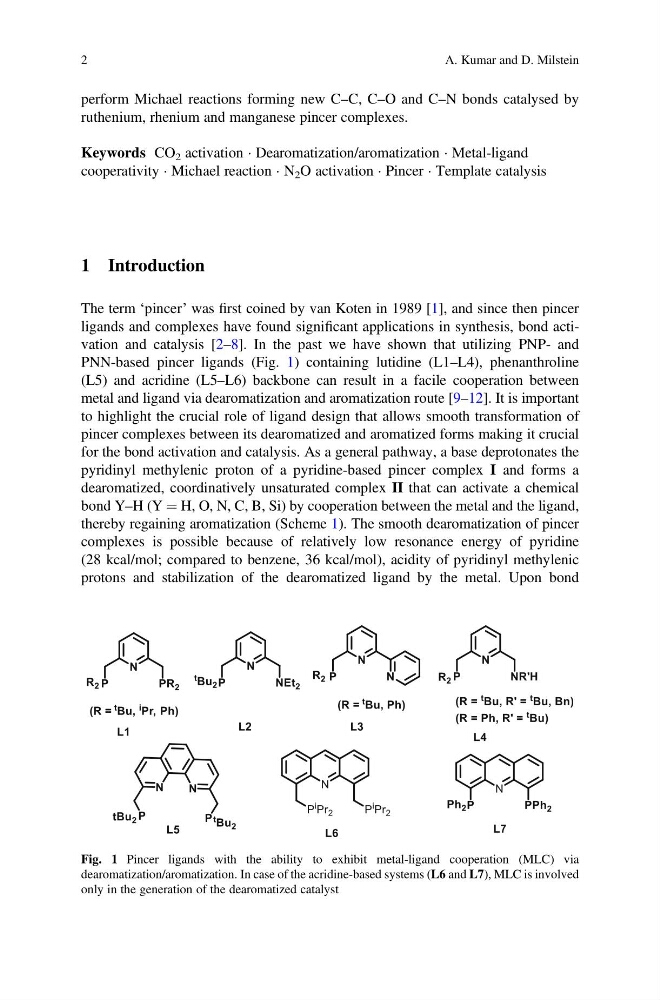
PNN-based pincer ligands (Fig. 1) containing lutidine (L1–L4), phenanthroline
(L5) and acridine (L5–L6) backbone can result in a facile cooperation between
metal and ligand via dearomatization and aromatization route [9–12]. It is important
to highlight the crucial role of ligand design that allows smooth transformation of
pincer complexes between its dearomatized and aromatized forms making it crucial
for the bond activation and catalysis. As a general pathway, a base deprotonates the
pyridinyl methylenic proton of a pyridine-based pincer complex I and forms a
dearomatized, coordinatively unsaturated complex II that can activate a chemical
bond Y–H (Y ¼ H, O, N, C, B, Si) by cooperation between the metal and the ligand,
thereby regaining aromatization (Scheme 1). The smooth dearomatization of pincer
complexes is possible because of relatively low resonance energy of pyridine
(28 kcal/mol; compared to benzene, 36 kcal/mol), acidity of pyridinyl methylenic
protons and stabilization of the dearomatized ligand by the metal. Upon bond
Fig. 1 Pincer ligands with the ability to exhibit metal-ligand cooperation (MLC) via
dearomatization/aromatization. In case of the acridine-based systems (L6 and L7), MLC is involved
only in the generation of the dearomatized catalyst
2
A. Kumar and D. Milstein
ruthenium, rhenium and manganese pincer complexes.
Keywords CO 2 activation · Dearomatization/aromatization · Metal-ligand
cooperativity · Michael reaction · N 2 O activation · Pincer · Template catalysis
1 Introduction
The term ‘pincer’ was first coined by van Koten in 1989 [1], and since then pincer
ligands and complexes have found significant applications in synthesis, bond activation and catalysis [2–8]. In the past we have shown that utilizing PNP- and
PNN-based pincer ligands (Fig. 1) containing lutidine (L1–L4), phenanthroline
(L5) and acridine (L5–L6) backbone can result in a facile cooperation between
metal and ligand via dearomatization and aromatization route [9–12]. It is important
to highlight the crucial role of ligand design that allows smooth transformation of
pincer complexes between its dearomatized and aromatized forms making it crucial
for the bond activation and catalysis. As a general pathway, a base deprotonates the
pyridinyl methylenic proton of a pyridine-based pincer complex I and forms a
dearomatized, coordinatively unsaturated complex II that can activate a chemical
bond Y–H (Y ¼ H, O, N, C, B, Si) by cooperation between the metal and the ligand,
thereby regaining aromatization (Scheme 1). The smooth dearomatization of pincer
complexes is possible because of relatively low resonance energy of pyridine
(28 kcal/mol; compared to benzene, 36 kcal/mol), acidity of pyridinyl methylenic
protons and stabilization of the dearomatized ligand by the metal. Upon bond
Fig. 1 Pincer ligands with the ability to exhibit metal-ligand cooperation (MLC) via
dearomatization/aromatization. In case of the acridine-based systems (L6 and L7), MLC is involved
only in the generation of the dearomatized catalyst
2
A. Kumar and D. Milstein