

heterobimetallic complexes is to create distinct coordination sites for selective
binding of hard and soft metal centers; however, this alone does not guarantee
success. In this context, the creation of distinctive environments within tridentate
pincer-type motifs may significantly amplify selectivity and help to obtain
well-defined systems in a highly efficient manner. It was demonstrated that the
bond-sharing metallobicyclic motif in transition metal pincer complexes provides
additional stabilization of the metal; therefore, they are less prone to reversible
dissociation and ligand redistribution than the corresponding chelate complexes.
Similarly, main group metals will also benefit from multidentate pincer-like
chelation.
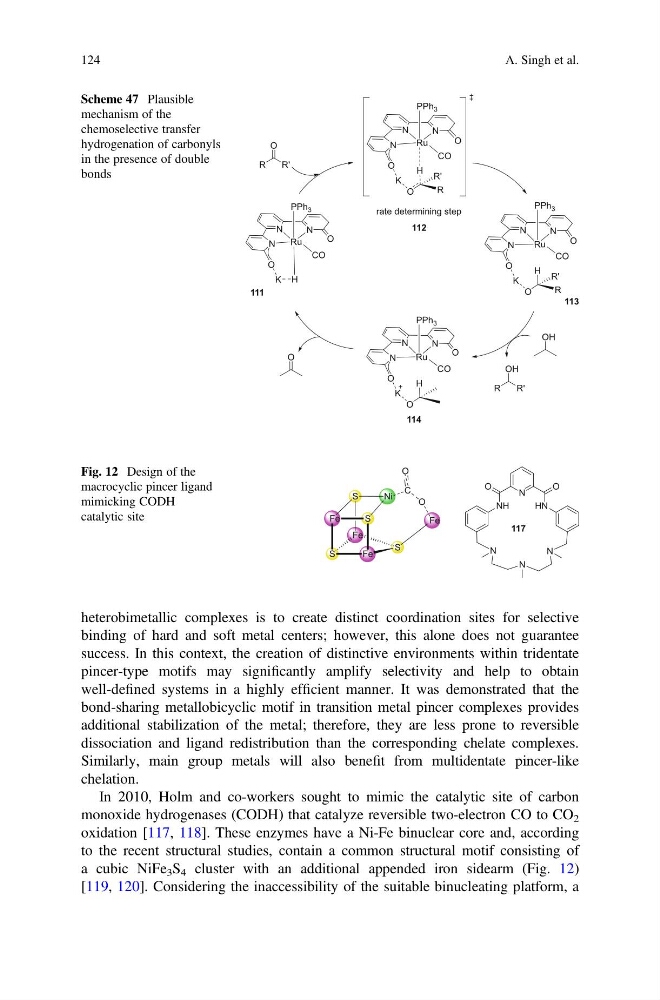
In 2010, Holm and co-workers sought to mimic the catalytic site of carbon
monoxide hydrogenases (CODH) that catalyze reversible two-electron CO to CO 2
oxidation [117, 118]. These enzymes have a Ni-Fe binuclear core and, according
to the recent structural studies, contain a common structural motif consisting of
a cubic NiFe 3 S 4 cluster with an additional appended iron sidearm (Fig. 12)
[119, 120]. Considering the inaccessibility of the suitable binucleating platform, a
N
N
N
Ru
CO
H
O
O
PPh 3
K
N
N
N
Ru
CO
O
O
PPh 3
K
O
R
R'
H
N
N
N
Ru
CO
O
O
PPh 3
K
O
R
R'
H
N
N
N
Ru
CO
O
O
PPh 3
K
O
H
R
R'
O
O
OH
R
R'
OH
rate determining step
112
113
111
114
Scheme 47 Plausible
mechanism of the
chemoselective transfer
hydrogenation of carbonyls
in the presence of double
bonds
Fe
S
Fe
S
S
Ni
Fe
S
Fe
C
O
O
N
O
HN
O
NH
N
N
N
117
Fig. 12 Design of the
macrocyclic pincer ligand
mimicking CODH
catalytic site
124
A. Singh et al.
binding of hard and soft metal centers; however, this alone does not guarantee
success. In this context, the creation of distinctive environments within tridentate
pincer-type motifs may significantly amplify selectivity and help to obtain
well-defined systems in a highly efficient manner. It was demonstrated that the
bond-sharing metallobicyclic motif in transition metal pincer complexes provides
additional stabilization of the metal; therefore, they are less prone to reversible
dissociation and ligand redistribution than the corresponding chelate complexes.
Similarly, main group metals will also benefit from multidentate pincer-like
chelation.
In 2010, Holm and co-workers sought to mimic the catalytic site of carbon
monoxide hydrogenases (CODH) that catalyze reversible two-electron CO to CO 2
oxidation [117, 118]. These enzymes have a Ni-Fe binuclear core and, according
to the recent structural studies, contain a common structural motif consisting of
a cubic NiFe 3 S 4 cluster with an additional appended iron sidearm (Fig. 12)
[119, 120]. Considering the inaccessibility of the suitable binucleating platform, a
N
N
N
Ru
CO
H
O
O
PPh 3
K
N
N
N
Ru
CO
O
O
PPh 3
K
O
R
R'
H
N
N
N
Ru
CO
O
O
PPh 3
K
O
R
R'
H
N
N
N
Ru
CO
O
O
PPh 3
K
O
H
R
R'
O
O
OH
R
R'
OH
rate determining step
112
113
111
114
Scheme 47 Plausible
mechanism of the
chemoselective transfer
hydrogenation of carbonyls
in the presence of double
bonds
Fe
S
Fe
S
S
Ni
Fe
S
Fe
C
O
O
N
O
HN
O
NH
N
N
N
117
Fig. 12 Design of the
macrocyclic pincer ligand
mimicking CODH
catalytic site
124
A. Singh et al.