

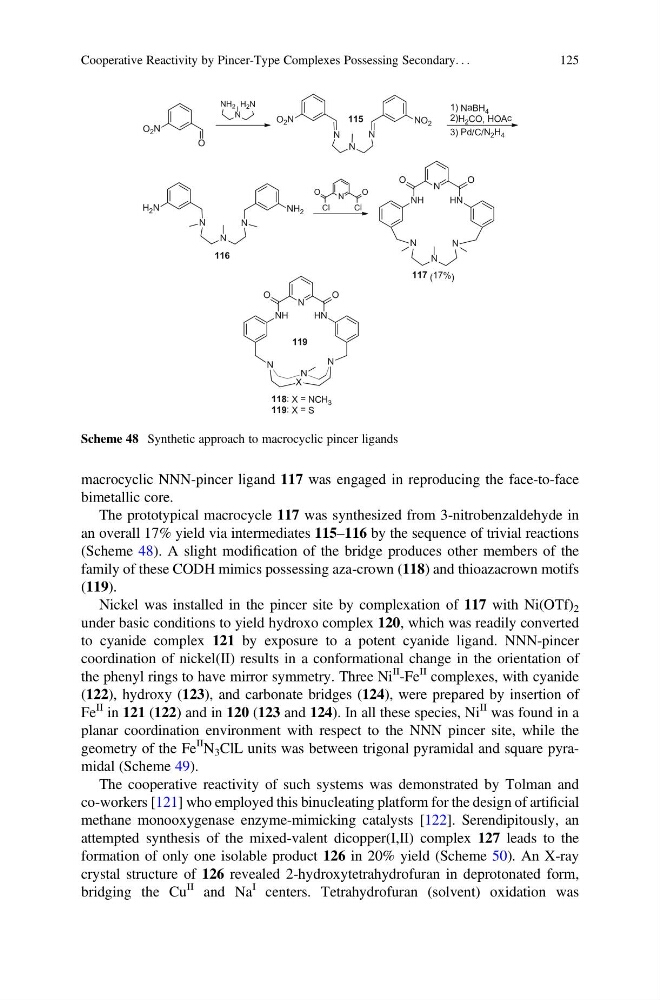
macrocyclic NNN-pincer ligand 117 was engaged in reproducing the face-to-face
bimetallic core.
The prototypical macrocycle 117 was synthesized from 3-nitrobenzaldehyde in
an overall 17% yield via intermediates 115–116 by the sequence of trivial reactions
(Scheme 48). A slight modification of the bridge produces other members of the
family of these CODH mimics possessing aza-crown (118) and thioazacrown motifs
(119).
Nickel was installed in the pincer site by complexation of 117 with Ni(OTf) 2
under basic conditions to yield hydroxo complex 120, which was readily converted
to cyanide complex 121 by exposure to a potent cyanide ligand. NNN-pincer
coordination of nickel(II) results in a conformational change in the orientation of
the phenyl rings to have mirror symmetry. Three Ni
II -Fe
II complexes, with cyanide
(122), hydroxy (123), and carbonate bridges (124), were prepared by insertion of
Fe
II in 121 (122) and in 120 (123 and 124). In all these species, Ni
II was found in a
planar coordination environment with respect to the NNN pincer site, while the
geometry of the Fe
II N 3 ClL units was between trigonal pyramidal and square pyramidal (Scheme 49).
The cooperative reactivity of such systems was demonstrated by Tolman and
co-workers [121] who employed this binucleating platform for the design of artificial
methane monooxygenase enzyme-mimicking catalysts [122]. Serendipitously, an
attempted synthesis of the mixed-valent dicopper(I,II) complex 127 leads to the
formation of only one isolable product 126 in 20% yield (Scheme 50). An X-ray
crystal structure of 126 revealed 2-hydroxytetrahydrofuran in deprotonated form,
bridging the Cu
II and Na
I centers. Tetrahydrofuran (solvent) oxidation was
N
O
HN
O
NH
N
N
N
115
O 2 N
O
O 2 N
N
N
N
NO 2
NH 2
N
H 2 N
1) NaBH 4
2)H 2 CO, HOAc
3) Pd/C/N 2 H 4
H 2 N
N
N
N
NH 2
N
O
Cl
O
Cl
116
117 ( 17% )
N
O
HN
O
NH
N
X
N
N
118: X = NCH 3
119: X = S
119
Scheme 48 Synthetic approach to macrocyclic pincer ligands
Cooperative Reactivity by Pincer-Type Complexes Possessing Secondary. . .
125
bimetallic core.
The prototypical macrocycle 117 was synthesized from 3-nitrobenzaldehyde in
an overall 17% yield via intermediates 115–116 by the sequence of trivial reactions
(Scheme 48). A slight modification of the bridge produces other members of the
family of these CODH mimics possessing aza-crown (118) and thioazacrown motifs
(119).
Nickel was installed in the pincer site by complexation of 117 with Ni(OTf) 2
under basic conditions to yield hydroxo complex 120, which was readily converted
to cyanide complex 121 by exposure to a potent cyanide ligand. NNN-pincer
coordination of nickel(II) results in a conformational change in the orientation of
the phenyl rings to have mirror symmetry. Three Ni
II -Fe
II complexes, with cyanide
(122), hydroxy (123), and carbonate bridges (124), were prepared by insertion of
Fe
II in 121 (122) and in 120 (123 and 124). In all these species, Ni
II was found in a
planar coordination environment with respect to the NNN pincer site, while the
geometry of the Fe
II N 3 ClL units was between trigonal pyramidal and square pyramidal (Scheme 49).
The cooperative reactivity of such systems was demonstrated by Tolman and
co-workers [121] who employed this binucleating platform for the design of artificial
methane monooxygenase enzyme-mimicking catalysts [122]. Serendipitously, an
attempted synthesis of the mixed-valent dicopper(I,II) complex 127 leads to the
formation of only one isolable product 126 in 20% yield (Scheme 50). An X-ray
crystal structure of 126 revealed 2-hydroxytetrahydrofuran in deprotonated form,
bridging the Cu
II and Na
I centers. Tetrahydrofuran (solvent) oxidation was
N
O
HN
O
NH
N
N
N
115
O 2 N
O
O 2 N
N
N
N
NO 2
NH 2
N
H 2 N
1) NaBH 4
2)H 2 CO, HOAc
3) Pd/C/N 2 H 4
H 2 N
N
N
N
NH 2
N
O
Cl
O
Cl
116
117 ( 17% )
N
O
HN
O
NH
N
X
N
N
118: X = NCH 3
119: X = S
119
Scheme 48 Synthetic approach to macrocyclic pincer ligands
Cooperative Reactivity by Pincer-Type Complexes Possessing Secondary. . .
125