

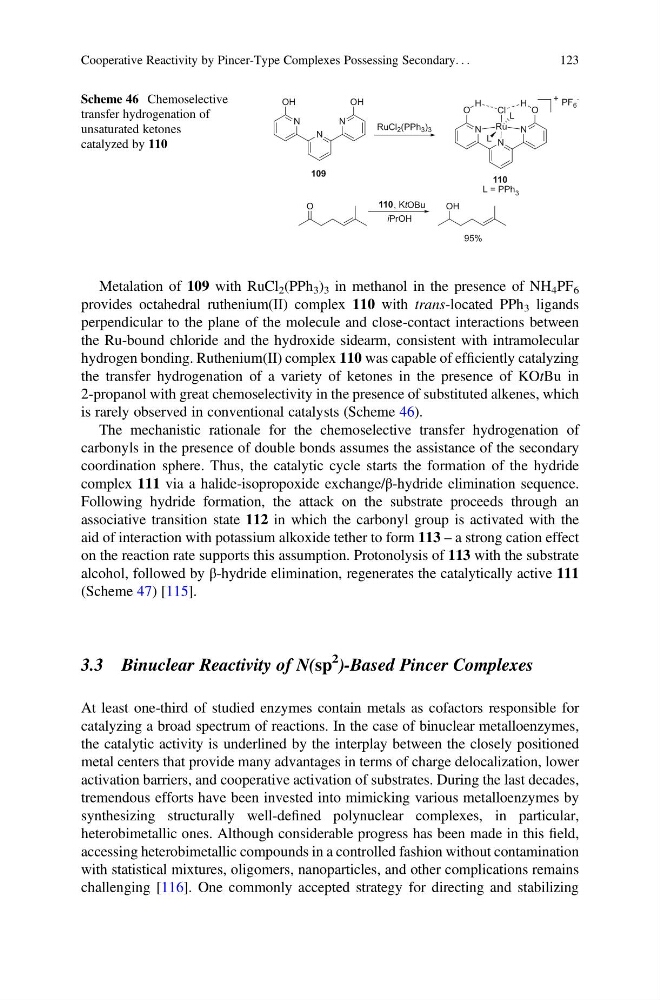
Metalation of 109 with RuCl 2 (PPh 3 ) 3 in methanol in the presence of NH 4 PF 6
provides octahedral ruthenium(II) complex 110 with trans-located PPh 3 ligands
perpendicular to the plane of the molecule and close-contact interactions between
the Ru-bound chloride and the hydroxide sidearm, consistent with intramolecular
hydrogen bonding. Ruthenium(II) complex 110 was capable of efficiently catalyzing
the transfer hydrogenation of a variety of ketones in the presence of KOtBu in
2-propanol with great chemoselectivity in the presence of substituted alkenes, which
is rarely observed in conventional catalysts (Scheme 46).
The mechanistic rationale for the chemoselective transfer hydrogenation of
carbonyls in the presence of double bonds assumes the assistance of the secondary
coordination sphere. Thus, the catalytic cycle starts the formation of the hydride
complex 111 via a halide-isopropoxide exchange/β-hydride elimination sequence.
Following hydride formation, the attack on the substrate proceeds through an
associative transition state 112 in which the carbonyl group is activated with the
aid of interaction with potassium alkoxide tether to form 113 – a strong cation effect
on the reaction rate supports this assumption. Protonolysis of 113 with the substrate
alcohol, followed by β-hydride elimination, regenerates the catalytically active 111
(Scheme 47) [115].
3.3 Binuclear Reactivity of N(sp
2
)-Based Pincer Complexes
At least one-third of studied enzymes contain metals as cofactors responsible for
catalyzing a broad spectrum of reactions. In the case of binuclear metalloenzymes,
the catalytic activity is underlined by the interplay between the closely positioned
metal centers that provide many advantages in terms of charge delocalization, lower
activation barriers, and cooperative activation of substrates. During the last decades,
tremendous efforts have been invested into mimicking various metalloenzymes by
synthesizing structurally well-defined polynuclear complexes, in particular,
heterobimetallic ones. Although considerable progress has been made in this field,
accessing heterobimetallic compounds in a controlled fashion without contamination
with statistical mixtures, oligomers, nanoparticles, and other complications remains
challenging [116]. One commonly accepted strategy for directing and stabilizing
N
N
N
OH
OH
N
N
N
O
O
Ru
Cl
L
L
+
110
RuCl 2 (PPh 3 ) 3
L = PPh 3
H
H
109
O
110, KtOBu
iPrOH
OH
95%
PF 6
-
Scheme 46 Chemoselective
transfer hydrogenation of
unsaturated ketones
catalyzed by 110
Cooperative Reactivity by Pincer-Type Complexes Possessing Secondary. . .
123
provides octahedral ruthenium(II) complex 110 with trans-located PPh 3 ligands
perpendicular to the plane of the molecule and close-contact interactions between
the Ru-bound chloride and the hydroxide sidearm, consistent with intramolecular
hydrogen bonding. Ruthenium(II) complex 110 was capable of efficiently catalyzing
the transfer hydrogenation of a variety of ketones in the presence of KOtBu in
2-propanol with great chemoselectivity in the presence of substituted alkenes, which
is rarely observed in conventional catalysts (Scheme 46).
The mechanistic rationale for the chemoselective transfer hydrogenation of
carbonyls in the presence of double bonds assumes the assistance of the secondary
coordination sphere. Thus, the catalytic cycle starts the formation of the hydride
complex 111 via a halide-isopropoxide exchange/β-hydride elimination sequence.
Following hydride formation, the attack on the substrate proceeds through an
associative transition state 112 in which the carbonyl group is activated with the
aid of interaction with potassium alkoxide tether to form 113 – a strong cation effect
on the reaction rate supports this assumption. Protonolysis of 113 with the substrate
alcohol, followed by β-hydride elimination, regenerates the catalytically active 111
(Scheme 47) [115].
3.3 Binuclear Reactivity of N(sp
2
)-Based Pincer Complexes
At least one-third of studied enzymes contain metals as cofactors responsible for
catalyzing a broad spectrum of reactions. In the case of binuclear metalloenzymes,
the catalytic activity is underlined by the interplay between the closely positioned
metal centers that provide many advantages in terms of charge delocalization, lower
activation barriers, and cooperative activation of substrates. During the last decades,
tremendous efforts have been invested into mimicking various metalloenzymes by
synthesizing structurally well-defined polynuclear complexes, in particular,
heterobimetallic ones. Although considerable progress has been made in this field,
accessing heterobimetallic compounds in a controlled fashion without contamination
with statistical mixtures, oligomers, nanoparticles, and other complications remains
challenging [116]. One commonly accepted strategy for directing and stabilizing
N
N
N
OH
OH
N
N
N
O
O
Ru
Cl
L
L
+
110
RuCl 2 (PPh 3 ) 3
L = PPh 3
H
H
109
O
110, KtOBu
iPrOH
OH
95%
PF 6
-
Scheme 46 Chemoselective
transfer hydrogenation of
unsaturated ketones
catalyzed by 110
Cooperative Reactivity by Pincer-Type Complexes Possessing Secondary. . .
123