

pendant amines and their steric bulk. Thus, when triethylammonium chloride
(pKa ¼ 18.8 in CH 3 CN) was used as the acid source, an initial rate of
2.30 Â 10
À8 M s
À1 was observed for the morpholine-based 106 (pKa ¼ 17.1 in
acetonitrile). However, a twofold increase in the initial rate (3.97 Â 10
À8 M s
À1
) was
found for the bulky 103 (pKa ¼ 19.2 in acetonitrile) and threefold (7.07 Â 10
À8 M s
À1
)
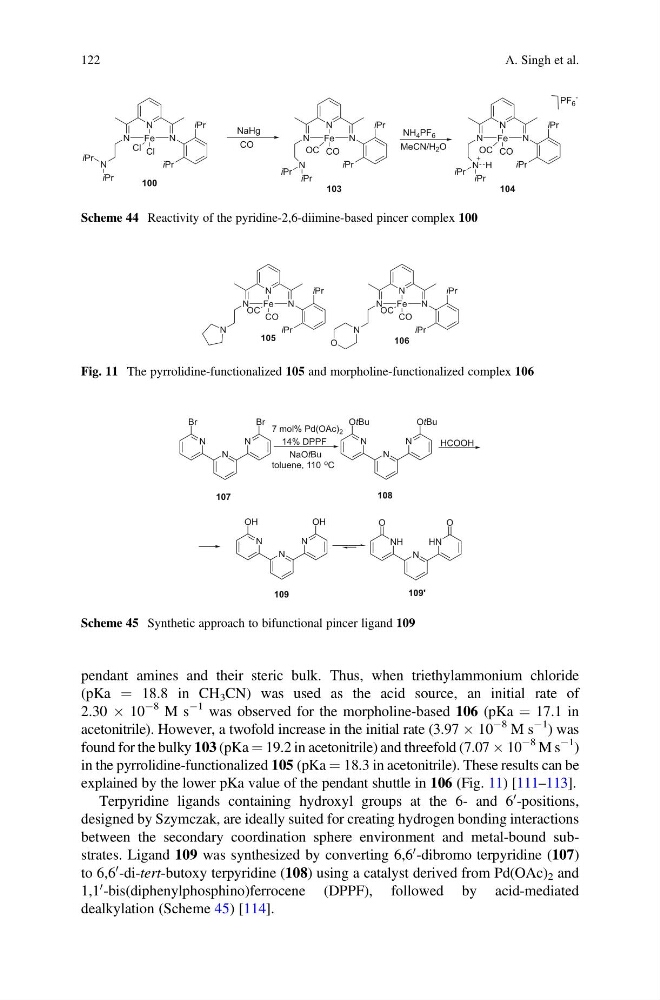
in the pyrrolidine-functionalized 105 (pKa ¼ 18.3 in acetonitrile). These results can be
explained by the lower pKa value of the pendant shuttle in 106 (Fig. 11) [111–113].
Terpyridine ligands containing hydroxyl groups at the 6- and 6
0 -positions,
designed by Szymczak, are ideally suited for creating hydrogen bonding interactions
between the secondary coordination sphere environment and metal-bound substrates. Ligand 109 was synthesized by converting 6,6
0 -dibromo terpyridine (107)
to 6,6
0 -di-tert-butoxy terpyridine (108) using a catalyst derived from Pd(OAc) 2 and
1,1
0 -bis(diphenylphosphino)ferrocene (DPPF), followed by acid-mediated
dealkylation (Scheme 45) [114].
100
N
N
N
iPr
iPr
N
iPr
iPr
Fe
Cl Cl
NaHg
CO
N
N
N
iPr
iPr
Fe
OC
N
iPr
iPr
103
CO
NH 4 PF 6
MeCN/H 2 O
N
N
N
iPr
iPr
Fe
OC
N
iPr
iPr
104
CO
H
PF 6
-
Scheme 44 Reactivity of the pyridine-2,6-diimine-based pincer complex 100
Fig. 11 The pyrrolidine-functionalized 105 and morpholine-functionalized complex 106
N
N
N
OtBu
OtBu
N
N
N
Br
Br
N
N
N
OH
OH
N
HN
NH
O
O
7 mol% Pd(OAc) 2
14% DPPF
NaOtBu
toluene, 110 o C
HCOOH
107
108
109
109'
Scheme 45 Synthetic approach to bifunctional pincer ligand 109
122
A. Singh et al.
(pKa ¼ 18.8 in CH 3 CN) was used as the acid source, an initial rate of
2.30 Â 10
À8 M s
À1 was observed for the morpholine-based 106 (pKa ¼ 17.1 in
acetonitrile). However, a twofold increase in the initial rate (3.97 Â 10
À8 M s
À1
) was
found for the bulky 103 (pKa ¼ 19.2 in acetonitrile) and threefold (7.07 Â 10
À8 M s
À1
)
in the pyrrolidine-functionalized 105 (pKa ¼ 18.3 in acetonitrile). These results can be
explained by the lower pKa value of the pendant shuttle in 106 (Fig. 11) [111–113].
Terpyridine ligands containing hydroxyl groups at the 6- and 6
0 -positions,
designed by Szymczak, are ideally suited for creating hydrogen bonding interactions
between the secondary coordination sphere environment and metal-bound substrates. Ligand 109 was synthesized by converting 6,6
0 -dibromo terpyridine (107)
to 6,6
0 -di-tert-butoxy terpyridine (108) using a catalyst derived from Pd(OAc) 2 and
1,1
0 -bis(diphenylphosphino)ferrocene (DPPF), followed by acid-mediated
dealkylation (Scheme 45) [114].
100
N
N
N
iPr
iPr
N
iPr
iPr
Fe
Cl Cl
NaHg
CO
N
N
N
iPr
iPr
Fe
OC
N
iPr
iPr
103
CO
NH 4 PF 6
MeCN/H 2 O
N
N
N
iPr
iPr
Fe
OC
N
iPr
iPr
104
CO
H
PF 6
-
Scheme 44 Reactivity of the pyridine-2,6-diimine-based pincer complex 100
Fig. 11 The pyrrolidine-functionalized 105 and morpholine-functionalized complex 106
N
N
N
OtBu
OtBu
N
N
N
Br
Br
N
N
N
OH
OH
N
HN
NH
O
O
7 mol% Pd(OAc) 2
14% DPPF
NaOtBu
toluene, 110 o C
HCOOH
107
108
109
109'
Scheme 45 Synthetic approach to bifunctional pincer ligand 109
122
A. Singh et al.