

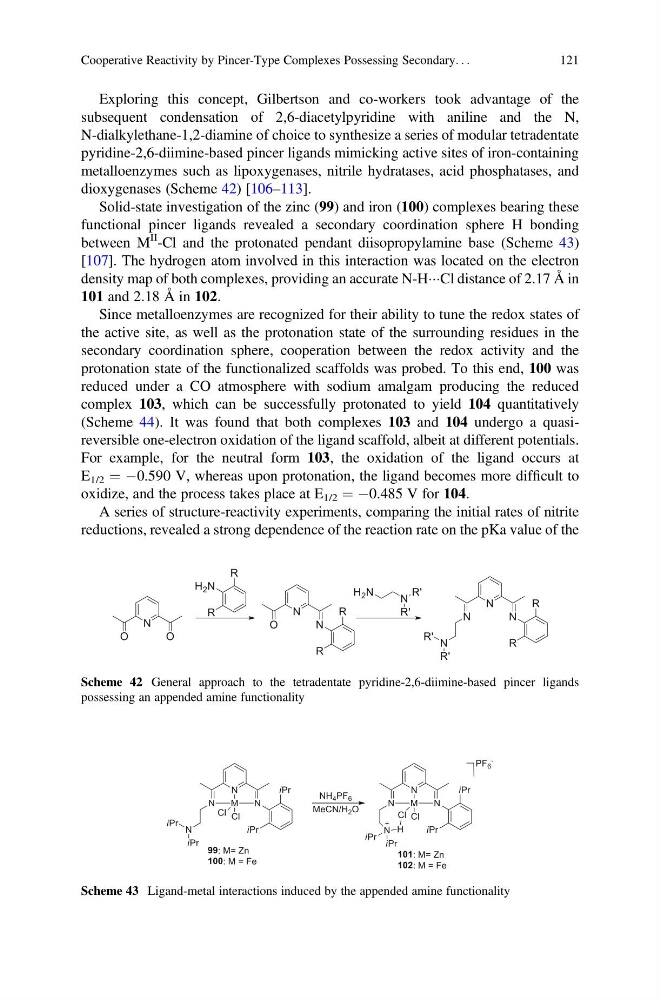
Exploring this concept, Gilbertson and co-workers took advantage of the
subsequent condensation of 2,6-diacetylpyridine with aniline and the N,
N-dialkylethane-1,2-diamine of choice to synthesize a series of modular tetradentate
pyridine-2,6-diimine-based pincer ligands mimicking active sites of iron-containing
metalloenzymes such as lipoxygenases, nitrile hydratases, acid phosphatases, and
dioxygenases (Scheme 42) [106–113].
Solid-state investigation of the zinc (99) and iron (100) complexes bearing these
functional pincer ligands revealed a secondary coordination sphere H bonding
between M
II -Cl and the protonated pendant diisopropylamine base (Scheme 43)
[107]. The hydrogen atom involved in this interaction was located on the electron
density map of both complexes, providing an accurate N-HÁÁÁCl distance of 2.17 Å in
101 and 2.18 Å in 102.
Since metalloenzymes are recognized for their ability to tune the redox states of
the active site, as well as the protonation state of the surrounding residues in the
secondary coordination sphere, cooperation between the redox activity and the
protonation state of the functionalized scaffolds was probed. To this end, 100 was
reduced under a CO atmosphere with sodium amalgam producing the reduced
complex 103, which can be successfully protonated to yield 104 quantitatively
(Scheme 44). It was found that both complexes 103 and 104 undergo a quasireversible one-electron oxidation of the ligand scaffold, albeit at different potentials.
For example, for the neutral form 103, the oxidation of the ligand occurs at
E 1/2 ¼ À0.590 V, whereas upon protonation, the ligand becomes more difficult to
oxidize, and the process takes place at E 1/2 ¼ À0.485 V for 104.
A series of structure-reactivity experiments, comparing the initial rates of nitrite
reductions, revealed a strong dependence of the reaction rate on the pKa value of the
Scheme 42 General approach to the tetradentate pyridine-2,6-diimine-based pincer ligands
possessing an appended amine functionality
Scheme 43 Ligand-metal interactions induced by the appended amine functionality
Cooperative Reactivity by Pincer-Type Complexes Possessing Secondary. . .
121
subsequent condensation of 2,6-diacetylpyridine with aniline and the N,
N-dialkylethane-1,2-diamine of choice to synthesize a series of modular tetradentate
pyridine-2,6-diimine-based pincer ligands mimicking active sites of iron-containing
metalloenzymes such as lipoxygenases, nitrile hydratases, acid phosphatases, and
dioxygenases (Scheme 42) [106–113].
Solid-state investigation of the zinc (99) and iron (100) complexes bearing these
functional pincer ligands revealed a secondary coordination sphere H bonding
between M
II -Cl and the protonated pendant diisopropylamine base (Scheme 43)
[107]. The hydrogen atom involved in this interaction was located on the electron
density map of both complexes, providing an accurate N-HÁÁÁCl distance of 2.17 Å in
101 and 2.18 Å in 102.
Since metalloenzymes are recognized for their ability to tune the redox states of
the active site, as well as the protonation state of the surrounding residues in the
secondary coordination sphere, cooperation between the redox activity and the
protonation state of the functionalized scaffolds was probed. To this end, 100 was
reduced under a CO atmosphere with sodium amalgam producing the reduced
complex 103, which can be successfully protonated to yield 104 quantitatively
(Scheme 44). It was found that both complexes 103 and 104 undergo a quasireversible one-electron oxidation of the ligand scaffold, albeit at different potentials.
For example, for the neutral form 103, the oxidation of the ligand occurs at
E 1/2 ¼ À0.590 V, whereas upon protonation, the ligand becomes more difficult to
oxidize, and the process takes place at E 1/2 ¼ À0.485 V for 104.
A series of structure-reactivity experiments, comparing the initial rates of nitrite
reductions, revealed a strong dependence of the reaction rate on the pKa value of the
Scheme 42 General approach to the tetradentate pyridine-2,6-diimine-based pincer ligands
possessing an appended amine functionality
Scheme 43 Ligand-metal interactions induced by the appended amine functionality
Cooperative Reactivity by Pincer-Type Complexes Possessing Secondary. . .
121