

3.2 N(sp
2
)-Based Pincer Complexes Possessing Hydrogen
Bonding Functionalities
Hydrogen bonding interactions by means of Brønsted acids or bases with metal
complexes provided an opportunity for hydrogen transfer to/from metal-coordinated
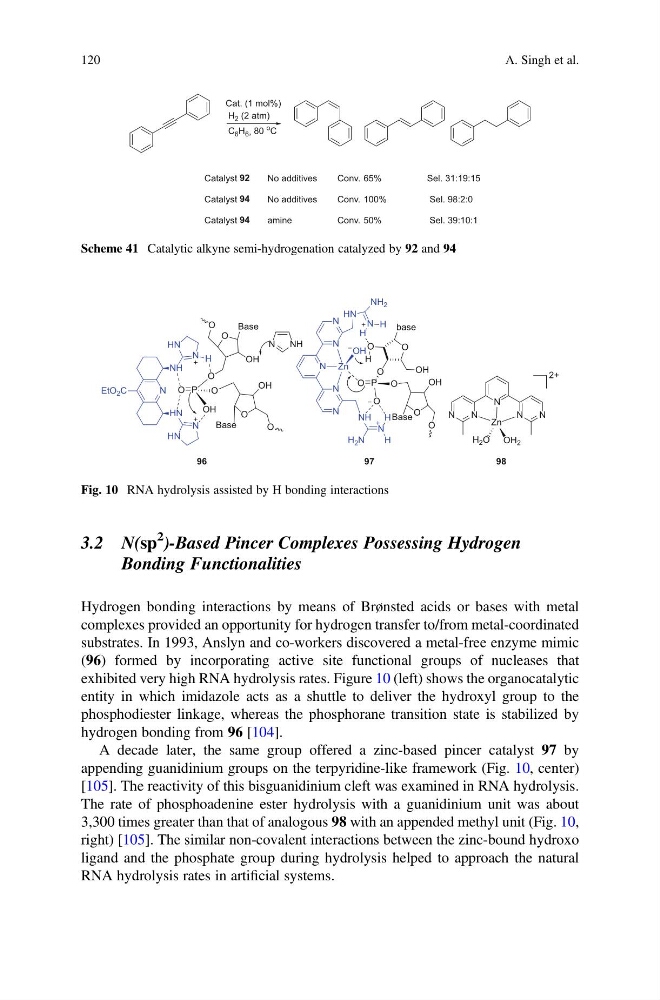
substrates. In 1993, Anslyn and co-workers discovered a metal-free enzyme mimic
(96) formed by incorporating active site functional groups of nucleases that
exhibited very high RNA hydrolysis rates. Figure 10 (left) shows the organocatalytic
entity in which imidazole acts as a shuttle to deliver the hydroxyl group to the
phosphodiester linkage, whereas the phosphorane transition state is stabilized by
hydrogen bonding from 96 [104].
A decade later, the same group offered a zinc-based pincer catalyst 97 by
appending guanidinium groups on the terpyridine-like framework (Fig. 10, center)
[105]. The reactivity of this bisguanidinium cleft was examined in RNA hydrolysis.
The rate of phosphoadenine ester hydrolysis with a guanidinium unit was about
3,300 times greater than that of analogous 98 with an appended methyl unit (Fig. 10,
right) [105]. The similar non-covalent interactions between the zinc-bound hydroxo
ligand and the phosphate group during hydrolysis helped to approach the natural
RNA hydrolysis rates in artificial systems.
N
EtO 2 C
NH
HN
HN
N
N
HN
O P
O
O
OH
H
O
O
OH
O
Base
OH
Base
O
N
NH
N
N
N
N
N
NH
HN
NH 2
N
H 2 N
N
Zn
OH
97
O P
O
O
O
O
OH
Base
O
H
H
H
96
N
N
N
N
N
Zn
OH 2
H 2 O
2+
98
H
O
base
OH
O
H
Fig. 10 RNA hydrolysis assisted by H bonding interactions
Cat. (1 mol%)
H 2 (2 atm)
C 6 H 6 , 80
o
C
Catalyst 92
No additives
Conv. 65%
Sel. 31:19:15
Catalyst 94
No additives
Conv. 100%
Sel. 98:2:0
Catalyst 94
amine
Conv. 50%
Sel. 39:10:1
Scheme 41 Catalytic alkyne semi-hydrogenation catalyzed by 92 and 94
120
A. Singh et al.
2
)-Based Pincer Complexes Possessing Hydrogen
Bonding Functionalities
Hydrogen bonding interactions by means of Brønsted acids or bases with metal
complexes provided an opportunity for hydrogen transfer to/from metal-coordinated
substrates. In 1993, Anslyn and co-workers discovered a metal-free enzyme mimic
(96) formed by incorporating active site functional groups of nucleases that
exhibited very high RNA hydrolysis rates. Figure 10 (left) shows the organocatalytic
entity in which imidazole acts as a shuttle to deliver the hydroxyl group to the
phosphodiester linkage, whereas the phosphorane transition state is stabilized by
hydrogen bonding from 96 [104].
A decade later, the same group offered a zinc-based pincer catalyst 97 by
appending guanidinium groups on the terpyridine-like framework (Fig. 10, center)
[105]. The reactivity of this bisguanidinium cleft was examined in RNA hydrolysis.
The rate of phosphoadenine ester hydrolysis with a guanidinium unit was about
3,300 times greater than that of analogous 98 with an appended methyl unit (Fig. 10,
right) [105]. The similar non-covalent interactions between the zinc-bound hydroxo
ligand and the phosphate group during hydrolysis helped to approach the natural
RNA hydrolysis rates in artificial systems.
N
EtO 2 C
NH
HN
HN
N
N
HN
O P
O
O
OH
H
O
O
OH
O
Base
OH
Base
O
N
NH
N
N
N
N
N
NH
HN
NH 2
N
H 2 N
N
Zn
OH
97
O P
O
O
O
O
OH
Base
O
H
H
H
96
N
N
N
N
N
Zn
OH 2
H 2 O
2+
98
H
O
base
OH
O
H
Fig. 10 RNA hydrolysis assisted by H bonding interactions
Cat. (1 mol%)
H 2 (2 atm)
C 6 H 6 , 80
o
C
Catalyst 92
No additives
Conv. 65%
Sel. 31:19:15
Catalyst 94
No additives
Conv. 100%
Sel. 98:2:0
Catalyst 94
amine
Conv. 50%
Sel. 39:10:1
Scheme 41 Catalytic alkyne semi-hydrogenation catalyzed by 92 and 94
120
A. Singh et al.