

[102]. Studying the coordination and organometallic chemistry of the visually
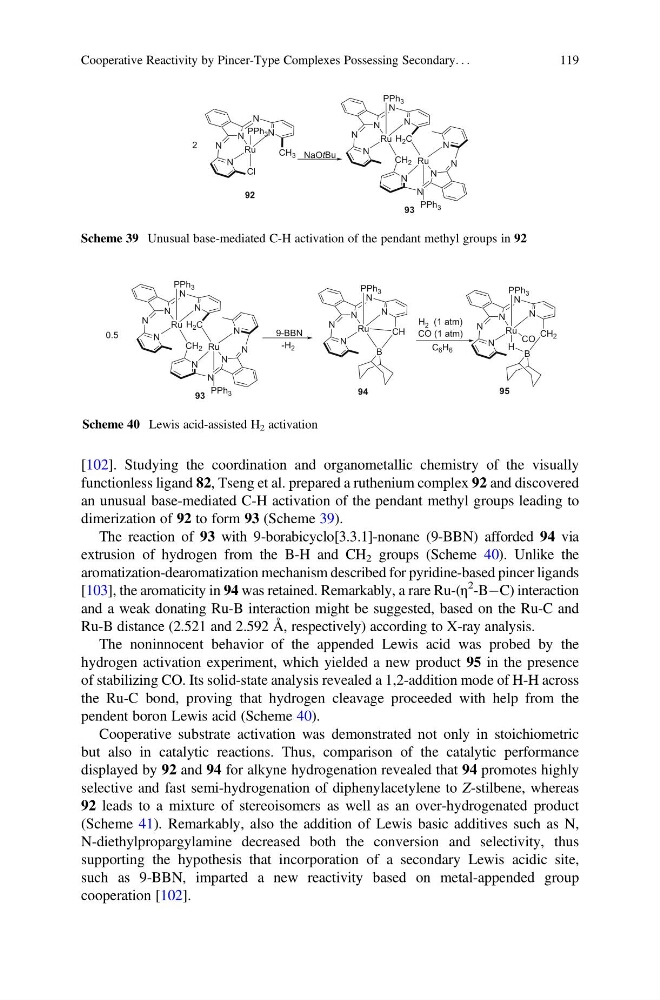
functionless ligand 82, Tseng et al. prepared a ruthenium complex 92 and discovered
an unusual base-mediated C-H activation of the pendant methyl groups leading to
dimerization of 92 to form 93 (Scheme 39).
The reaction of 93 with 9-borabicyclo[3.3.1]-nonane (9-BBN) afforded 94 via
extrusion of hydrogen from the B-H and CH 2 groups (Scheme 40). Unlike the
aromatization-dearomatization mechanism described for pyridine-based pincer ligands
[103], the aromaticity in 94 was retained. Remarkably, a rare Ru-(η
2
-BÀC) interaction
and a weak donating Ru-B interaction might be suggested, based on the Ru-C and
Ru-B distance (2.521 and 2.592 Å, respectively) according to X-ray analysis.
The noninnocent behavior of the appended Lewis acid was probed by the
hydrogen activation experiment, which yielded a new product 95 in the presence
of stabilizing CO. Its solid-state analysis revealed a 1,2-addition mode of H-H across
the Ru-C bond, proving that hydrogen cleavage proceeded with help from the
pendent boron Lewis acid (Scheme 40).
Cooperative substrate activation was demonstrated not only in stoichiometric
but also in catalytic reactions. Thus, comparison of the catalytic performance
displayed by 92 and 94 for alkyne hydrogenation revealed that 94 promotes highly
selective and fast semi-hydrogenation of diphenylacetylene to Z-stilbene, whereas
92 leads to a mixture of stereoisomers as well as an over-hydrogenated product
(Scheme 41). Remarkably, also the addition of Lewis basic additives such as N,
N-diethylpropargylamine decreased both the conversion and selectivity, thus
supporting the hypothesis that incorporation of a secondary Lewis acidic site,
such as 9-BBN, imparted a new reactivity based on metal-appended group
cooperation [102].
N
N
N
N
N
Ru
CH 3
PPh 3
Cl
N
N
N
N
N
Ru H 2 C
PPh 3
N
N
N
N
N
Ru
CH 2
PPh 3
NaOtBu
92
93
2
Scheme 39 Unusual base-mediated C-H activation of the pendant methyl groups in 92
N
N
N
N
N
Ru H 2 C
PPh 3
N
N
N
N
N
Ru
CH 2
PPh 3
93
N
N
N
N
N
Ru
CH
PPh 3
9-BBN
94
B
N
N
N
N
N
Ru
CH 2
PPh 3
H B
H 2 (1 atm)
C 6 H 6
CO (1 atm)
CO
-H 2
95
0.5
Scheme 40 Lewis acid-assisted H 2 activation
Cooperative Reactivity by Pincer-Type Complexes Possessing Secondary. . .
119
functionless ligand 82, Tseng et al. prepared a ruthenium complex 92 and discovered
an unusual base-mediated C-H activation of the pendant methyl groups leading to
dimerization of 92 to form 93 (Scheme 39).
The reaction of 93 with 9-borabicyclo[3.3.1]-nonane (9-BBN) afforded 94 via
extrusion of hydrogen from the B-H and CH 2 groups (Scheme 40). Unlike the
aromatization-dearomatization mechanism described for pyridine-based pincer ligands
[103], the aromaticity in 94 was retained. Remarkably, a rare Ru-(η
2
-BÀC) interaction
and a weak donating Ru-B interaction might be suggested, based on the Ru-C and
Ru-B distance (2.521 and 2.592 Å, respectively) according to X-ray analysis.
The noninnocent behavior of the appended Lewis acid was probed by the
hydrogen activation experiment, which yielded a new product 95 in the presence
of stabilizing CO. Its solid-state analysis revealed a 1,2-addition mode of H-H across
the Ru-C bond, proving that hydrogen cleavage proceeded with help from the
pendent boron Lewis acid (Scheme 40).
Cooperative substrate activation was demonstrated not only in stoichiometric
but also in catalytic reactions. Thus, comparison of the catalytic performance
displayed by 92 and 94 for alkyne hydrogenation revealed that 94 promotes highly
selective and fast semi-hydrogenation of diphenylacetylene to Z-stilbene, whereas
92 leads to a mixture of stereoisomers as well as an over-hydrogenated product
(Scheme 41). Remarkably, also the addition of Lewis basic additives such as N,
N-diethylpropargylamine decreased both the conversion and selectivity, thus
supporting the hypothesis that incorporation of a secondary Lewis acidic site,
such as 9-BBN, imparted a new reactivity based on metal-appended group
cooperation [102].
N
N
N
N
N
Ru
CH 3
PPh 3
Cl
N
N
N
N
N
Ru H 2 C
PPh 3
N
N
N
N
N
Ru
CH 2
PPh 3
NaOtBu
92
93
2
Scheme 39 Unusual base-mediated C-H activation of the pendant methyl groups in 92
N
N
N
N
N
Ru H 2 C
PPh 3
N
N
N
N
N
Ru
CH 2
PPh 3
93
N
N
N
N
N
Ru
CH
PPh 3
9-BBN
94
B
N
N
N
N
N
Ru
CH 2
PPh 3
H B
H 2 (1 atm)
C 6 H 6
CO (1 atm)
CO
-H 2
95
0.5
Scheme 40 Lewis acid-assisted H 2 activation
Cooperative Reactivity by Pincer-Type Complexes Possessing Secondary. . .
119