

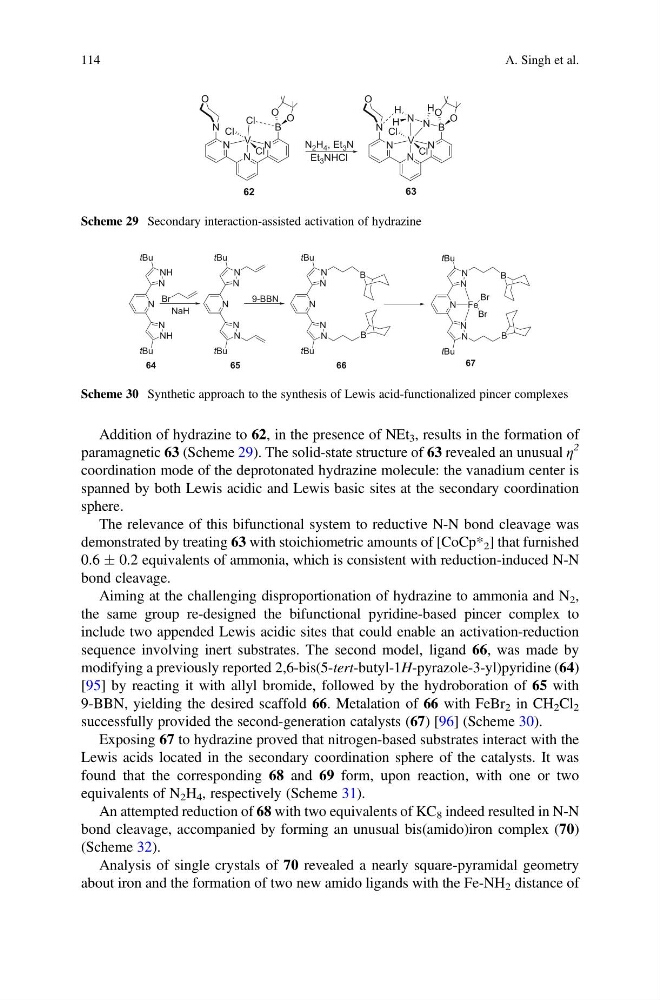
Addition of hydrazine to 62, in the presence of NEt 3 , results in the formation of
paramagnetic 63 (Scheme 29). The solid-state structure of 63 revealed an unusual η
2
coordination mode of the deprotonated hydrazine molecule: the vanadium center is
spanned by both Lewis acidic and Lewis basic sites at the secondary coordination
sphere.
The relevance of this bifunctional system to reductive N-N bond cleavage was
demonstrated by treating 63 with stoichiometric amounts of [CoCp* 2 ] that furnished
0.6 Æ 0.2 equivalents of ammonia, which is consistent with reduction-induced N-N
bond cleavage.
Aiming at the challenging disproportionation of hydrazine to ammonia and N 2 ,
the same group re-designed the bifunctional pyridine-based pincer complex to
include two appended Lewis acidic sites that could enable an activation-reduction
sequence involving inert substrates. The second model, ligand 66, was made by
modifying a previously reported 2,6-bis(5-tert-butyl-1H-pyrazole-3-yl)pyridine (64)
[95] by reacting it with allyl bromide, followed by the hydroboration of 65 with
9-BBN, yielding the desired scaffold 66. Metalation of 66 with FeBr 2 in CH 2 Cl 2
successfully provided the second-generation catalysts (67) [96] (Scheme 30).
Exposing 67 to hydrazine proved that nitrogen-based substrates interact with the
Lewis acids located in the secondary coordination sphere of the catalysts. It was
found that the corresponding 68 and 69 form, upon reaction, with one or two
equivalents of N 2 H 4 , respectively (Scheme 31).
An attempted reduction of 68 with two equivalents of KC 8 indeed resulted in N-N
bond cleavage, accompanied by forming an unusual bis(amido)iron complex (70)
(Scheme 32).
Analysis of single crystals of 70 revealed a nearly square-pyramidal geometry
about iron and the formation of two new amido ligands with the Fe-NH 2 distance of
N
N
N V
N N B
O
O
H
H
H
N
O
Cl
Cl
N
N
N V
B
O
O
N
O
Cl
Cl
Cl
N 2 H 4 , Et 3 N
Et 3 NHCl
62
63
Scheme 29 Secondary interaction-assisted activation of hydrazine
N
N
NH
NH
N
tBu
tBu
N
N
N
N
N
tBu
tBu
N
N
N
N
N
tBu
tBu
Br
NaH
9-BBN
B
B
64
65
66
N
N
N
N
N
tBu
tBu
B
B
67
Fe
Br
Br
Scheme 30 Synthetic approach to the synthesis of Lewis acid-functionalized pincer complexes
114
A. Singh et al.
paramagnetic 63 (Scheme 29). The solid-state structure of 63 revealed an unusual η
2
coordination mode of the deprotonated hydrazine molecule: the vanadium center is
spanned by both Lewis acidic and Lewis basic sites at the secondary coordination
sphere.
The relevance of this bifunctional system to reductive N-N bond cleavage was
demonstrated by treating 63 with stoichiometric amounts of [CoCp* 2 ] that furnished
0.6 Æ 0.2 equivalents of ammonia, which is consistent with reduction-induced N-N
bond cleavage.
Aiming at the challenging disproportionation of hydrazine to ammonia and N 2 ,
the same group re-designed the bifunctional pyridine-based pincer complex to
include two appended Lewis acidic sites that could enable an activation-reduction
sequence involving inert substrates. The second model, ligand 66, was made by
modifying a previously reported 2,6-bis(5-tert-butyl-1H-pyrazole-3-yl)pyridine (64)
[95] by reacting it with allyl bromide, followed by the hydroboration of 65 with
9-BBN, yielding the desired scaffold 66. Metalation of 66 with FeBr 2 in CH 2 Cl 2
successfully provided the second-generation catalysts (67) [96] (Scheme 30).
Exposing 67 to hydrazine proved that nitrogen-based substrates interact with the
Lewis acids located in the secondary coordination sphere of the catalysts. It was
found that the corresponding 68 and 69 form, upon reaction, with one or two
equivalents of N 2 H 4 , respectively (Scheme 31).
An attempted reduction of 68 with two equivalents of KC 8 indeed resulted in N-N
bond cleavage, accompanied by forming an unusual bis(amido)iron complex (70)
(Scheme 32).
Analysis of single crystals of 70 revealed a nearly square-pyramidal geometry
about iron and the formation of two new amido ligands with the Fe-NH 2 distance of
N
N
N V
N N B
O
O
H
H
H
N
O
Cl
Cl
N
N
N V
B
O
O
N
O
Cl
Cl
Cl
N 2 H 4 , Et 3 N
Et 3 NHCl
62
63
Scheme 29 Secondary interaction-assisted activation of hydrazine
N
N
NH
NH
N
tBu
tBu
N
N
N
N
N
tBu
tBu
N
N
N
N
N
tBu
tBu
Br
NaH
9-BBN
B
B
64
65
66
N
N
N
N
N
tBu
tBu
B
B
67
Fe
Br
Br
Scheme 30 Synthetic approach to the synthesis of Lewis acid-functionalized pincer complexes
114
A. Singh et al.