

3 N-Based Pincer Complexes
Increasing attention has recently been paid to pincer-type complexes with a central
amine group, due to the versatility of their coordination chemistry and a more
versatile synthesis of the N-based scaffolds. In principle, the amine can be bound
to alkyl, alkenyl, or aryl groups as well as heteroatom-containing groups such as
silanes. The donor groups may incorporate phosphines, carbenes, heterocycles, and
heteroatoms, which makes N-based pincer ligands attractive candidates for the
installation of the secondary coordination sphere.
3.1 N(sp
2
)-Based Pincer Complexes Possessing Lewis Acid
Functionalities
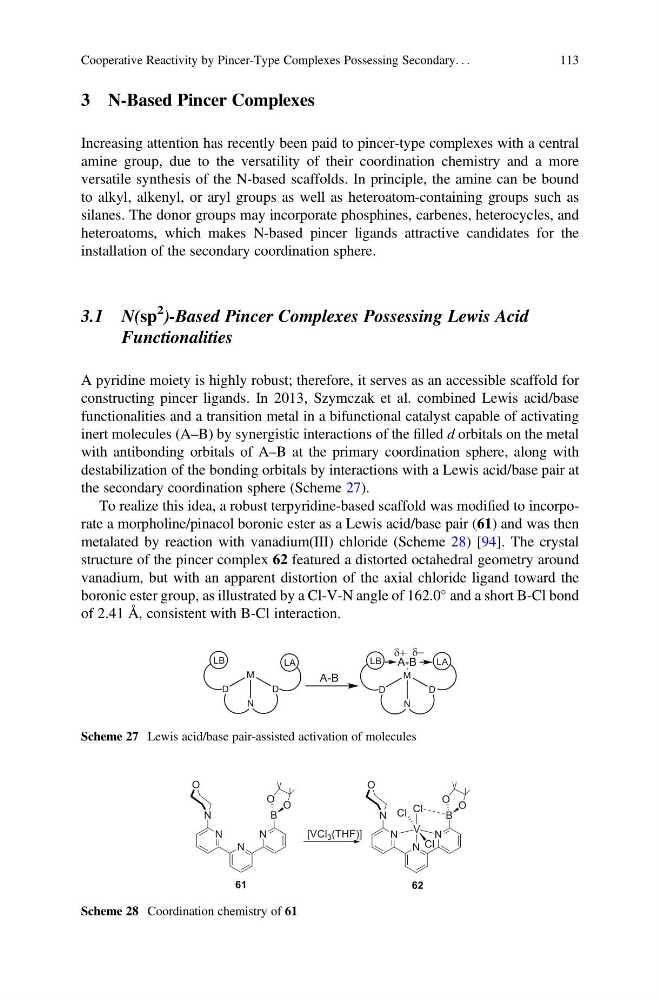
A pyridine moiety is highly robust; therefore, it serves as an accessible scaffold for
constructing pincer ligands. In 2013, Szymczak et al. combined Lewis acid/base
functionalities and a transition metal in a bifunctional catalyst capable of activating
inert molecules (A–B) by synergistic interactions of the filled d orbitals on the metal
with antibonding orbitals of A–B at the primary coordination sphere, along with
destabilization of the bonding orbitals by interactions with a Lewis acid/base pair at
the secondary coordination sphere (Scheme 27).
To realize this idea, a robust terpyridine-based scaffold was modified to incorporate a morpholine/pinacol boronic ester as a Lewis acid/base pair (61) and was then
metalated by reaction with vanadium(III) chloride (Scheme 28) [94]. The crystal
structure of the pincer complex 62 featured a distorted octahedral geometry around
vanadium, but with an apparent distortion of the axial chloride ligand toward the
boronic ester group, as illustrated by a Cl-V-N angle of 162.0
and a short B-Cl bond
of 2.41 Å, consistent with B-Cl interaction.
Scheme 27 Lewis acid/base pair-assisted activation of molecules
Scheme 28 Coordination chemistry of 61
Cooperative Reactivity by Pincer-Type Complexes Possessing Secondary. . .
113
Increasing attention has recently been paid to pincer-type complexes with a central
amine group, due to the versatility of their coordination chemistry and a more
versatile synthesis of the N-based scaffolds. In principle, the amine can be bound
to alkyl, alkenyl, or aryl groups as well as heteroatom-containing groups such as
silanes. The donor groups may incorporate phosphines, carbenes, heterocycles, and
heteroatoms, which makes N-based pincer ligands attractive candidates for the
installation of the secondary coordination sphere.
3.1 N(sp
2
)-Based Pincer Complexes Possessing Lewis Acid
Functionalities
A pyridine moiety is highly robust; therefore, it serves as an accessible scaffold for
constructing pincer ligands. In 2013, Szymczak et al. combined Lewis acid/base
functionalities and a transition metal in a bifunctional catalyst capable of activating
inert molecules (A–B) by synergistic interactions of the filled d orbitals on the metal
with antibonding orbitals of A–B at the primary coordination sphere, along with
destabilization of the bonding orbitals by interactions with a Lewis acid/base pair at
the secondary coordination sphere (Scheme 27).
To realize this idea, a robust terpyridine-based scaffold was modified to incorporate a morpholine/pinacol boronic ester as a Lewis acid/base pair (61) and was then
metalated by reaction with vanadium(III) chloride (Scheme 28) [94]. The crystal
structure of the pincer complex 62 featured a distorted octahedral geometry around
vanadium, but with an apparent distortion of the axial chloride ligand toward the
boronic ester group, as illustrated by a Cl-V-N angle of 162.0
and a short B-Cl bond
of 2.41 Å, consistent with B-Cl interaction.
Scheme 27 Lewis acid/base pair-assisted activation of molecules
Scheme 28 Coordination chemistry of 61
Cooperative Reactivity by Pincer-Type Complexes Possessing Secondary. . .
113