

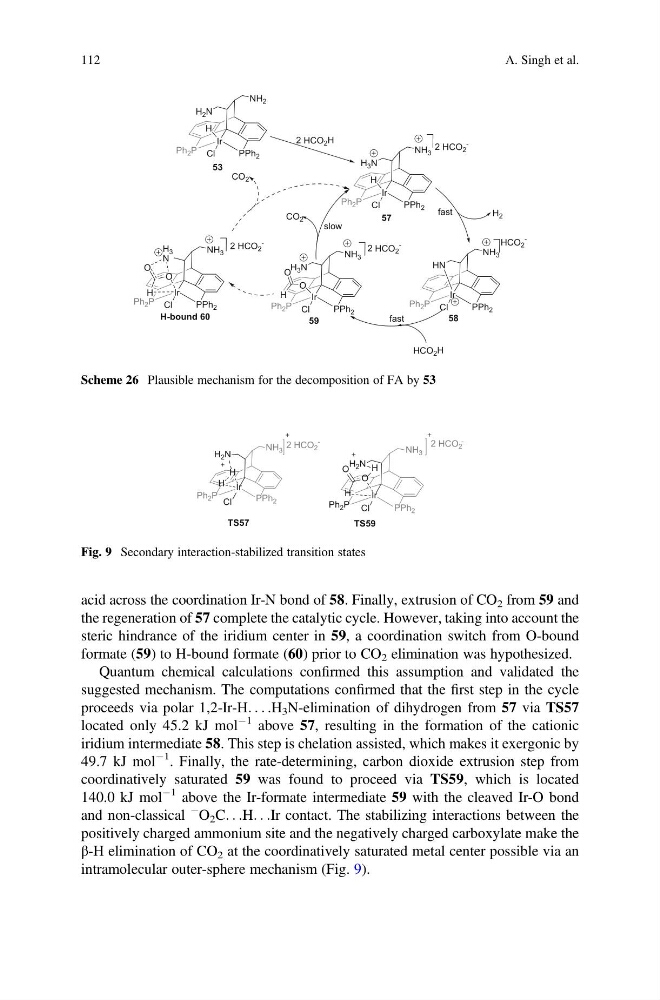
acid across the coordination Ir-N bond of 58. Finally, extrusion of CO 2 from 59 and
the regeneration of 57 complete the catalytic cycle. However, taking into account the
steric hindrance of the iridium center in 59, a coordination switch from O-bound
formate (59) to H-bound formate (60) prior to CO 2 elimination was hypothesized.
Quantum chemical calculations confirmed this assumption and validated the
suggested mechanism. The computations confirmed that the first step in the cycle
proceeds via polar 1,2-Ir-H. . . .H 3 N-elimination of dihydrogen from 57 via TS57
located only 45.2 kJ mol
À1 above 57, resulting in the formation of the cationic
iridium intermediate 58. This step is chelation assisted, which makes it exergonic by
49.7 kJ mol
À1 . Finally, the rate-determining, carbon dioxide extrusion step from
coordinatively saturated 59 was found to proceed via TS59, which is located
140.0 kJ mol
À1 above the Ir-formate intermediate 59 with the cleaved Ir-O bond
and non-classical
À
O 2 C. . .H. . .Ir contact. The stabilizing interactions between the
positively charged ammonium site and the negatively charged carboxylate make the
β-H elimination of CO 2 at the coordinatively saturated metal center possible via an
intramolecular outer-sphere mechanism (Fig. 9).
Ph 2 P
PPh 2
NH 2
H 2 N
Ir
H
Cl
53
2 HCO 2 H
Ph 2 P
PPh 2
NH 3
H 3 N
Ir
Cl
O
O
H
2 HCO 2
-
HCO 2 H
59
CO 2
Ph 2 P
PPh 2
NH 3
HN
Ir
Cl
HCO 2
-
58
Ph 2 P
PPh 2
NH 3
H 3 N
Ir
H
Cl
57
2 HCO 2
-
H 2
fast
fast
slow
Ph 2 P
PPh 2
NH 3
H 3
N
Ir
Cl
O
O
H
CO 2
H-bound 60
2 HCO 2
-
Scheme 26 Plausible mechanism for the decomposition of FA by 53
Ph 2 P
PPh 2
NH 3
H 2 N
Ir
Cl
O
O
H
2 HCO 2
-
H
Ph 2 P
PPh 2
NH 3
H 2 N
Ir
Cl
2 HCO 2
-
H
H
TS57
TS59
Fig. 9 Secondary interaction-stabilized transition states
112
A. Singh et al.
the regeneration of 57 complete the catalytic cycle. However, taking into account the
steric hindrance of the iridium center in 59, a coordination switch from O-bound
formate (59) to H-bound formate (60) prior to CO 2 elimination was hypothesized.
Quantum chemical calculations confirmed this assumption and validated the
suggested mechanism. The computations confirmed that the first step in the cycle
proceeds via polar 1,2-Ir-H. . . .H 3 N-elimination of dihydrogen from 57 via TS57
located only 45.2 kJ mol
À1 above 57, resulting in the formation of the cationic
iridium intermediate 58. This step is chelation assisted, which makes it exergonic by
49.7 kJ mol
À1 . Finally, the rate-determining, carbon dioxide extrusion step from
coordinatively saturated 59 was found to proceed via TS59, which is located
140.0 kJ mol
À1 above the Ir-formate intermediate 59 with the cleaved Ir-O bond
and non-classical
À
O 2 C. . .H. . .Ir contact. The stabilizing interactions between the
positively charged ammonium site and the negatively charged carboxylate make the
β-H elimination of CO 2 at the coordinatively saturated metal center possible via an
intramolecular outer-sphere mechanism (Fig. 9).
Ph 2 P
PPh 2
NH 2
H 2 N
Ir
H
Cl
53
2 HCO 2 H
Ph 2 P
PPh 2
NH 3
H 3 N
Ir
Cl
O
O
H
2 HCO 2
-
HCO 2 H
59
CO 2
Ph 2 P
PPh 2
NH 3
HN
Ir
Cl
HCO 2
-
58
Ph 2 P
PPh 2
NH 3
H 3 N
Ir
H
Cl
57
2 HCO 2
-
H 2
fast
fast
slow
Ph 2 P
PPh 2
NH 3
H 3
N
Ir
Cl
O
O
H
CO 2
H-bound 60
2 HCO 2
-
Scheme 26 Plausible mechanism for the decomposition of FA by 53
Ph 2 P
PPh 2
NH 3
H 2 N
Ir
Cl
O
O
H
2 HCO 2
-
H
Ph 2 P
PPh 2
NH 3
H 2 N
Ir
Cl
2 HCO 2
-
H
H
TS57
TS59
Fig. 9 Secondary interaction-stabilized transition states
112
A. Singh et al.