

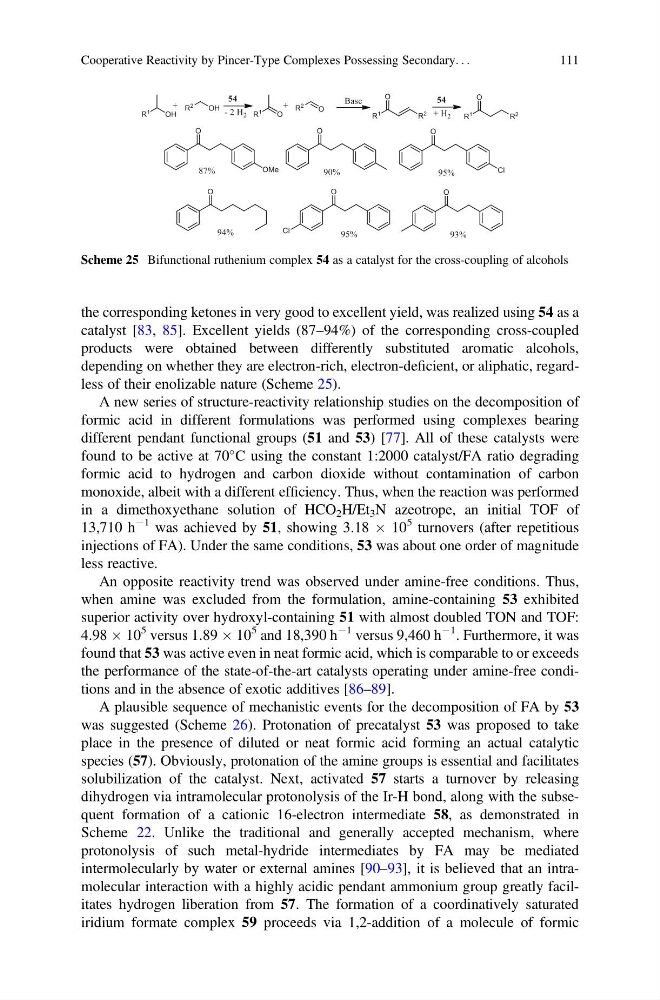
the corresponding ketones in very good to excellent yield, was realized using 54 as a
catalyst [83, 85]. Excellent yields (87–94%) of the corresponding cross-coupled
products were obtained between differently substituted aromatic alcohols,
depending on whether they are electron-rich, electron-deficient, or aliphatic, regardless of their enolizable nature (Scheme 25).
A new series of structure-reactivity relationship studies on the decomposition of
formic acid in different formulations was performed using complexes bearing
different pendant functional groups (51 and 53) [77]. All of these catalysts were
found to be active at 70
C using the constant 1:2000 catalyst/FA ratio degrading
formic acid to hydrogen and carbon dioxide without contamination of carbon
monoxide, albeit with a different efficiency. Thus, when the reaction was performed
in a dimethoxyethane solution of HCO 2 H/Et 3 N azeotrope, an initial TOF of
13,710 h
À1 was achieved by 51, showing 3.18 Â 10
5 turnovers (after repetitious
injections of FA). Under the same conditions, 53 was about one order of magnitude
less reactive.
An opposite reactivity trend was observed under amine-free conditions. Thus,
when amine was excluded from the formulation, amine-containing 53 exhibited
superior activity over hydroxyl-containing 51 with almost doubled TON and TOF:
4.98 Â 10
5 versus 1.89 Â 10
5 and 18,390 h
À1 versus 9,460 h
À1 . Furthermore, it was
found that 53 was active even in neat formic acid, which is comparable to or exceeds
the performance of the state-of-the-art catalysts operating under amine-free conditions and in the absence of exotic additives [86–89].
A plausible sequence of mechanistic events for the decomposition of FA by 53
was suggested (Scheme 26). Protonation of precatalyst 53 was proposed to take
place in the presence of diluted or neat formic acid forming an actual catalytic
species (57). Obviously, protonation of the amine groups is essential and facilitates
solubilization of the catalyst. Next, activated 57 starts a turnover by releasing
dihydrogen via intramolecular protonolysis of the Ir-H bond, along with the subsequent formation of a cationic 16-electron intermediate 58, as demonstrated in
Scheme 22. Unlike the traditional and generally accepted mechanism, where
protonolysis of such metal-hydride intermediates by FA may be mediated
intermolecularly by water or external amines [90–93], it is believed that an intramolecular interaction with a highly acidic pendant ammonium group greatly facilitates hydrogen liberation from 57. The formation of a coordinatively saturated
iridium formate complex 59 proceeds via 1,2-addition of a molecule of formic
Scheme 25 Bifunctional ruthenium complex 54 as a catalyst for the cross-coupling of alcohols
Cooperative Reactivity by Pincer-Type Complexes Possessing Secondary. . .
111
catalyst [83, 85]. Excellent yields (87–94%) of the corresponding cross-coupled
products were obtained between differently substituted aromatic alcohols,
depending on whether they are electron-rich, electron-deficient, or aliphatic, regardless of their enolizable nature (Scheme 25).
A new series of structure-reactivity relationship studies on the decomposition of
formic acid in different formulations was performed using complexes bearing
different pendant functional groups (51 and 53) [77]. All of these catalysts were
found to be active at 70
C using the constant 1:2000 catalyst/FA ratio degrading
formic acid to hydrogen and carbon dioxide without contamination of carbon
monoxide, albeit with a different efficiency. Thus, when the reaction was performed
in a dimethoxyethane solution of HCO 2 H/Et 3 N azeotrope, an initial TOF of
13,710 h
À1 was achieved by 51, showing 3.18 Â 10
5 turnovers (after repetitious
injections of FA). Under the same conditions, 53 was about one order of magnitude
less reactive.
An opposite reactivity trend was observed under amine-free conditions. Thus,
when amine was excluded from the formulation, amine-containing 53 exhibited
superior activity over hydroxyl-containing 51 with almost doubled TON and TOF:
4.98 Â 10
5 versus 1.89 Â 10
5 and 18,390 h
À1 versus 9,460 h
À1 . Furthermore, it was
found that 53 was active even in neat formic acid, which is comparable to or exceeds
the performance of the state-of-the-art catalysts operating under amine-free conditions and in the absence of exotic additives [86–89].
A plausible sequence of mechanistic events for the decomposition of FA by 53
was suggested (Scheme 26). Protonation of precatalyst 53 was proposed to take
place in the presence of diluted or neat formic acid forming an actual catalytic
species (57). Obviously, protonation of the amine groups is essential and facilitates
solubilization of the catalyst. Next, activated 57 starts a turnover by releasing
dihydrogen via intramolecular protonolysis of the Ir-H bond, along with the subsequent formation of a cationic 16-electron intermediate 58, as demonstrated in
Scheme 22. Unlike the traditional and generally accepted mechanism, where
protonolysis of such metal-hydride intermediates by FA may be mediated
intermolecularly by water or external amines [90–93], it is believed that an intramolecular interaction with a highly acidic pendant ammonium group greatly facilitates hydrogen liberation from 57. The formation of a coordinatively saturated
iridium formate complex 59 proceeds via 1,2-addition of a molecule of formic
Scheme 25 Bifunctional ruthenium complex 54 as a catalyst for the cross-coupling of alcohols
Cooperative Reactivity by Pincer-Type Complexes Possessing Secondary. . .
111