

protonolysis of the Ir-H bond with the aid of the protonated sidearm in 57, leading to
the formation of a cationic intermediate 58 stabilized by amine chelation (Scheme
22, bottom).
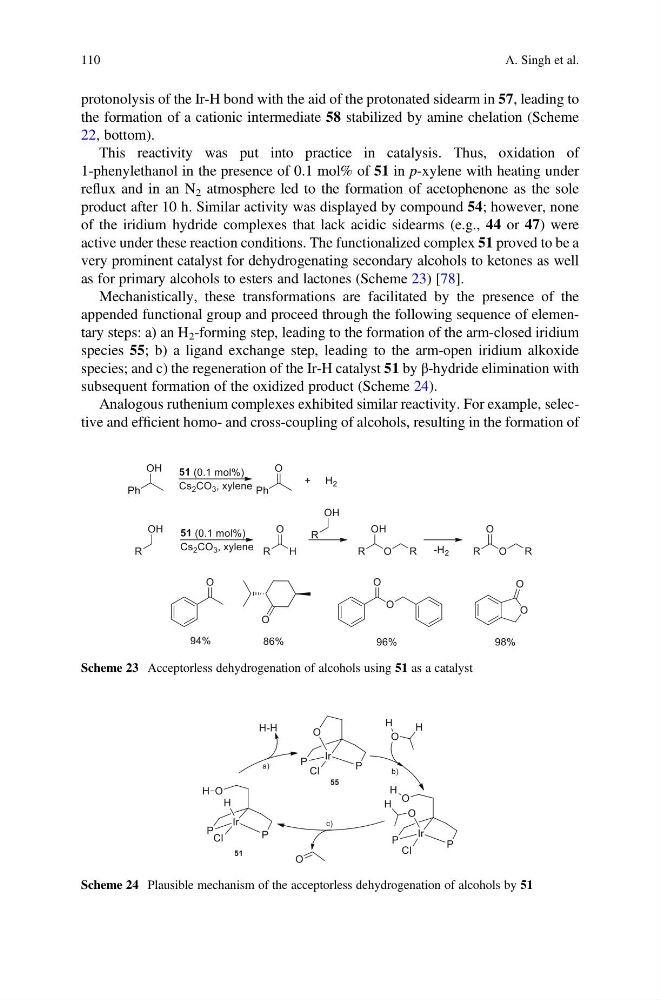
This reactivity was put into practice in catalysis. Thus, oxidation of
1-phenylethanol in the presence of 0.1 mol% of 51 in p-xylene with heating under
reflux and in an N 2 atmosphere led to the formation of acetophenone as the sole
product after 10 h. Similar activity was displayed by compound 54; however, none
of the iridium hydride complexes that lack acidic sidearms (e.g., 44 or 47) were
active under these reaction conditions. The functionalized complex 51 proved to be a
very prominent catalyst for dehydrogenating secondary alcohols to ketones as well
as for primary alcohols to esters and lactones (Scheme 23) [78].
Mechanistically, these transformations are facilitated by the presence of the
appended functional group and proceed through the following sequence of elementary steps: a) an H 2 -forming step, leading to the formation of the arm-closed iridium
species 55; b) a ligand exchange step, leading to the arm-open iridium alkoxide
species; and c) the regeneration of the Ir-H catalyst 51 by β-hydride elimination with
subsequent formation of the oxidized product (Scheme 24).
Analogous ruthenium complexes exhibited similar reactivity. For example, selective and efficient homo- and cross-coupling of alcohols, resulting in the formation of
Scheme 23 Acceptorless dehydrogenation of alcohols using 51 as a catalyst
Scheme 24 Plausible mechanism of the acceptorless dehydrogenation of alcohols by 51
110
A. Singh et al.
the formation of a cationic intermediate 58 stabilized by amine chelation (Scheme
22, bottom).
This reactivity was put into practice in catalysis. Thus, oxidation of
1-phenylethanol in the presence of 0.1 mol% of 51 in p-xylene with heating under
reflux and in an N 2 atmosphere led to the formation of acetophenone as the sole
product after 10 h. Similar activity was displayed by compound 54; however, none
of the iridium hydride complexes that lack acidic sidearms (e.g., 44 or 47) were
active under these reaction conditions. The functionalized complex 51 proved to be a
very prominent catalyst for dehydrogenating secondary alcohols to ketones as well
as for primary alcohols to esters and lactones (Scheme 23) [78].
Mechanistically, these transformations are facilitated by the presence of the
appended functional group and proceed through the following sequence of elementary steps: a) an H 2 -forming step, leading to the formation of the arm-closed iridium
species 55; b) a ligand exchange step, leading to the arm-open iridium alkoxide
species; and c) the regeneration of the Ir-H catalyst 51 by β-hydride elimination with
subsequent formation of the oxidized product (Scheme 24).
Analogous ruthenium complexes exhibited similar reactivity. For example, selective and efficient homo- and cross-coupling of alcohols, resulting in the formation of
Scheme 23 Acceptorless dehydrogenation of alcohols using 51 as a catalyst
Scheme 24 Plausible mechanism of the acceptorless dehydrogenation of alcohols by 51
110
A. Singh et al.