

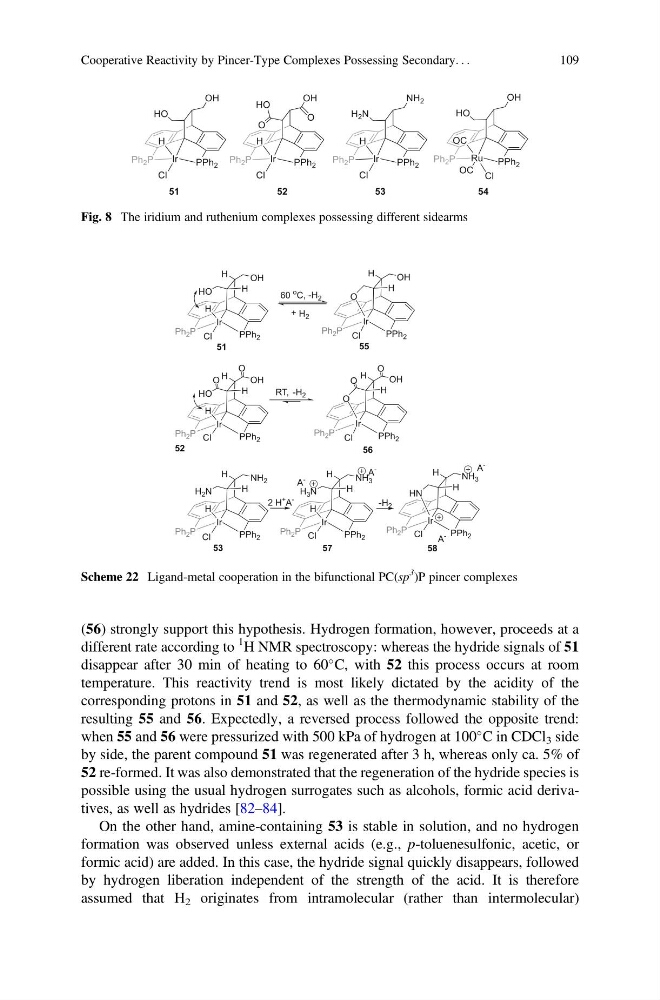
(56) strongly support this hypothesis. Hydrogen formation, however, proceeds at a
different rate according to
1 H NMR spectroscopy: whereas the hydride signals of 51
disappear after 30 min of heating to 60
C, with 52 this process occurs at room
temperature. This reactivity trend is most likely dictated by the acidity of the
corresponding protons in 51 and 52, as well as the thermodynamic stability of the
resulting 55 and 56. Expectedly, a reversed process followed the opposite trend:
when 55 and 56 were pressurized with 500 kPa of hydrogen at 100
C in CDCl 3 side
by side, the parent compound 51 was regenerated after 3 h, whereas only ca. 5% of
52 re-formed. It was also demonstrated that the regeneration of the hydride species is
possible using the usual hydrogen surrogates such as alcohols, formic acid derivatives, as well as hydrides [82–84].
On the other hand, amine-containing 53 is stable in solution, and no hydrogen
formation was observed unless external acids (e.g., p-toluenesulfonic, acetic, or
formic acid) are added. In this case, the hydride signal quickly disappears, followed
by hydrogen liberation independent of the strength of the acid. It is therefore
assumed that H 2 originates from intramolecular (rather than intermolecular)
Fig. 8 The iridium and ruthenium complexes possessing different sidearms
Ph 2 P
PPh 2
OH
HO
H
H
Ir
H
Cl
52
56
RT, -H 2
O
O
60
o
C, -H 2
+ H 2
Ph 2 P
PPh 2
NH 2
H 2 N
H
H
Ir
H
Cl
2 H
+
A
-
Ph 2 P
PPh 2
NH 3
H 3 N
H
H
Ir
H
Cl
A
-
-H 2
Ph 2 P
PPh 2
NH 3
HN
H
H
Ir
Cl
A
-
57
58
A
-
A
-
Ph 2 P
PPh 2
OH
O
H
H
Ir
Cl
55
Ph 2 P
PPh 2
OH
HO
H
H
Ir
H
Cl
51
Ph 2 P
PPh 2
OH
O
H
H
Ir
Cl
O
O
53
Scheme 22 Ligand-metal cooperation in the bifunctional PC(sp
3
)P pincer complexes
Cooperative Reactivity by Pincer-Type Complexes Possessing Secondary. . .
109
different rate according to
1 H NMR spectroscopy: whereas the hydride signals of 51
disappear after 30 min of heating to 60
C, with 52 this process occurs at room
temperature. This reactivity trend is most likely dictated by the acidity of the
corresponding protons in 51 and 52, as well as the thermodynamic stability of the
resulting 55 and 56. Expectedly, a reversed process followed the opposite trend:
when 55 and 56 were pressurized with 500 kPa of hydrogen at 100
C in CDCl 3 side
by side, the parent compound 51 was regenerated after 3 h, whereas only ca. 5% of
52 re-formed. It was also demonstrated that the regeneration of the hydride species is
possible using the usual hydrogen surrogates such as alcohols, formic acid derivatives, as well as hydrides [82–84].
On the other hand, amine-containing 53 is stable in solution, and no hydrogen
formation was observed unless external acids (e.g., p-toluenesulfonic, acetic, or
formic acid) are added. In this case, the hydride signal quickly disappears, followed
by hydrogen liberation independent of the strength of the acid. It is therefore
assumed that H 2 originates from intramolecular (rather than intermolecular)
Fig. 8 The iridium and ruthenium complexes possessing different sidearms
Ph 2 P
PPh 2
OH
HO
H
H
Ir
H
Cl
52
56
RT, -H 2
O
O
60
o
C, -H 2
+ H 2
Ph 2 P
PPh 2
NH 2
H 2 N
H
H
Ir
H
Cl
2 H
+
A
-
Ph 2 P
PPh 2
NH 3
H 3 N
H
H
Ir
H
Cl
A
-
-H 2
Ph 2 P
PPh 2
NH 3
HN
H
H
Ir
Cl
A
-
57
58
A
-
A
-
Ph 2 P
PPh 2
OH
O
H
H
Ir
Cl
55
Ph 2 P
PPh 2
OH
HO
H
H
Ir
H
Cl
51
Ph 2 P
PPh 2
OH
O
H
H
Ir
Cl
O
O
53
Scheme 22 Ligand-metal cooperation in the bifunctional PC(sp
3
)P pincer complexes
Cooperative Reactivity by Pincer-Type Complexes Possessing Secondary. . .
109