

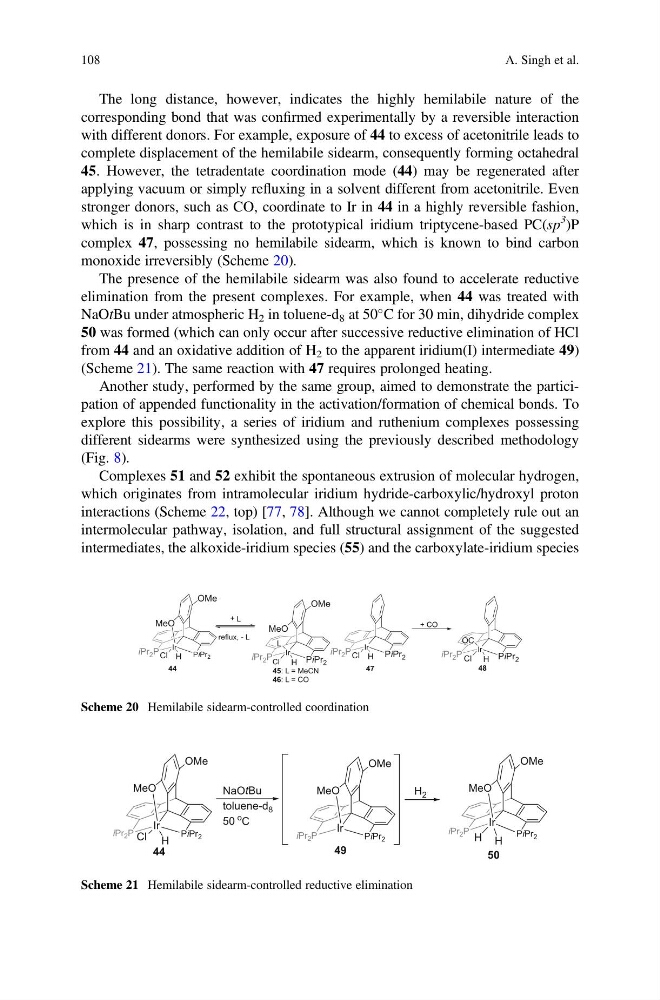
The long distance, however, indicates the highly hemilabile nature of the
corresponding bond that was confirmed experimentally by a reversible interaction
with different donors. For example, exposure of 44 to excess of acetonitrile leads to
complete displacement of the hemilabile sidearm, consequently forming octahedral
45. However, the tetradentate coordination mode (44) may be regenerated after
applying vacuum or simply refluxing in a solvent different from acetonitrile. Even
stronger donors, such as CO, coordinate to Ir in 44 in a highly reversible fashion,
which is in sharp contrast to the prototypical iridium triptycene-based PC(sp
3 )P
complex 47, possessing no hemilabile sidearm, which is known to bind carbon
monoxide irreversibly (Scheme 20).
The presence of the hemilabile sidearm was also found to accelerate reductive
elimination from the present complexes. For example, when 44 was treated with
NaOtBu under atmospheric H 2 in toluene-d 8 at 50
C for 30 min, dihydride complex
50 was formed (which can only occur after successive reductive elimination of HCl
from 44 and an oxidative addition of H 2 to the apparent iridium(I) intermediate 49)
(Scheme 21). The same reaction with 47 requires prolonged heating.
Another study, performed by the same group, aimed to demonstrate the participation of appended functionality in the activation/formation of chemical bonds. To
explore this possibility, a series of iridium and ruthenium complexes possessing
different sidearms were synthesized using the previously described methodology
(Fig. 8).
Complexes 51 and 52 exhibit the spontaneous extrusion of molecular hydrogen,
which originates from intramolecular iridium hydride-carboxylic/hydroxyl proton
interactions (Scheme 22, top) [77, 78]. Although we cannot completely rule out an
intermolecular pathway, isolation, and full structural assignment of the suggested
intermediates, the alkoxide-iridium species (55) and the carboxylate-iridium species
iPr 2 P
PiPr 2
MeO
OMe
Ir
Cl H
iPr 2 P
PiPr 2
MeO
OMe
Ir
Cl
H
L
+ L
reflux, - L
44
iPr 2 P
PiPr 2
Ir
Cl H
iPr 2 P
PiPr 2
Ir
Cl H
OC
+ CO
47
45: L = MeCN
46: L = CO
48
Scheme 20 Hemilabile sidearm-controlled coordination
MeO
OMe
iPr 2 P
PiPr 2
Ir
H
Cl
MeO
OMe
iPr 2 P
PiPr 2
Ir
H
NaOtBu
toluene-d 8
50
o C
H
44
50
MeO
OMe
iPr 2 P
PiPr 2
Ir
H 2
49
Scheme 21 Hemilabile sidearm-controlled reductive elimination
108
A. Singh et al.
corresponding bond that was confirmed experimentally by a reversible interaction
with different donors. For example, exposure of 44 to excess of acetonitrile leads to
complete displacement of the hemilabile sidearm, consequently forming octahedral
45. However, the tetradentate coordination mode (44) may be regenerated after
applying vacuum or simply refluxing in a solvent different from acetonitrile. Even
stronger donors, such as CO, coordinate to Ir in 44 in a highly reversible fashion,
which is in sharp contrast to the prototypical iridium triptycene-based PC(sp
3 )P
complex 47, possessing no hemilabile sidearm, which is known to bind carbon
monoxide irreversibly (Scheme 20).
The presence of the hemilabile sidearm was also found to accelerate reductive
elimination from the present complexes. For example, when 44 was treated with
NaOtBu under atmospheric H 2 in toluene-d 8 at 50
C for 30 min, dihydride complex
50 was formed (which can only occur after successive reductive elimination of HCl
from 44 and an oxidative addition of H 2 to the apparent iridium(I) intermediate 49)
(Scheme 21). The same reaction with 47 requires prolonged heating.
Another study, performed by the same group, aimed to demonstrate the participation of appended functionality in the activation/formation of chemical bonds. To
explore this possibility, a series of iridium and ruthenium complexes possessing
different sidearms were synthesized using the previously described methodology
(Fig. 8).
Complexes 51 and 52 exhibit the spontaneous extrusion of molecular hydrogen,
which originates from intramolecular iridium hydride-carboxylic/hydroxyl proton
interactions (Scheme 22, top) [77, 78]. Although we cannot completely rule out an
intermolecular pathway, isolation, and full structural assignment of the suggested
intermediates, the alkoxide-iridium species (55) and the carboxylate-iridium species
iPr 2 P
PiPr 2
MeO
OMe
Ir
Cl H
iPr 2 P
PiPr 2
MeO
OMe
Ir
Cl
H
L
+ L
reflux, - L
44
iPr 2 P
PiPr 2
Ir
Cl H
iPr 2 P
PiPr 2
Ir
Cl H
OC
+ CO
47
45: L = MeCN
46: L = CO
48
Scheme 20 Hemilabile sidearm-controlled coordination
MeO
OMe
iPr 2 P
PiPr 2
Ir
H
Cl
MeO
OMe
iPr 2 P
PiPr 2
Ir
H
NaOtBu
toluene-d 8
50
o C
H
44
50
MeO
OMe
iPr 2 P
PiPr 2
Ir
H 2
49
Scheme 21 Hemilabile sidearm-controlled reductive elimination
108
A. Singh et al.