

Using only minor modifications, other ligands possessing different functional
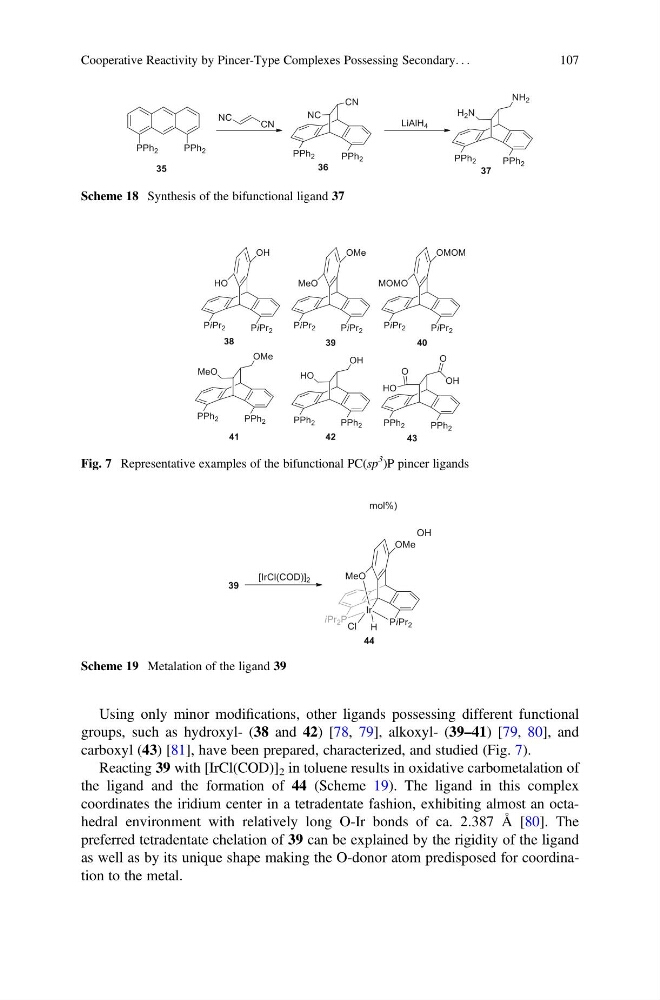
groups, such as hydroxyl- (38 and 42) [78, 79], alkoxyl- (39–41) [79, 80], and
carboxyl (43) [81], have been prepared, characterized, and studied (Fig. 7).
Reacting 39 with [IrCl(COD)] 2 in toluene results in oxidative carbometalation of
the ligand and the formation of 44 (Scheme 19). The ligand in this complex
coordinates the iridium center in a tetradentate fashion, exhibiting almost an octahedral environment with relatively long O-Ir bonds of ca. 2.387 Å [80]. The
preferred tetradentate chelation of 39 can be explained by the rigidity of the ligand
as well as by its unique shape making the O-donor atom predisposed for coordination to the metal.
Scheme 18 Synthesis of the bifunctional ligand 37
Fig. 7 Representative examples of the bifunctional PC(sp
3
)P pincer ligands
mol%)
OH
Scheme 19 Metalation of the ligand 39
Cooperative Reactivity by Pincer-Type Complexes Possessing Secondary. . .
107
groups, such as hydroxyl- (38 and 42) [78, 79], alkoxyl- (39–41) [79, 80], and
carboxyl (43) [81], have been prepared, characterized, and studied (Fig. 7).
Reacting 39 with [IrCl(COD)] 2 in toluene results in oxidative carbometalation of
the ligand and the formation of 44 (Scheme 19). The ligand in this complex
coordinates the iridium center in a tetradentate fashion, exhibiting almost an octahedral environment with relatively long O-Ir bonds of ca. 2.387 Å [80]. The
preferred tetradentate chelation of 39 can be explained by the rigidity of the ligand
as well as by its unique shape making the O-donor atom predisposed for coordination to the metal.
Scheme 18 Synthesis of the bifunctional ligand 37
Fig. 7 Representative examples of the bifunctional PC(sp
3
)P pincer ligands
mol%)
OH
Scheme 19 Metalation of the ligand 39
Cooperative Reactivity by Pincer-Type Complexes Possessing Secondary. . .
107