

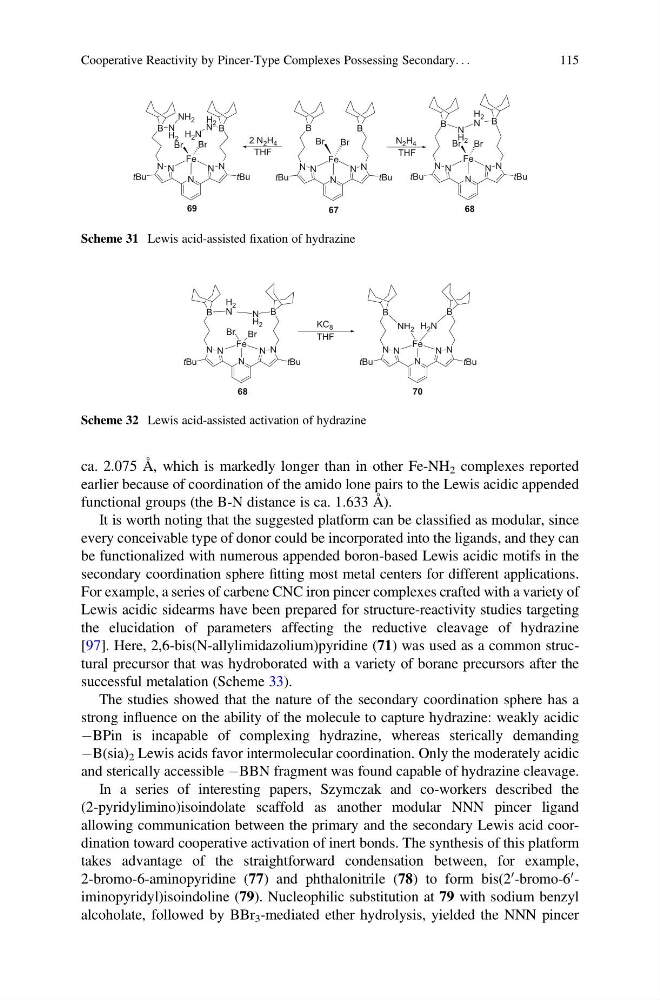
ca. 2.075 Å, which is markedly longer than in other Fe-NH 2 complexes reported
earlier because of coordination of the amido lone pairs to the Lewis acidic appended
functional groups (the B-N distance is ca. 1.633 Å).
It is worth noting that the suggested platform can be classified as modular, since
every conceivable type of donor could be incorporated into the ligands, and they can
be functionalized with numerous appended boron-based Lewis acidic motifs in the
secondary coordination sphere fitting most metal centers for different applications.
For example, a series of carbene CNC iron pincer complexes crafted with a variety of
Lewis acidic sidearms have been prepared for structure-reactivity studies targeting
the elucidation of parameters affecting the reductive cleavage of hydrazine
[97]. Here, 2,6-bis(N-allylimidazolium)pyridine (71) was used as a common structural precursor that was hydroborated with a variety of borane precursors after the
successful metalation (Scheme 33).
The studies showed that the nature of the secondary coordination sphere has a
strong influence on the ability of the molecule to capture hydrazine: weakly acidic
ÀBPin is incapable of complexing hydrazine, whereas sterically demanding
ÀB(sia) 2 Lewis acids favor intermolecular coordination. Only the moderately acidic
and sterically accessible ÀBBN fragment was found capable of hydrazine cleavage.
In a series of interesting papers, Szymczak and co-workers described the
(2-pyridylimino)isoindolate scaffold as another modular NNN pincer ligand
allowing communication between the primary and the secondary Lewis acid coordination toward cooperative activation of inert bonds. The synthesis of this platform
takes advantage of the straightforward condensation between, for example,
2-bromo-6-aminopyridine (77) and phthalonitrile (78) to form bis(2
0 -bromo-6
0 -
iminopyridyl)isoindoline (79). Nucleophilic substitution at 79 with sodium benzyl
alcoholate, followed by BBr 3 -mediated ether hydrolysis, yielded the NNN pincer
N
N
N
N
N
Fe
Br
Br
B
B
N
N
N
N
N
Fe
B
B
Br Br
tBu
tBu
tBu
tBu
N
N
N
N
N
Fe
Br
Br
B
B
N
N
tBu
tBu
NH 2
H 2 N
N
H 2
H 2
N
2 N 2 H 4
THF
N 2 H 4
THF
67
68
69
H 2
H 2
Scheme 31 Lewis acid-assisted fixation of hydrazine
N
N
N
N
N
tBu
tBu
B
B
68
Fe
Br Br
H 2
N
N
H 2
N
N
N
N
N
tBu
tBu
B
B
70
Fe
NH 2 H 2 N
KC 8
THF
Scheme 32 Lewis acid-assisted activation of hydrazine
Cooperative Reactivity by Pincer-Type Complexes Possessing Secondary. . .
115
earlier because of coordination of the amido lone pairs to the Lewis acidic appended
functional groups (the B-N distance is ca. 1.633 Å).
It is worth noting that the suggested platform can be classified as modular, since
every conceivable type of donor could be incorporated into the ligands, and they can
be functionalized with numerous appended boron-based Lewis acidic motifs in the
secondary coordination sphere fitting most metal centers for different applications.
For example, a series of carbene CNC iron pincer complexes crafted with a variety of
Lewis acidic sidearms have been prepared for structure-reactivity studies targeting
the elucidation of parameters affecting the reductive cleavage of hydrazine
[97]. Here, 2,6-bis(N-allylimidazolium)pyridine (71) was used as a common structural precursor that was hydroborated with a variety of borane precursors after the
successful metalation (Scheme 33).
The studies showed that the nature of the secondary coordination sphere has a
strong influence on the ability of the molecule to capture hydrazine: weakly acidic
ÀBPin is incapable of complexing hydrazine, whereas sterically demanding
ÀB(sia) 2 Lewis acids favor intermolecular coordination. Only the moderately acidic
and sterically accessible ÀBBN fragment was found capable of hydrazine cleavage.
In a series of interesting papers, Szymczak and co-workers described the
(2-pyridylimino)isoindolate scaffold as another modular NNN pincer ligand
allowing communication between the primary and the secondary Lewis acid coordination toward cooperative activation of inert bonds. The synthesis of this platform
takes advantage of the straightforward condensation between, for example,
2-bromo-6-aminopyridine (77) and phthalonitrile (78) to form bis(2
0 -bromo-6
0 -
iminopyridyl)isoindoline (79). Nucleophilic substitution at 79 with sodium benzyl
alcoholate, followed by BBr 3 -mediated ether hydrolysis, yielded the NNN pincer
N
N
N
N
N
Fe
Br
Br
B
B
N
N
N
N
N
Fe
B
B
Br Br
tBu
tBu
tBu
tBu
N
N
N
N
N
Fe
Br
Br
B
B
N
N
tBu
tBu
NH 2
H 2 N
N
H 2
H 2
N
2 N 2 H 4
THF
N 2 H 4
THF
67
68
69
H 2
H 2
Scheme 31 Lewis acid-assisted fixation of hydrazine
N
N
N
N
N
tBu
tBu
B
B
68
Fe
Br Br
H 2
N
N
H 2
N
N
N
N
N
tBu
tBu
B
B
70
Fe
NH 2 H 2 N
KC 8
THF
Scheme 32 Lewis acid-assisted activation of hydrazine
Cooperative Reactivity by Pincer-Type Complexes Possessing Secondary. . .
115