

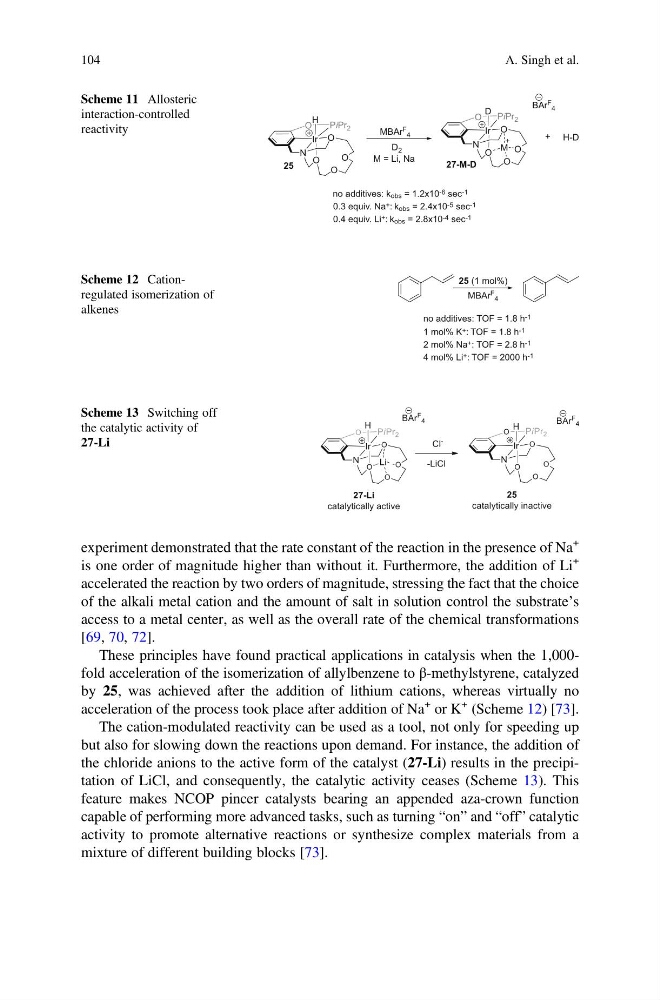
experiment demonstrated that the rate constant of the reaction in the presence of Na
+
is one order of magnitude higher than without it. Furthermore, the addition of Li
+
accelerated the reaction by two orders of magnitude, stressing the fact that the choice
of the alkali metal cation and the amount of salt in solution control the substrate’s
access to a metal center, as well as the overall rate of the chemical transformations
[69, 70, 72].
These principles have found practical applications in catalysis when the 1,000fold acceleration of the isomerization of allylbenzene to β-methylstyrene, catalyzed
by 25, was achieved after the addition of lithium cations, whereas virtually no
acceleration of the process took place after addition of Na
+ or K
+ (Scheme 12) [73].
The cation-modulated reactivity can be used as a tool, not only for speeding up
but also for slowing down the reactions upon demand. For instance, the addition of
the chloride anions to the active form of the catalyst (27-Li) results in the precipitation of LiCl, and consequently, the catalytic activity ceases (Scheme 13). This
feature makes NCOP pincer catalysts bearing an appended aza-crown function
capable of performing more advanced tasks, such as turning “on” and “off” catalytic
activity to promote alternative reactions or synthesize complex materials from a
mixture of different building blocks [73].
O
O
O
O
O
N
PiPr 2
Ir
H
25
MBAr F 4
D 2
+ H-D
O
O
O
O
O
N
PiPr 2
Ir
D
27-M-D
M = Li, Na
M
no additives: kobs = 1.2x10 -6 sec -1
0.3 equiv. Na + : kobs = 2.4x10 -5 sec -1
0.4 equiv. Li + : kobs = 2.8x10 -4 sec -1
BAr F 4
Scheme 11 Allosteric
interaction-controlled
reactivity
no additives: TOF = 1.8 h -1
1 mol% K + : TOF = 1.8 h -1
2 mol% Na + : TOF = 2.8 h -1
4 mol% Li + : TOF = 2000 h -1
25 (1 mol%)
MBAr F
4
Scheme 12 Cationregulated isomerization of
alkenes
Scheme 13 Switching off
the catalytic activity of
27-Li
104
A. Singh et al.
+
is one order of magnitude higher than without it. Furthermore, the addition of Li
+
accelerated the reaction by two orders of magnitude, stressing the fact that the choice
of the alkali metal cation and the amount of salt in solution control the substrate’s
access to a metal center, as well as the overall rate of the chemical transformations
[69, 70, 72].
These principles have found practical applications in catalysis when the 1,000fold acceleration of the isomerization of allylbenzene to β-methylstyrene, catalyzed
by 25, was achieved after the addition of lithium cations, whereas virtually no
acceleration of the process took place after addition of Na
+ or K
+ (Scheme 12) [73].
The cation-modulated reactivity can be used as a tool, not only for speeding up
but also for slowing down the reactions upon demand. For instance, the addition of
the chloride anions to the active form of the catalyst (27-Li) results in the precipitation of LiCl, and consequently, the catalytic activity ceases (Scheme 13). This
feature makes NCOP pincer catalysts bearing an appended aza-crown function
capable of performing more advanced tasks, such as turning “on” and “off” catalytic
activity to promote alternative reactions or synthesize complex materials from a
mixture of different building blocks [73].
O
O
O
O
O
N
PiPr 2
Ir
H
25
MBAr F 4
D 2
+ H-D
O
O
O
O
O
N
PiPr 2
Ir
D
27-M-D
M = Li, Na
M
no additives: kobs = 1.2x10 -6 sec -1
0.3 equiv. Na + : kobs = 2.4x10 -5 sec -1
0.4 equiv. Li + : kobs = 2.8x10 -4 sec -1
BAr F 4
Scheme 11 Allosteric
interaction-controlled
reactivity
no additives: TOF = 1.8 h -1
1 mol% K + : TOF = 1.8 h -1
2 mol% Na + : TOF = 2.8 h -1
4 mol% Li + : TOF = 2000 h -1
25 (1 mol%)
MBAr F
4
Scheme 12 Cationregulated isomerization of
alkenes
Scheme 13 Switching off
the catalytic activity of
27-Li
104
A. Singh et al.