

2.2 C(sp
3
)-Based Pincer Complexes
As was mentioned, the structural simplicity of the planar C(sp
2 )-based pincer
skeleton limits the installation of the appended functionality to the peripheral
donor group. In this context, more complex and three-dimensional aliphatic pincer
complexes provide more flexibility for designing the secondary coordination environment in the vicinity of the metal center. This is especially important in cases of
octahedral and trigonal bipyramidal complexes (Fig. 6).
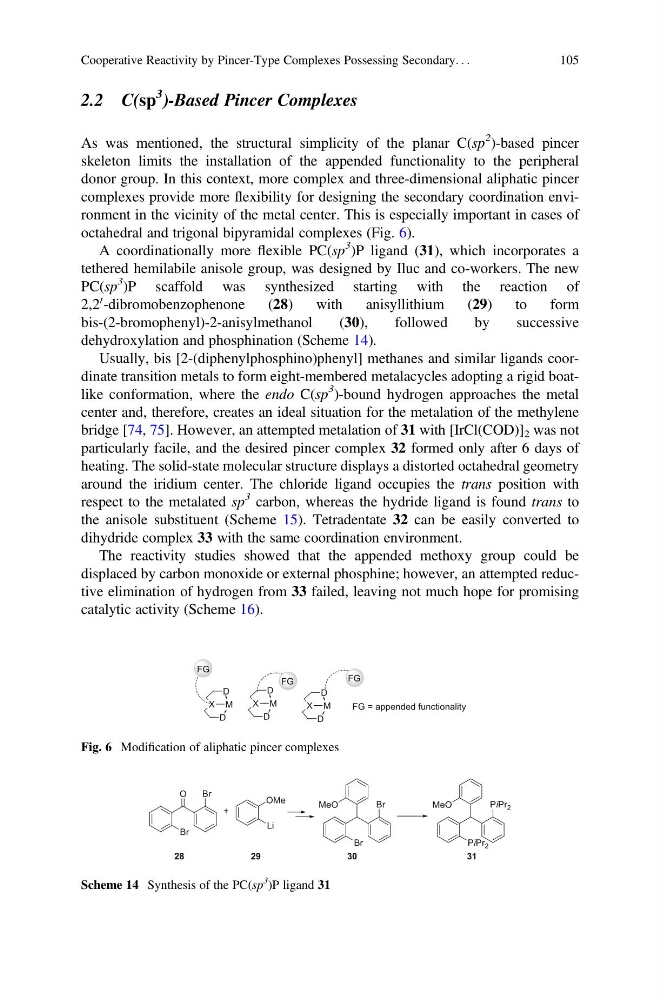
A coordinationally more flexible PC(sp
3 )P ligand (31), which incorporates a
tethered hemilabile anisole group, was designed by Iluc and co-workers. The new
PC(sp
3 )P scaffold was synthesized starting with the reaction of
2,2
0 -dibromobenzophenone
(28)
with
anisyllithium
(29)
to
form
bis-(2-bromophenyl)-2-anisylmethanol
(30),
followed
by
successive
dehydroxylation and phosphination (Scheme 14).
Usually, bis [2-(diphenylphosphino)phenyl] methanes and similar ligands coordinate transition metals to form eight-membered metalacycles adopting a rigid boatlike conformation, where the endo C(sp
3 )-bound hydrogen approaches the metal
center and, therefore, creates an ideal situation for the metalation of the methylene
bridge [74, 75]. However, an attempted metalation of 31 with [IrCl(COD)] 2 was not
particularly facile, and the desired pincer complex 32 formed only after 6 days of
heating. The solid-state molecular structure displays a distorted octahedral geometry
around the iridium center. The chloride ligand occupies the trans position with
respect to the metalated sp
3 carbon, whereas the hydride ligand is found trans to
the anisole substituent (Scheme 15). Tetradentate 32 can be easily converted to
dihydride complex 33 with the same coordination environment.
The reactivity studies showed that the appended methoxy group could be
displaced by carbon monoxide or external phosphine; however, an attempted reductive elimination of hydrogen from 33 failed, leaving not much hope for promising
catalytic activity (Scheme 16).
X
D
D
M
FG = appended functionality
X
D
D
M
X
D
D
M
FG
FG
FG
Fig. 6 Modification of aliphatic pincer complexes
O
Br
OMe
Li
+
Br
Br
Br
MeO
PiPr 2
PiPr 2
MeO
31
28
29
30
Scheme 14 Synthesis of the PC(sp
3
)P ligand 31
Cooperative Reactivity by Pincer-Type Complexes Possessing Secondary. . .
105
3
)-Based Pincer Complexes
As was mentioned, the structural simplicity of the planar C(sp
2 )-based pincer
skeleton limits the installation of the appended functionality to the peripheral
donor group. In this context, more complex and three-dimensional aliphatic pincer
complexes provide more flexibility for designing the secondary coordination environment in the vicinity of the metal center. This is especially important in cases of
octahedral and trigonal bipyramidal complexes (Fig. 6).
A coordinationally more flexible PC(sp
3 )P ligand (31), which incorporates a
tethered hemilabile anisole group, was designed by Iluc and co-workers. The new
PC(sp
3 )P scaffold was synthesized starting with the reaction of
2,2
0 -dibromobenzophenone
(28)
with
anisyllithium
(29)
to
form
bis-(2-bromophenyl)-2-anisylmethanol
(30),
followed
by
successive
dehydroxylation and phosphination (Scheme 14).
Usually, bis [2-(diphenylphosphino)phenyl] methanes and similar ligands coordinate transition metals to form eight-membered metalacycles adopting a rigid boatlike conformation, where the endo C(sp
3 )-bound hydrogen approaches the metal
center and, therefore, creates an ideal situation for the metalation of the methylene
bridge [74, 75]. However, an attempted metalation of 31 with [IrCl(COD)] 2 was not
particularly facile, and the desired pincer complex 32 formed only after 6 days of
heating. The solid-state molecular structure displays a distorted octahedral geometry
around the iridium center. The chloride ligand occupies the trans position with
respect to the metalated sp
3 carbon, whereas the hydride ligand is found trans to
the anisole substituent (Scheme 15). Tetradentate 32 can be easily converted to
dihydride complex 33 with the same coordination environment.
The reactivity studies showed that the appended methoxy group could be
displaced by carbon monoxide or external phosphine; however, an attempted reductive elimination of hydrogen from 33 failed, leaving not much hope for promising
catalytic activity (Scheme 16).
X
D
D
M
FG = appended functionality
X
D
D
M
X
D
D
M
FG
FG
FG
Fig. 6 Modification of aliphatic pincer complexes
O
Br
OMe
Li
+
Br
Br
Br
MeO
PiPr 2
PiPr 2
MeO
31
28
29
30
Scheme 14 Synthesis of the PC(sp
3
)P ligand 31
Cooperative Reactivity by Pincer-Type Complexes Possessing Secondary. . .
105