

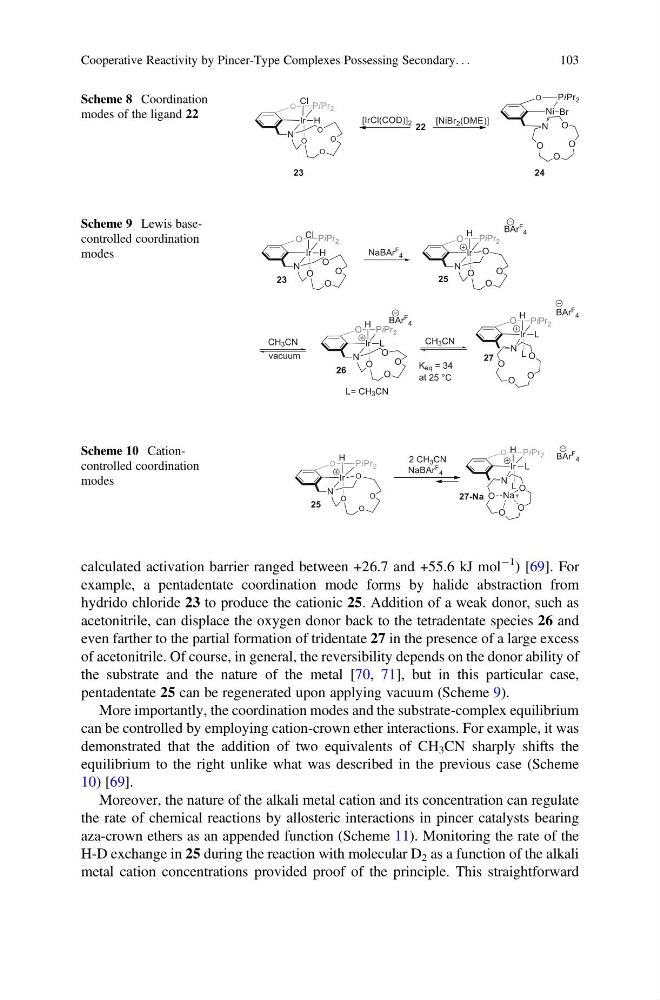
calculated activation barrier ranged between +26.7 and +55.6 kJ mol
À1 ) [69]. For
example, a pentadentate coordination mode forms by halide abstraction from
hydrido chloride 23 to produce the cationic 25. Addition of a weak donor, such as
acetonitrile, can displace the oxygen donor back to the tetradentate species 26 and
even farther to the partial formation of tridentate 27 in the presence of a large excess
of acetonitrile. Of course, in general, the reversibility depends on the donor ability of
the substrate and the nature of the metal [70, 71], but in this particular case,
pentadentate 25 can be regenerated upon applying vacuum (Scheme 9).
More importantly, the coordination modes and the substrate-complex equilibrium
can be controlled by employing cation-crown ether interactions. For example, it was
demonstrated that the addition of two equivalents of CH 3 CN sharply shifts the
equilibrium to the right unlike what was described in the previous case (Scheme
10) [69].
Moreover, the nature of the alkali metal cation and its concentration can regulate
the rate of chemical reactions by allosteric interactions in pincer catalysts bearing
aza-crown ethers as an appended function (Scheme 11). Monitoring the rate of the
H-D exchange in 25 during the reaction with molecular D 2 as a function of the alkali
metal cation concentrations provided proof of the principle. This straightforward
Scheme 8 Coordination
modes of the ligand 22
O
O
O
O
O
N
PiPr 2
Ir
Cl
H
23
NaBAr F
4
O
O
O
O
O
N
PiPr 2
Ir
H
25
CH3CN
O
O
O
O
O
N
PiPr 2
Ir
H
L
26
CH3CN
O
PiPr 2
Ir L
O
O
O
O
N
27
H
L
L= CH3CN
Keq = 34
at 25 °C
vacuum
BAr F 4
BAr F
4
BAr F
4
Scheme 9 Lewis basecontrolled coordination
modes
Scheme 10 Cationcontrolled coordination
modes
Cooperative Reactivity by Pincer-Type Complexes Possessing Secondary. . .
103
À1 ) [69]. For
example, a pentadentate coordination mode forms by halide abstraction from
hydrido chloride 23 to produce the cationic 25. Addition of a weak donor, such as
acetonitrile, can displace the oxygen donor back to the tetradentate species 26 and
even farther to the partial formation of tridentate 27 in the presence of a large excess
of acetonitrile. Of course, in general, the reversibility depends on the donor ability of
the substrate and the nature of the metal [70, 71], but in this particular case,
pentadentate 25 can be regenerated upon applying vacuum (Scheme 9).
More importantly, the coordination modes and the substrate-complex equilibrium
can be controlled by employing cation-crown ether interactions. For example, it was
demonstrated that the addition of two equivalents of CH 3 CN sharply shifts the
equilibrium to the right unlike what was described in the previous case (Scheme
10) [69].
Moreover, the nature of the alkali metal cation and its concentration can regulate
the rate of chemical reactions by allosteric interactions in pincer catalysts bearing
aza-crown ethers as an appended function (Scheme 11). Monitoring the rate of the
H-D exchange in 25 during the reaction with molecular D 2 as a function of the alkali
metal cation concentrations provided proof of the principle. This straightforward
Scheme 8 Coordination
modes of the ligand 22
O
O
O
O
O
N
PiPr 2
Ir
Cl
H
23
NaBAr F
4
O
O
O
O
O
N
PiPr 2
Ir
H
25
CH3CN
O
O
O
O
O
N
PiPr 2
Ir
H
L
26
CH3CN
O
PiPr 2
Ir L
O
O
O
O
N
27
H
L
L= CH3CN
Keq = 34
at 25 °C
vacuum
BAr F 4
BAr F
4
BAr F
4
Scheme 9 Lewis basecontrolled coordination
modes
Scheme 10 Cationcontrolled coordination
modes
Cooperative Reactivity by Pincer-Type Complexes Possessing Secondary. . .
103