

1.1 Genesis
The term “secondary interactions” in the context of transition metal catalysis was
coined by Ito and Sawamura to describe enzyme-like catalyst-substrate interactions
that occur outside the primary coordination sphere of the metal site [53]. At the
outset, secondary interactions have been mentioned in the literature only sporadically and mainly referred to asymmetric synthesis [54–60]; however, more systematic and comprehensive studies, aiming at “teaching” organometallic pincer catalysts
“new tricks,” appeared after Crabtree and Klein Gebbink independently provided the
first landmark examples of the interplay between the primary and secondary coordination spheres leading to a non-classical pincer reactivity.
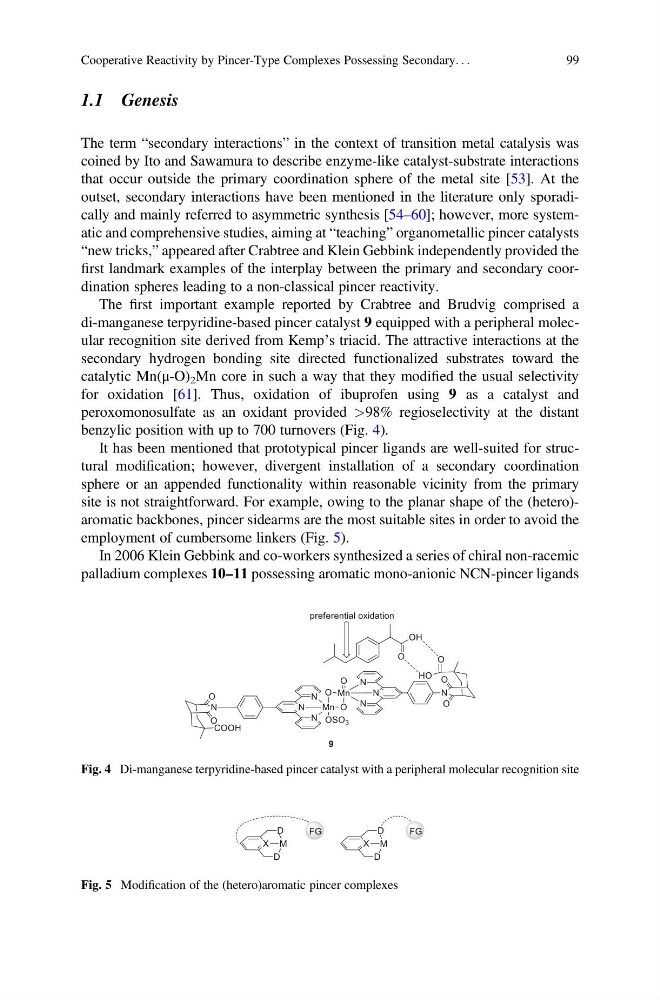
The first important example reported by Crabtree and Brudvig comprised a
di-manganese terpyridine-based pincer catalyst 9 equipped with a peripheral molecular recognition site derived from Kemp’s triacid. The attractive interactions at the
secondary hydrogen bonding site directed functionalized substrates toward the
catalytic Mn(μ-O) 2 Mn core in such a way that they modified the usual selectivity
for oxidation [61]. Thus, oxidation of ibuprofen using 9 as a catalyst and
peroxomonosulfate as an oxidant provided >98% regioselectivity at the distant
benzylic position with up to 700 turnovers (Fig. 4).
It has been mentioned that prototypical pincer ligands are well-suited for structural modification; however, divergent installation of a secondary coordination
sphere or an appended functionality within reasonable vicinity from the primary
site is not straightforward. For example, owing to the planar shape of the (hetero)aromatic backbones, pincer sidearms are the most suitable sites in order to avoid the
employment of cumbersome linkers (Fig. 5).
In 2006 Klein Gebbink and co-workers synthesized a series of chiral non-racemic
palladium complexes 10–11 possessing aromatic mono-anionic NCN-pincer ligands
Fig. 4 Di-manganese terpyridine-based pincer catalyst with a peripheral molecular recognition site
X
D
D
M
X
D
D
M
FG
FG
Fig. 5 Modification of the (hetero)aromatic pincer complexes
Cooperative Reactivity by Pincer-Type Complexes Possessing Secondary. . .
99
The term “secondary interactions” in the context of transition metal catalysis was
coined by Ito and Sawamura to describe enzyme-like catalyst-substrate interactions
that occur outside the primary coordination sphere of the metal site [53]. At the
outset, secondary interactions have been mentioned in the literature only sporadically and mainly referred to asymmetric synthesis [54–60]; however, more systematic and comprehensive studies, aiming at “teaching” organometallic pincer catalysts
“new tricks,” appeared after Crabtree and Klein Gebbink independently provided the
first landmark examples of the interplay between the primary and secondary coordination spheres leading to a non-classical pincer reactivity.
The first important example reported by Crabtree and Brudvig comprised a
di-manganese terpyridine-based pincer catalyst 9 equipped with a peripheral molecular recognition site derived from Kemp’s triacid. The attractive interactions at the
secondary hydrogen bonding site directed functionalized substrates toward the
catalytic Mn(μ-O) 2 Mn core in such a way that they modified the usual selectivity
for oxidation [61]. Thus, oxidation of ibuprofen using 9 as a catalyst and
peroxomonosulfate as an oxidant provided >98% regioselectivity at the distant
benzylic position with up to 700 turnovers (Fig. 4).
It has been mentioned that prototypical pincer ligands are well-suited for structural modification; however, divergent installation of a secondary coordination
sphere or an appended functionality within reasonable vicinity from the primary
site is not straightforward. For example, owing to the planar shape of the (hetero)aromatic backbones, pincer sidearms are the most suitable sites in order to avoid the
employment of cumbersome linkers (Fig. 5).
In 2006 Klein Gebbink and co-workers synthesized a series of chiral non-racemic
palladium complexes 10–11 possessing aromatic mono-anionic NCN-pincer ligands
Fig. 4 Di-manganese terpyridine-based pincer catalyst with a peripheral molecular recognition site
X
D
D
M
X
D
D
M
FG
FG
Fig. 5 Modification of the (hetero)aromatic pincer complexes
Cooperative Reactivity by Pincer-Type Complexes Possessing Secondary. . .
99