

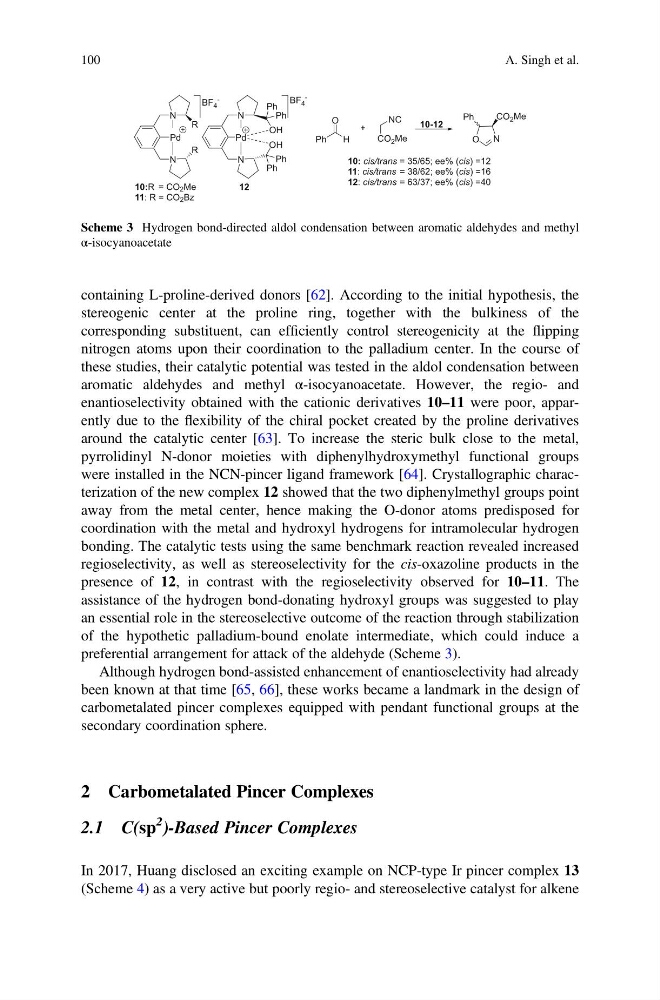
containing L-proline-derived donors [62]. According to the initial hypothesis, the
stereogenic center at the proline ring, together with the bulkiness of the
corresponding substituent, can efficiently control stereogenicity at the flipping
nitrogen atoms upon their coordination to the palladium center. In the course of
these studies, their catalytic potential was tested in the aldol condensation between
aromatic aldehydes and methyl α-isocyanoacetate. However, the regio- and
enantioselectivity obtained with the cationic derivatives 10–11 were poor, apparently due to the flexibility of the chiral pocket created by the proline derivatives
around the catalytic center [63]. To increase the steric bulk close to the metal,
pyrrolidinyl N-donor moieties with diphenylhydroxymethyl functional groups
were installed in the NCN-pincer ligand framework [64]. Crystallographic characterization of the new complex 12 showed that the two diphenylmethyl groups point
away from the metal center, hence making the O-donor atoms predisposed for
coordination with the metal and hydroxyl hydrogens for intramolecular hydrogen
bonding. The catalytic tests using the same benchmark reaction revealed increased
regioselectivity, as well as stereoselectivity for the cis-oxazoline products in the
presence of 12, in contrast with the regioselectivity observed for 10–11. The
assistance of the hydrogen bond-donating hydroxyl groups was suggested to play
an essential role in the stereoselective outcome of the reaction through stabilization
of the hypothetic palladium-bound enolate intermediate, which could induce a
preferential arrangement for attack of the aldehyde (Scheme 3).
Although hydrogen bond-assisted enhancement of enantioselectivity had already
been known at that time [65, 66], these works became a landmark in the design of
carbometalated pincer complexes equipped with pendant functional groups at the
secondary coordination sphere.
2 Carbometalated Pincer Complexes
2.1 C(sp
2
)-Based Pincer Complexes
In 2017, Huang disclosed an exciting example on NCP-type Ir pincer complex 13
(Scheme 4) as a very active but poorly regio- and stereoselective catalyst for alkene
Pd
N
N
R
R
Pd
N
N
10:R = CO2Me
11: R = CO2Bz
OH
OH
Ph
Ph
Ph
Ph
12
Ph
H
O
+
NC
CO 2 Me
O
N
CO 2 Me
Ph
10: cis/trans = 35/65; ee% (cis) =12
11: cis/trans = 38/62; ee% (cis) =16
12: cis/trans = 63/37; ee% (cis) =40
BF 4
-
BF 4
-
10-12
Scheme 3 Hydrogen bond-directed aldol condensation between aromatic aldehydes and methyl
α-isocyanoacetate
100
A. Singh et al.
stereogenic center at the proline ring, together with the bulkiness of the
corresponding substituent, can efficiently control stereogenicity at the flipping
nitrogen atoms upon their coordination to the palladium center. In the course of
these studies, their catalytic potential was tested in the aldol condensation between
aromatic aldehydes and methyl α-isocyanoacetate. However, the regio- and
enantioselectivity obtained with the cationic derivatives 10–11 were poor, apparently due to the flexibility of the chiral pocket created by the proline derivatives
around the catalytic center [63]. To increase the steric bulk close to the metal,
pyrrolidinyl N-donor moieties with diphenylhydroxymethyl functional groups
were installed in the NCN-pincer ligand framework [64]. Crystallographic characterization of the new complex 12 showed that the two diphenylmethyl groups point
away from the metal center, hence making the O-donor atoms predisposed for
coordination with the metal and hydroxyl hydrogens for intramolecular hydrogen
bonding. The catalytic tests using the same benchmark reaction revealed increased
regioselectivity, as well as stereoselectivity for the cis-oxazoline products in the
presence of 12, in contrast with the regioselectivity observed for 10–11. The
assistance of the hydrogen bond-donating hydroxyl groups was suggested to play
an essential role in the stereoselective outcome of the reaction through stabilization
of the hypothetic palladium-bound enolate intermediate, which could induce a
preferential arrangement for attack of the aldehyde (Scheme 3).
Although hydrogen bond-assisted enhancement of enantioselectivity had already
been known at that time [65, 66], these works became a landmark in the design of
carbometalated pincer complexes equipped with pendant functional groups at the
secondary coordination sphere.
2 Carbometalated Pincer Complexes
2.1 C(sp
2
)-Based Pincer Complexes
In 2017, Huang disclosed an exciting example on NCP-type Ir pincer complex 13
(Scheme 4) as a very active but poorly regio- and stereoselective catalyst for alkene
Pd
N
N
R
R
Pd
N
N
10:R = CO2Me
11: R = CO2Bz
OH
OH
Ph
Ph
Ph
Ph
12
Ph
H
O
+
NC
CO 2 Me
O
N
CO 2 Me
Ph
10: cis/trans = 35/65; ee% (cis) =12
11: cis/trans = 38/62; ee% (cis) =16
12: cis/trans = 63/37; ee% (cis) =40
BF 4
-
BF 4
-
10-12
Scheme 3 Hydrogen bond-directed aldol condensation between aromatic aldehydes and methyl
α-isocyanoacetate
100
A. Singh et al.