

C(sp
3 )-carbometalated and α- or β-eliminated species has shown that the pincer
complexes have the ability to accommodate more exotic coordination states, thus
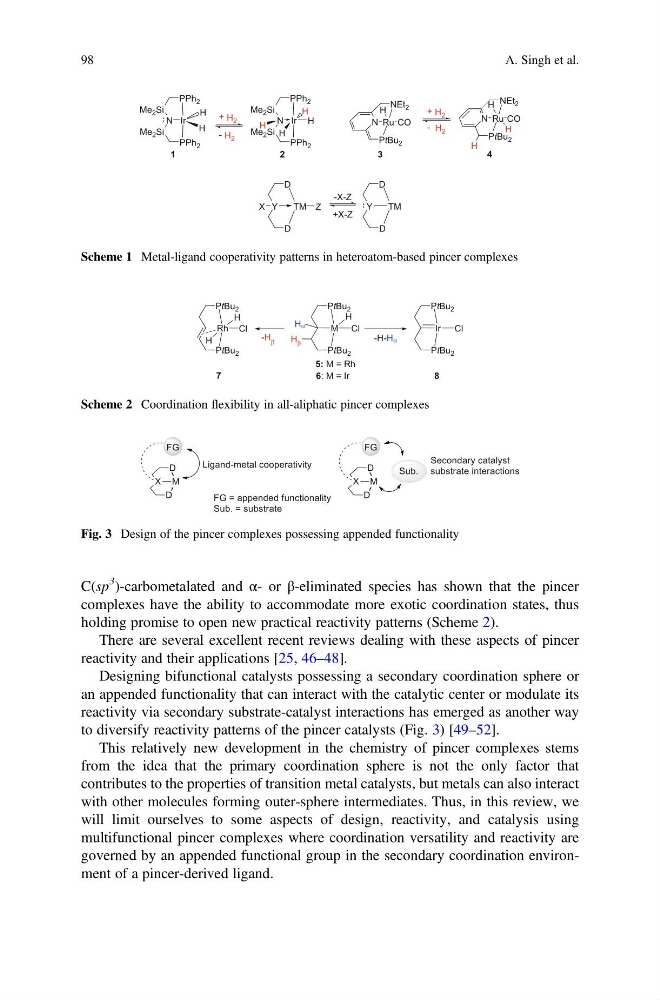
holding promise to open new practical reactivity patterns (Scheme 2).
There are several excellent recent reviews dealing with these aspects of pincer
reactivity and their applications [25, 46–48].
Designing bifunctional catalysts possessing a secondary coordination sphere or
an appended functionality that can interact with the catalytic center or modulate its
reactivity via secondary substrate-catalyst interactions has emerged as another way
to diversify reactivity patterns of the pincer catalysts (Fig. 3) [49–52].
This relatively new development in the chemistry of pincer complexes stems
from the idea that the primary coordination sphere is not the only factor that
contributes to the properties of transition metal catalysts, but metals can also interact
with other molecules forming outer-sphere intermediates. Thus, in this review, we
will limit ourselves to some aspects of design, reactivity, and catalysis using
multifunctional pincer complexes where coordination versatility and reactivity are
governed by an appended functional group in the secondary coordination environment of a pincer-derived ligand.
Me 2 Si
N
Me 2 Si
PPh 2
PPh 2
Ir H
H
H
H
2
Me 2 Si
N
Me 2 Si
PPh 2
PPh 2
Ir H
H
1
- H 2
+ H 2
N
PtBu 2
NEt 2
Ru CO
3
H
N
PtBu 2
NEt 2
Ru CO
4
H
H
H
+ H 2
- H 2
Y
D
D
TM
Y
D
D
TM
X
Z
-X-Z
+X-Z
Scheme 1 Metal-ligand cooperativity patterns in heteroatom-based pincer complexes
PtBu 2
PtBu 2
Hα
M Cl
H
PtBu 2
PtBu 2
Ir
Cl
H β
PtBu 2
PtBu 2
Rh Cl
6: M = Ir
5: M = Rh
7
8
H
H
-H-Hα
-H β
Scheme 2 Coordination flexibility in all-aliphatic pincer complexes
Fig. 3 Design of the pincer complexes possessing appended functionality
98
A. Singh et al.
3 )-carbometalated and α- or β-eliminated species has shown that the pincer
complexes have the ability to accommodate more exotic coordination states, thus
holding promise to open new practical reactivity patterns (Scheme 2).
There are several excellent recent reviews dealing with these aspects of pincer
reactivity and their applications [25, 46–48].
Designing bifunctional catalysts possessing a secondary coordination sphere or
an appended functionality that can interact with the catalytic center or modulate its
reactivity via secondary substrate-catalyst interactions has emerged as another way
to diversify reactivity patterns of the pincer catalysts (Fig. 3) [49–52].
This relatively new development in the chemistry of pincer complexes stems
from the idea that the primary coordination sphere is not the only factor that
contributes to the properties of transition metal catalysts, but metals can also interact
with other molecules forming outer-sphere intermediates. Thus, in this review, we
will limit ourselves to some aspects of design, reactivity, and catalysis using
multifunctional pincer complexes where coordination versatility and reactivity are
governed by an appended functional group in the secondary coordination environment of a pincer-derived ligand.
Me 2 Si
N
Me 2 Si
PPh 2
PPh 2
Ir H
H
H
H
2
Me 2 Si
N
Me 2 Si
PPh 2
PPh 2
Ir H
H
1
- H 2
+ H 2
N
PtBu 2
NEt 2
Ru CO
3
H
N
PtBu 2
NEt 2
Ru CO
4
H
H
H
+ H 2
- H 2
Y
D
D
TM
Y
D
D
TM
X
Z
-X-Z
+X-Z
Scheme 1 Metal-ligand cooperativity patterns in heteroatom-based pincer complexes
PtBu 2
PtBu 2
Hα
M Cl
H
PtBu 2
PtBu 2
Ir
Cl
H β
PtBu 2
PtBu 2
Rh Cl
6: M = Ir
5: M = Rh
7
8
H
H
-H-Hα
-H β
Scheme 2 Coordination flexibility in all-aliphatic pincer complexes
Fig. 3 Design of the pincer complexes possessing appended functionality
98
A. Singh et al.