

formation of the kinetically and thermodynamically stable C-M bond-sharing bicyclic motif (Fig. 1) [15, 16].
A great deal of interest and the subsequent development of pincer ligands were in
(hetero)aromatic complexes. The most common type of pincer platforms comprised
either a central, formally anionic aryl moiety or a neutral heteroaromatic unit – both
donate two electrons to the metal. Direct communication between the metal-centered
d xz orbital and the π orbitals of the (hetero)aromatic backbone, along with the
possibility to fine-tune the electronic properties of the metal site by modulating the
electronic nature of the ring, makes them attractive candidates for practical applications [17–21].
Non-aromatic pincer complexes are far less common and have received only
limited attention compared with their arene-based cousins, mainly due to the lower
availability of the precursors and ligands. On the other hand, the conformational
flexibility of the all-aliphatic frames, along with the presence of labile α- and
β-hydrogen, reduces their stability, compared with the aromatic counterparts [22–
25], although, as typical for all pincer complexes, the η
3 -mer coordination mode is
still translated into carbon-metal and heteroatom-metal bonds that are stable to such
an extent that they can be handled under a non-inert atmosphere, survive exposure to
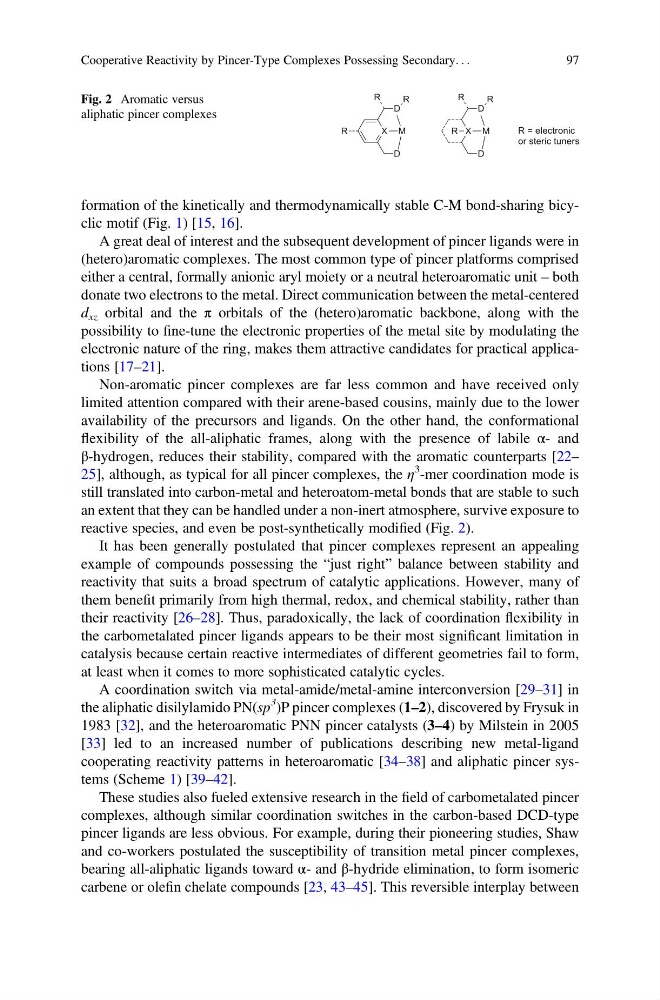
reactive species, and even be post-synthetically modified (Fig. 2).
It has been generally postulated that pincer complexes represent an appealing
example of compounds possessing the “just right” balance between stability and
reactivity that suits a broad spectrum of catalytic applications. However, many of
them benefit primarily from high thermal, redox, and chemical stability, rather than
their reactivity [26–28]. Thus, paradoxically, the lack of coordination flexibility in
the carbometalated pincer ligands appears to be their most significant limitation in
catalysis because certain reactive intermediates of different geometries fail to form,
at least when it comes to more sophisticated catalytic cycles.
A coordination switch via metal-amide/metal-amine interconversion [29–31] in
the aliphatic disilylamido PN(sp
3 )P pincer complexes (1–2), discovered by Frysuk in
1983 [32], and the heteroaromatic PNN pincer catalysts (3–4) by Milstein in 2005
[33] led to an increased number of publications describing new metal-ligand
cooperating reactivity patterns in heteroaromatic [34–38] and aliphatic pincer systems (Scheme 1) [39–42].
These studies also fueled extensive research in the field of carbometalated pincer
complexes, although similar coordination switches in the carbon-based DCD-type
pincer ligands are less obvious. For example, during their pioneering studies, Shaw
and co-workers postulated the susceptibility of transition metal pincer complexes,
bearing all-aliphatic ligands toward α- and β-hydride elimination, to form isomeric
carbene or olefin chelate compounds [23, 43–45]. This reversible interplay between
Fig. 2 Aromatic versus
aliphatic pincer complexes
Cooperative Reactivity by Pincer-Type Complexes Possessing Secondary. . .
97
A great deal of interest and the subsequent development of pincer ligands were in
(hetero)aromatic complexes. The most common type of pincer platforms comprised
either a central, formally anionic aryl moiety or a neutral heteroaromatic unit – both
donate two electrons to the metal. Direct communication between the metal-centered
d xz orbital and the π orbitals of the (hetero)aromatic backbone, along with the
possibility to fine-tune the electronic properties of the metal site by modulating the
electronic nature of the ring, makes them attractive candidates for practical applications [17–21].
Non-aromatic pincer complexes are far less common and have received only
limited attention compared with their arene-based cousins, mainly due to the lower
availability of the precursors and ligands. On the other hand, the conformational
flexibility of the all-aliphatic frames, along with the presence of labile α- and
β-hydrogen, reduces their stability, compared with the aromatic counterparts [22–
25], although, as typical for all pincer complexes, the η
3 -mer coordination mode is
still translated into carbon-metal and heteroatom-metal bonds that are stable to such
an extent that they can be handled under a non-inert atmosphere, survive exposure to
reactive species, and even be post-synthetically modified (Fig. 2).
It has been generally postulated that pincer complexes represent an appealing
example of compounds possessing the “just right” balance between stability and
reactivity that suits a broad spectrum of catalytic applications. However, many of
them benefit primarily from high thermal, redox, and chemical stability, rather than
their reactivity [26–28]. Thus, paradoxically, the lack of coordination flexibility in
the carbometalated pincer ligands appears to be their most significant limitation in
catalysis because certain reactive intermediates of different geometries fail to form,
at least when it comes to more sophisticated catalytic cycles.
A coordination switch via metal-amide/metal-amine interconversion [29–31] in
the aliphatic disilylamido PN(sp
3 )P pincer complexes (1–2), discovered by Frysuk in
1983 [32], and the heteroaromatic PNN pincer catalysts (3–4) by Milstein in 2005
[33] led to an increased number of publications describing new metal-ligand
cooperating reactivity patterns in heteroaromatic [34–38] and aliphatic pincer systems (Scheme 1) [39–42].
These studies also fueled extensive research in the field of carbometalated pincer
complexes, although similar coordination switches in the carbon-based DCD-type
pincer ligands are less obvious. For example, during their pioneering studies, Shaw
and co-workers postulated the susceptibility of transition metal pincer complexes,
bearing all-aliphatic ligands toward α- and β-hydride elimination, to form isomeric
carbene or olefin chelate compounds [23, 43–45]. This reversible interplay between
Fig. 2 Aromatic versus
aliphatic pincer complexes
Cooperative Reactivity by Pincer-Type Complexes Possessing Secondary. . .
97