

ligands and secondary interactions provides excellent opportunities for fine-tuning
the properties of a coordinated metal center and, consequently, attracts considerable
interest.
Keywords Ligand-metal cooperation · Pendant functional group · Pincer
complexes · Secondary interactions
Abbreviations
BAr
F
4
Tetrakis(pentafluorophenyl)borate
B(sia) 2 Diisoamylborane
BBN
9-Borabicyclo[3.3.1]nonyl
BnOH Benzyl alcohol
BPin
4,4,5,5-Tetramethyl-1,2,2-dioxoboryl
COD
1,5-Cyclooctadiene
Cp*
Pentamethylcyclopentadienyl
DME
Dimethoxyethane
FA
Formic acid
KC 8
Potassium graphite
kPa
Kilopascal
MOM
Methoxymethyl
NHC
N-heterocyclic carbenes
RNA
Ribonucleic acid
RT
Room temperature
TOF
Turnover frequency
TON
Turnover number
TS
Transition state
Ts
Toluenesulfonyl
1 Introduction
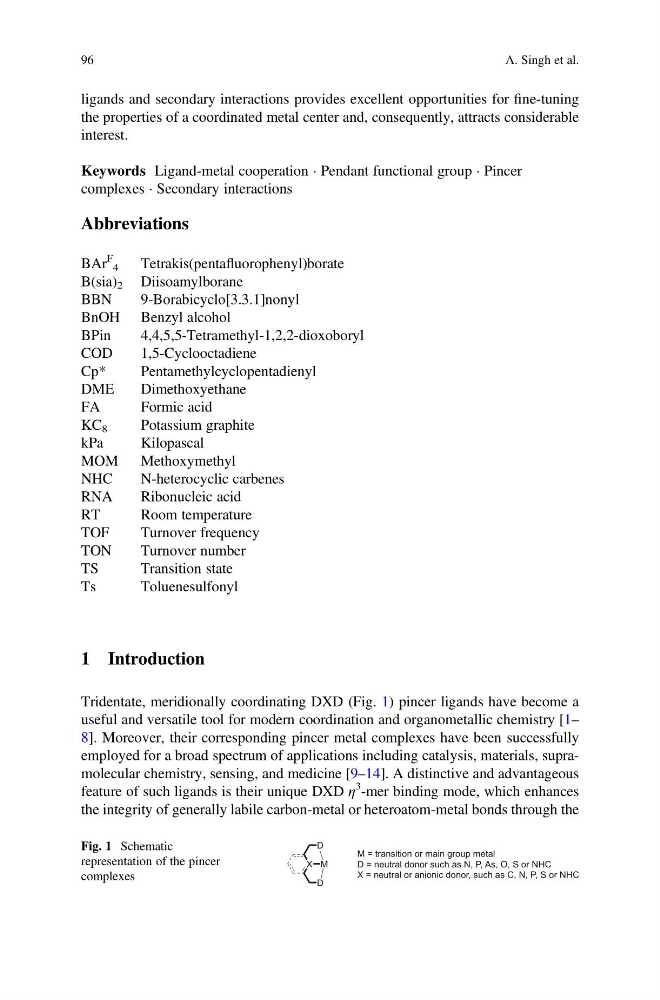
Tridentate, meridionally coordinating DXD (Fig. 1) pincer ligands have become a
useful and versatile tool for modern coordination and organometallic chemistry [1–
8]. Moreover, their corresponding pincer metal complexes have been successfully
employed for a broad spectrum of applications including catalysis, materials, supramolecular chemistry, sensing, and medicine [9–14]. A distinctive and advantageous
feature of such ligands is their unique DXD η
3 -mer binding mode, which enhances
the integrity of generally labile carbon-metal or heteroatom-metal bonds through the
X
D
D
M
M = transition or main group metal
D = neutral donor such as N, P, As, O, S or NHC
X = neutral or anionic donor, such as C, N, P, S or NHC
Fig. 1 Schematic
representation of the pincer
complexes
96
A. Singh et al.
the properties of a coordinated metal center and, consequently, attracts considerable
interest.
Keywords Ligand-metal cooperation · Pendant functional group · Pincer
complexes · Secondary interactions
Abbreviations
BAr
F
4
Tetrakis(pentafluorophenyl)borate
B(sia) 2 Diisoamylborane
BBN
9-Borabicyclo[3.3.1]nonyl
BnOH Benzyl alcohol
BPin
4,4,5,5-Tetramethyl-1,2,2-dioxoboryl
COD
1,5-Cyclooctadiene
Cp*
Pentamethylcyclopentadienyl
DME
Dimethoxyethane
FA
Formic acid
KC 8
Potassium graphite
kPa
Kilopascal
MOM
Methoxymethyl
NHC
N-heterocyclic carbenes
RNA
Ribonucleic acid
RT
Room temperature
TOF
Turnover frequency
TON
Turnover number
TS
Transition state
Ts
Toluenesulfonyl
1 Introduction
Tridentate, meridionally coordinating DXD (Fig. 1) pincer ligands have become a
useful and versatile tool for modern coordination and organometallic chemistry [1–
8]. Moreover, their corresponding pincer metal complexes have been successfully
employed for a broad spectrum of applications including catalysis, materials, supramolecular chemistry, sensing, and medicine [9–14]. A distinctive and advantageous
feature of such ligands is their unique DXD η
3 -mer binding mode, which enhances
the integrity of generally labile carbon-metal or heteroatom-metal bonds through the
X
D
D
M
M = transition or main group metal
D = neutral donor such as N, P, As, O, S or NHC
X = neutral or anionic donor, such as C, N, P, S or NHC
Fig. 1 Schematic
representation of the pincer
complexes
96
A. Singh et al.