

54
4 Responses of Plasma-Facing Surface to Power Load Given by Radiation …
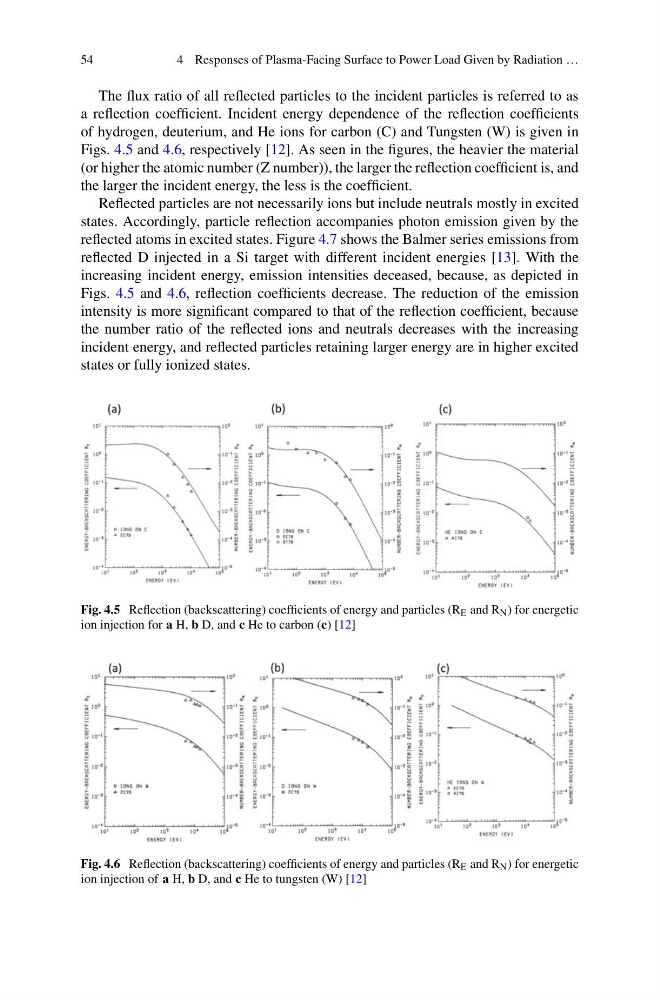
The flux ratio of all reflected particles to the incident particles is referred to as
a reflection coefficient. Incident energy dependence of the reflection coefficients
of hydrogen, deuterium, and He ions for carbon (C) and Tungsten (W) is given in
Figs. 4.5 and 4.6, respectively [12]. As seen in the figures, the heavier the material
(or higher the atomic number (Z number)), the larger the reflection coefficient is, and
the larger the incident energy, the less is the coefficient.
Reflected particles are not necessarily ions but include neutrals mostly in excited
states. Accordingly, particle reflection accompanies photon emission given by the
reflected atoms in excited states. Figure 4.7 shows the Balmer series emissions from
reflected D injected in a Si target with different incident energies [13]. With the
increasing incident energy, emission intensities deceased, because, as depicted in
Figs. 4.5 and 4.6, reflection coefficients decrease. The reduction of the emission
intensity is more significant compared to that of the reflection coefficient, because
the number ratio of the reflected ions and neutrals decreases with the increasing
incident energy, and reflected particles retaining larger energy are in higher excited
states or fully ionized states.
Fig. 4.5 Reflection (backscattering) coefficients of energy and particles (R E and R N ) for energetic
ion injection for a H, b D, and c He to carbon (c) [12]
Fig. 4.6 Reflection (backscattering) coefficients of energy and particles (R E and R N ) for energetic
ion injection of a H, b D, and c He to tungsten (W) [12]
4 Responses of Plasma-Facing Surface to Power Load Given by Radiation …
The flux ratio of all reflected particles to the incident particles is referred to as
a reflection coefficient. Incident energy dependence of the reflection coefficients
of hydrogen, deuterium, and He ions for carbon (C) and Tungsten (W) is given in
Figs. 4.5 and 4.6, respectively [12]. As seen in the figures, the heavier the material
(or higher the atomic number (Z number)), the larger the reflection coefficient is, and
the larger the incident energy, the less is the coefficient.
Reflected particles are not necessarily ions but include neutrals mostly in excited
states. Accordingly, particle reflection accompanies photon emission given by the
reflected atoms in excited states. Figure 4.7 shows the Balmer series emissions from
reflected D injected in a Si target with different incident energies [13]. With the
increasing incident energy, emission intensities deceased, because, as depicted in
Figs. 4.5 and 4.6, reflection coefficients decrease. The reduction of the emission
intensity is more significant compared to that of the reflection coefficient, because
the number ratio of the reflected ions and neutrals decreases with the increasing
incident energy, and reflected particles retaining larger energy are in higher excited
states or fully ionized states.
Fig. 4.5 Reflection (backscattering) coefficients of energy and particles (R E and R N ) for energetic
ion injection for a H, b D, and c He to carbon (c) [12]
Fig. 4.6 Reflection (backscattering) coefficients of energy and particles (R E and R N ) for energetic
ion injection of a H, b D, and c He to tungsten (W) [12]