

4.3 Emission of Ions and Neutrals
53
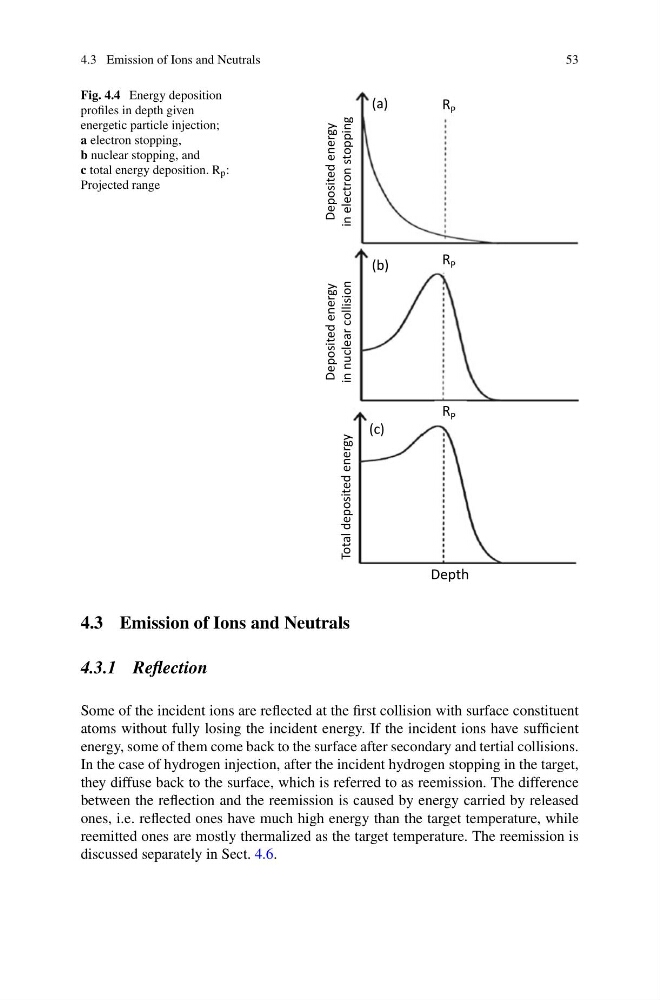
Fig. 4.4 Energy deposition
profiles in depth given
energetic particle injection;
a electron stopping,
b nuclear stopping, and
c total energy deposition. R p :
Projected range
(a)
Deposited energy
in electron stopping
R P
(b)
R P
Deposited energy
in nuclear collision
Total deposited energy
(c)
R P
Depth
4.3 Emission of Ions and Neutrals
4.3.1 Reflection
Some of the incident ions are reflected at the first collision with surface constituent
atoms without fully losing the incident energy. If the incident ions have sufficient
energy, some of them come back to the surface after secondary and tertial collisions.
In the case of hydrogen injection, after the incident hydrogen stopping in the target,
they diffuse back to the surface, which is referred to as reemission. The difference
between the reflection and the reemission is caused by energy carried by released
ones, i.e. reflected ones have much high energy than the target temperature, while
reemitted ones are mostly thermalized as the target temperature. The reemission is
discussed separately in Sect. 4.6.
53
Fig. 4.4 Energy deposition
profiles in depth given
energetic particle injection;
a electron stopping,
b nuclear stopping, and
c total energy deposition. R p :
Projected range
(a)
Deposited energy
in electron stopping
R P
(b)
R P
Deposited energy
in nuclear collision
Total deposited energy
(c)
R P
Depth
4.3 Emission of Ions and Neutrals
4.3.1 Reflection
Some of the incident ions are reflected at the first collision with surface constituent
atoms without fully losing the incident energy. If the incident ions have sufficient
energy, some of them come back to the surface after secondary and tertial collisions.
In the case of hydrogen injection, after the incident hydrogen stopping in the target,
they diffuse back to the surface, which is referred to as reemission. The difference
between the reflection and the reemission is caused by energy carried by released
ones, i.e. reflected ones have much high energy than the target temperature, while
reemitted ones are mostly thermalized as the target temperature. The reemission is
discussed separately in Sect. 4.6.