

4.3 Emission of Ions and Neutrals
55
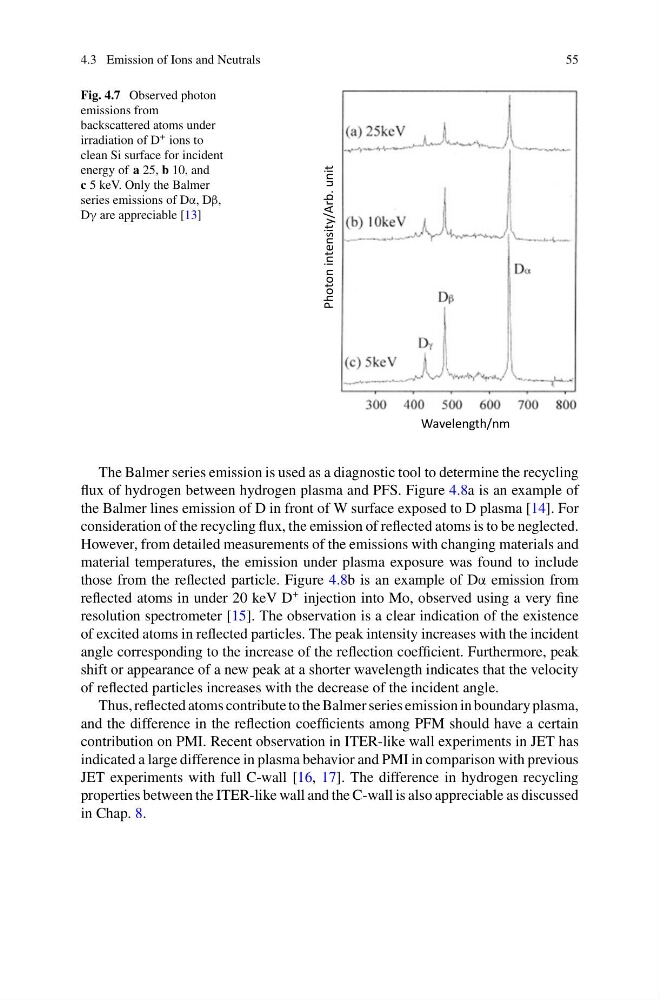
Fig. 4.7 Observed photon
emissions from
backscattered atoms under
irradiation of D + ions to
clean Si surface for incident
energy of a 25, b 10, and
c 5 keV. Only the Balmer
series emissions of Dα, Dβ,
Dγ are appreciable [13]
Wavelength/nm
Photon intensity/Arb. unit
The Balmer series emission is used as a diagnostic tool to determine the recycling
flux of hydrogen between hydrogen plasma and PFS. Figure 4.8a is an example of
the Balmer lines emission of D in front of W surface exposed to D plasma [14]. For
consideration of the recycling flux, the emission of reflected atoms is to be neglected.
However, from detailed measurements of the emissions with changing materials and
material temperatures, the emission under plasma exposure was found to include
those from the reflected particle. Figure 4.8b is an example of Dα emission from
reflected atoms in under 20 keV D
+ injection into Mo, observed using a very fine
resolution spectrometer [15]. The observation is a clear indication of the existence
of excited atoms in reflected particles. The peak intensity increases with the incident
angle corresponding to the increase of the reflection coefficient. Furthermore, peak
shift or appearance of a new peak at a shorter wavelength indicates that the velocity
of reflected particles increases with the decrease of the incident angle.
Thus, reflected atoms contribute to the Balmer series emission in boundary plasma,
and the difference in the reflection coefficients among PFM should have a certain
contribution on PMI. Recent observation in ITER-like wall experiments in JET has
indicated a large difference in plasma behavior and PMI in comparison with previous
JET experiments with full C-wall [16, 17]. The difference in hydrogen recycling
properties between the ITER-like wall and the C-wall is also appreciable as discussed
in Chap. 8.
55
Fig. 4.7 Observed photon
emissions from
backscattered atoms under
irradiation of D + ions to
clean Si surface for incident
energy of a 25, b 10, and
c 5 keV. Only the Balmer
series emissions of Dα, Dβ,
Dγ are appreciable [13]
Wavelength/nm
Photon intensity/Arb. unit
The Balmer series emission is used as a diagnostic tool to determine the recycling
flux of hydrogen between hydrogen plasma and PFS. Figure 4.8a is an example of
the Balmer lines emission of D in front of W surface exposed to D plasma [14]. For
consideration of the recycling flux, the emission of reflected atoms is to be neglected.
However, from detailed measurements of the emissions with changing materials and
material temperatures, the emission under plasma exposure was found to include
those from the reflected particle. Figure 4.8b is an example of Dα emission from
reflected atoms in under 20 keV D
+ injection into Mo, observed using a very fine
resolution spectrometer [15]. The observation is a clear indication of the existence
of excited atoms in reflected particles. The peak intensity increases with the incident
angle corresponding to the increase of the reflection coefficient. Furthermore, peak
shift or appearance of a new peak at a shorter wavelength indicates that the velocity
of reflected particles increases with the decrease of the incident angle.
Thus, reflected atoms contribute to the Balmer series emission in boundary plasma,
and the difference in the reflection coefficients among PFM should have a certain
contribution on PMI. Recent observation in ITER-like wall experiments in JET has
indicated a large difference in plasma behavior and PMI in comparison with previous
JET experiments with full C-wall [16, 17]. The difference in hydrogen recycling
properties between the ITER-like wall and the C-wall is also appreciable as discussed
in Chap. 8.