

2.4 PMI Observed by Proves and Limiter Experiments
31
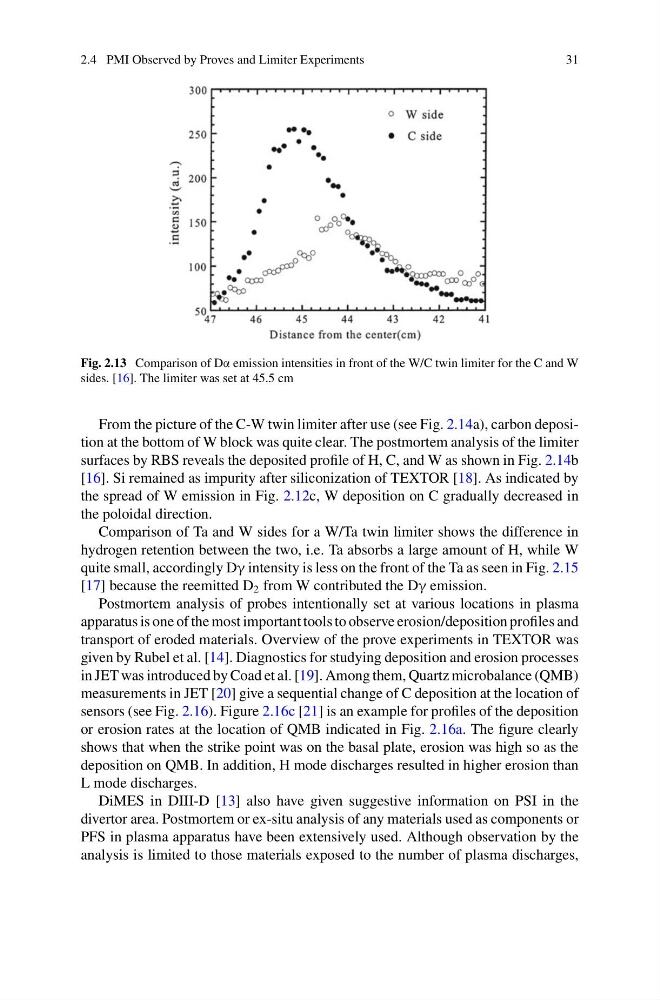
Fig. 2.13 Comparison of Dα emission intensities in front of the W/C twin limiter for the C and W
sides. [16]. The limiter was set at 45.5 cm
From the picture of the C-W twin limiter after use (see Fig. 2.14a), carbon deposition at the bottom of W block was quite clear. The postmortem analysis of the limiter
surfaces by RBS reveals the deposited profile of H, C, and W as shown in Fig. 2.14b
[16]. Si remained as impurity after siliconization of TEXTOR [18]. As indicated by
the spread of W emission in Fig. 2.12c, W deposition on C gradually decreased in
the poloidal direction.
Comparison of Ta and W sides for a W/Ta twin limiter shows the difference in
hydrogen retention between the two, i.e. Ta absorbs a large amount of H, while W
quite small, accordingly Dγ intensity is less on the front of the Ta as seen in Fig. 2.15
[17] because the reemitted D 2 from W contributed the Dγ emission.
Postmortem analysis of probes intentionally set at various locations in plasma
apparatus is one of the most important tools to observe erosion/deposition profiles and
transport of eroded materials. Overview of the prove experiments in TEXTOR was
given by Rubel et al. [14]. Diagnostics for studying deposition and erosion processes
in JET was introduced by Coad et al. [19]. Among them, Quartz microbalance (QMB)
measurements in JET [20] give a sequential change of C deposition at the location of
sensors (see Fig. 2.16). Figure 2.16c [21] is an example for profiles of the deposition
or erosion rates at the location of QMB indicated in Fig. 2.16a. The figure clearly
shows that when the strike point was on the basal plate, erosion was high so as the
deposition on QMB. In addition, H mode discharges resulted in higher erosion than
L mode discharges.
DiMES in DIII-D [13] also have given suggestive information on PSI in the
divertor area. Postmortem or ex-situ analysis of any materials used as components or
PFS in plasma apparatus have been extensively used. Although observation by the
analysis is limited to those materials exposed to the number of plasma discharges,
31
Fig. 2.13 Comparison of Dα emission intensities in front of the W/C twin limiter for the C and W
sides. [16]. The limiter was set at 45.5 cm
From the picture of the C-W twin limiter after use (see Fig. 2.14a), carbon deposition at the bottom of W block was quite clear. The postmortem analysis of the limiter
surfaces by RBS reveals the deposited profile of H, C, and W as shown in Fig. 2.14b
[16]. Si remained as impurity after siliconization of TEXTOR [18]. As indicated by
the spread of W emission in Fig. 2.12c, W deposition on C gradually decreased in
the poloidal direction.
Comparison of Ta and W sides for a W/Ta twin limiter shows the difference in
hydrogen retention between the two, i.e. Ta absorbs a large amount of H, while W
quite small, accordingly Dγ intensity is less on the front of the Ta as seen in Fig. 2.15
[17] because the reemitted D 2 from W contributed the Dγ emission.
Postmortem analysis of probes intentionally set at various locations in plasma
apparatus is one of the most important tools to observe erosion/deposition profiles and
transport of eroded materials. Overview of the prove experiments in TEXTOR was
given by Rubel et al. [14]. Diagnostics for studying deposition and erosion processes
in JET was introduced by Coad et al. [19]. Among them, Quartz microbalance (QMB)
measurements in JET [20] give a sequential change of C deposition at the location of
sensors (see Fig. 2.16). Figure 2.16c [21] is an example for profiles of the deposition
or erosion rates at the location of QMB indicated in Fig. 2.16a. The figure clearly
shows that when the strike point was on the basal plate, erosion was high so as the
deposition on QMB. In addition, H mode discharges resulted in higher erosion than
L mode discharges.
DiMES in DIII-D [13] also have given suggestive information on PSI in the
divertor area. Postmortem or ex-situ analysis of any materials used as components or
PFS in plasma apparatus have been extensively used. Although observation by the
analysis is limited to those materials exposed to the number of plasma discharges,