

30
2 Discharges in Current Large Tokamaks
(a)
Thermograph
2-D line spectrum image
ALT-II graphite
Belt limiter
S = 3 x 10 4 cm2
r L = 46 cm
Test limiter
S = 60 cm 2
r L =44 -60 cm
2D line spectra image
(b)
(c)
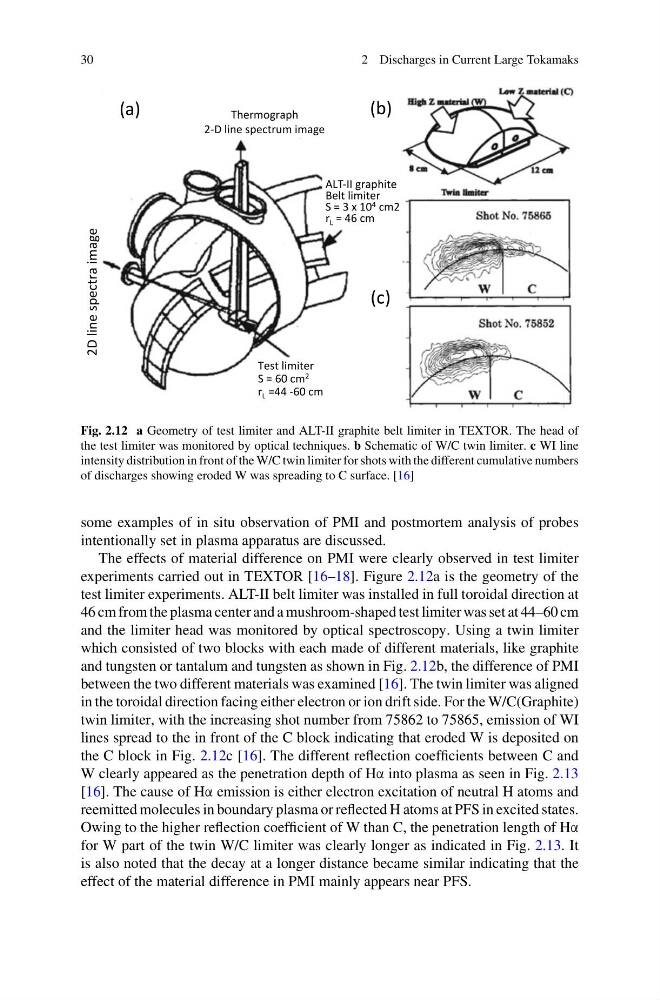
Fig. 2.12 a Geometry of test limiter and ALT-II graphite belt limiter in TEXTOR. The head of
the test limiter was monitored by optical techniques. b Schematic of W/C twin limiter. c WI line
intensity distribution in front of the W/C twin limiter for shots with the different cumulative numbers
of discharges showing eroded W was spreading to C surface. [16]
some examples of in situ observation of PMI and postmortem analysis of probes
intentionally set in plasma apparatus are discussed.
The effects of material difference on PMI were clearly observed in test limiter
experiments carried out in TEXTOR [16–18]. Figure 2.12a is the geometry of the
test limiter experiments. ALT-II belt limiter was installed in full toroidal direction at
46 cm from the plasma center and a mushroom-shaped test limiter was set at 44–60 cm
and the limiter head was monitored by optical spectroscopy. Using a twin limiter
which consisted of two blocks with each made of different materials, like graphite
and tungsten or tantalum and tungsten as shown in Fig. 2.12b, the difference of PMI
between the two different materials was examined [16]. The twin limiter was aligned
in the toroidal direction facing either electron or ion drift side. For the W/C(Graphite)
twin limiter, with the increasing shot number from 75862 to 75865, emission of WI
lines spread to the in front of the C block indicating that eroded W is deposited on
the C block in Fig. 2.12c [16]. The different reflection coefficients between C and
W clearly appeared as the penetration depth of Hα into plasma as seen in Fig. 2.13
[16]. The cause of Hα emission is either electron excitation of neutral H atoms and
reemitted molecules in boundary plasma or reflected H atoms at PFS in excited states.
Owing to the higher reflection coefficient of W than C, the penetration length of Hα
for W part of the twin W/C limiter was clearly longer as indicated in Fig. 2.13. It
is also noted that the decay at a longer distance became similar indicating that the
effect of the material difference in PMI mainly appears near PFS.
2 Discharges in Current Large Tokamaks
(a)
Thermograph
2-D line spectrum image
ALT-II graphite
Belt limiter
S = 3 x 10 4 cm2
r L = 46 cm
Test limiter
S = 60 cm 2
r L =44 -60 cm
2D line spectra image
(b)
(c)
Fig. 2.12 a Geometry of test limiter and ALT-II graphite belt limiter in TEXTOR. The head of
the test limiter was monitored by optical techniques. b Schematic of W/C twin limiter. c WI line
intensity distribution in front of the W/C twin limiter for shots with the different cumulative numbers
of discharges showing eroded W was spreading to C surface. [16]
some examples of in situ observation of PMI and postmortem analysis of probes
intentionally set in plasma apparatus are discussed.
The effects of material difference on PMI were clearly observed in test limiter
experiments carried out in TEXTOR [16–18]. Figure 2.12a is the geometry of the
test limiter experiments. ALT-II belt limiter was installed in full toroidal direction at
46 cm from the plasma center and a mushroom-shaped test limiter was set at 44–60 cm
and the limiter head was monitored by optical spectroscopy. Using a twin limiter
which consisted of two blocks with each made of different materials, like graphite
and tungsten or tantalum and tungsten as shown in Fig. 2.12b, the difference of PMI
between the two different materials was examined [16]. The twin limiter was aligned
in the toroidal direction facing either electron or ion drift side. For the W/C(Graphite)
twin limiter, with the increasing shot number from 75862 to 75865, emission of WI
lines spread to the in front of the C block indicating that eroded W is deposited on
the C block in Fig. 2.12c [16]. The different reflection coefficients between C and
W clearly appeared as the penetration depth of Hα into plasma as seen in Fig. 2.13
[16]. The cause of Hα emission is either electron excitation of neutral H atoms and
reemitted molecules in boundary plasma or reflected H atoms at PFS in excited states.
Owing to the higher reflection coefficient of W than C, the penetration length of Hα
for W part of the twin W/C limiter was clearly longer as indicated in Fig. 2.13. It
is also noted that the decay at a longer distance became similar indicating that the
effect of the material difference in PMI mainly appears near PFS.