

2.3 Diagnostics for PMI Research
23
JT-60U
(a)
(b)
(c)
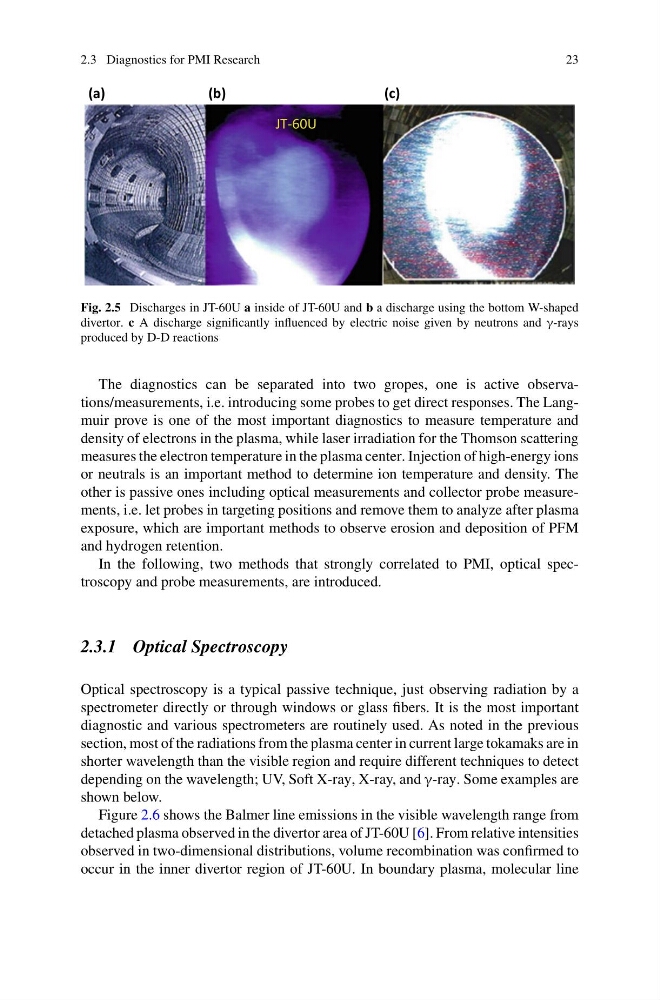
Fig. 2.5 Discharges in JT-60U a inside of JT-60U and b a discharge using the bottom W-shaped
divertor. c A discharge significantly influenced by electric noise given by neutrons and γ-rays
produced by D-D reactions
The diagnostics can be separated into two gropes, one is active observations/measurements, i.e. introducing some probes to get direct responses. The Langmuir prove is one of the most important diagnostics to measure temperature and
density of electrons in the plasma, while laser irradiation for the Thomson scattering
measures the electron temperature in the plasma center. Injection of high-energy ions
or neutrals is an important method to determine ion temperature and density. The
other is passive ones including optical measurements and collector probe measurements, i.e. let probes in targeting positions and remove them to analyze after plasma
exposure, which are important methods to observe erosion and deposition of PFM
and hydrogen retention.
In the following, two methods that strongly correlated to PMI, optical spectroscopy and probe measurements, are introduced.
2.3.1 Optical Spectroscopy
Optical spectroscopy is a typical passive technique, just observing radiation by a
spectrometer directly or through windows or glass fibers. It is the most important
diagnostic and various spectrometers are routinely used. As noted in the previous
section, most of the radiations from the plasma center in current large tokamaks are in
shorter wavelength than the visible region and require different techniques to detect
depending on the wavelength; UV, Soft X-ray, X-ray, and γ-ray. Some examples are
shown below.
Figure 2.6 shows the Balmer line emissions in the visible wavelength range from
detached plasma observed in the divertor area of JT-60U [6]. From relative intensities
observed in two-dimensional distributions, volume recombination was confirmed to
occur in the inner divertor region of JT-60U. In boundary plasma, molecular line
23
JT-60U
(a)
(b)
(c)
Fig. 2.5 Discharges in JT-60U a inside of JT-60U and b a discharge using the bottom W-shaped
divertor. c A discharge significantly influenced by electric noise given by neutrons and γ-rays
produced by D-D reactions
The diagnostics can be separated into two gropes, one is active observations/measurements, i.e. introducing some probes to get direct responses. The Langmuir prove is one of the most important diagnostics to measure temperature and
density of electrons in the plasma, while laser irradiation for the Thomson scattering
measures the electron temperature in the plasma center. Injection of high-energy ions
or neutrals is an important method to determine ion temperature and density. The
other is passive ones including optical measurements and collector probe measurements, i.e. let probes in targeting positions and remove them to analyze after plasma
exposure, which are important methods to observe erosion and deposition of PFM
and hydrogen retention.
In the following, two methods that strongly correlated to PMI, optical spectroscopy and probe measurements, are introduced.
2.3.1 Optical Spectroscopy
Optical spectroscopy is a typical passive technique, just observing radiation by a
spectrometer directly or through windows or glass fibers. It is the most important
diagnostic and various spectrometers are routinely used. As noted in the previous
section, most of the radiations from the plasma center in current large tokamaks are in
shorter wavelength than the visible region and require different techniques to detect
depending on the wavelength; UV, Soft X-ray, X-ray, and γ-ray. Some examples are
shown below.
Figure 2.6 shows the Balmer line emissions in the visible wavelength range from
detached plasma observed in the divertor area of JT-60U [6]. From relative intensities
observed in two-dimensional distributions, volume recombination was confirmed to
occur in the inner divertor region of JT-60U. In boundary plasma, molecular line