

24
2 Discharges in Current Large Tokamaks
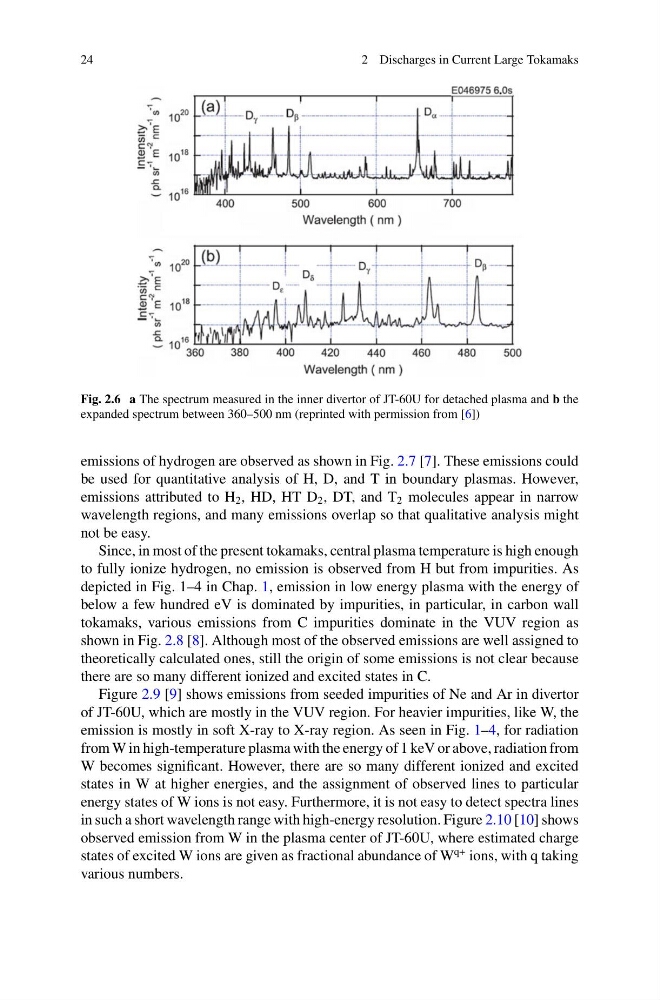
Fig. 2.6 a The spectrum measured in the inner divertor of JT-60U for detached plasma and b the
expanded spectrum between 360–500 nm (reprinted with permission from [6])
emissions of hydrogen are observed as shown in Fig. 2.7 [7]. These emissions could
be used for quantitative analysis of H, D, and T in boundary plasmas. However,
emissions attributed to H 2 , HD, HT D 2 , DT, and T 2 molecules appear in narrow
wavelength regions, and many emissions overlap so that qualitative analysis might
not be easy.
Since, in most of the present tokamaks, central plasma temperature is high enough
to fully ionize hydrogen, no emission is observed from H but from impurities. As
depicted in Fig. 1–4 in Chap. 1, emission in low energy plasma with the energy of
below a few hundred eV is dominated by impurities, in particular, in carbon wall
tokamaks, various emissions from C impurities dominate in the VUV region as
shown in Fig. 2.8 [8]. Although most of the observed emissions are well assigned to
theoretically calculated ones, still the origin of some emissions is not clear because
there are so many different ionized and excited states in C.
Figure 2.9 [9] shows emissions from seeded impurities of Ne and Ar in divertor
of JT-60U, which are mostly in the VUV region. For heavier impurities, like W, the
emission is mostly in soft X-ray to X-ray region. As seen in Fig. 1–4, for radiation
from W in high-temperature plasma with the energy of 1 keV or above, radiation from
W becomes significant. However, there are so many different ionized and excited
states in W at higher energies, and the assignment of observed lines to particular
energy states of W ions is not easy. Furthermore, it is not easy to detect spectra lines
in such a short wavelength range with high-energy resolution. Figure 2.10 [10] shows
observed emission from W in the plasma center of JT-60U, where estimated charge
states of excited W ions are given as fractional abundance of W
q+ ions, with q taking
various numbers.
2 Discharges in Current Large Tokamaks
Fig. 2.6 a The spectrum measured in the inner divertor of JT-60U for detached plasma and b the
expanded spectrum between 360–500 nm (reprinted with permission from [6])
emissions of hydrogen are observed as shown in Fig. 2.7 [7]. These emissions could
be used for quantitative analysis of H, D, and T in boundary plasmas. However,
emissions attributed to H 2 , HD, HT D 2 , DT, and T 2 molecules appear in narrow
wavelength regions, and many emissions overlap so that qualitative analysis might
not be easy.
Since, in most of the present tokamaks, central plasma temperature is high enough
to fully ionize hydrogen, no emission is observed from H but from impurities. As
depicted in Fig. 1–4 in Chap. 1, emission in low energy plasma with the energy of
below a few hundred eV is dominated by impurities, in particular, in carbon wall
tokamaks, various emissions from C impurities dominate in the VUV region as
shown in Fig. 2.8 [8]. Although most of the observed emissions are well assigned to
theoretically calculated ones, still the origin of some emissions is not clear because
there are so many different ionized and excited states in C.
Figure 2.9 [9] shows emissions from seeded impurities of Ne and Ar in divertor
of JT-60U, which are mostly in the VUV region. For heavier impurities, like W, the
emission is mostly in soft X-ray to X-ray region. As seen in Fig. 1–4, for radiation
from W in high-temperature plasma with the energy of 1 keV or above, radiation from
W becomes significant. However, there are so many different ionized and excited
states in W at higher energies, and the assignment of observed lines to particular
energy states of W ions is not easy. Furthermore, it is not easy to detect spectra lines
in such a short wavelength range with high-energy resolution. Figure 2.10 [10] shows
observed emission from W in the plasma center of JT-60U, where estimated charge
states of excited W ions are given as fractional abundance of W
q+ ions, with q taking
various numbers.