

168
9 Fuel Retention in a Rector with Full …
Carbon tile
Deposited layers
2 Eroded area
1
Eroded area
First wall
Divertor
10
23
10
24
10
25
10
26
10
2
10
3
10
4
10
5
10
6
10
7
1 Eroded area
First wall
Fuel retention [(H+D) atoms]
Time [sec]
1 Deposited layers
on plasma facing
surfaces
2 Deposited layers on
on plasma shadowed
areas
Total retention
Bulk retention
2 Eroded area
Divertor
Energetic
particles
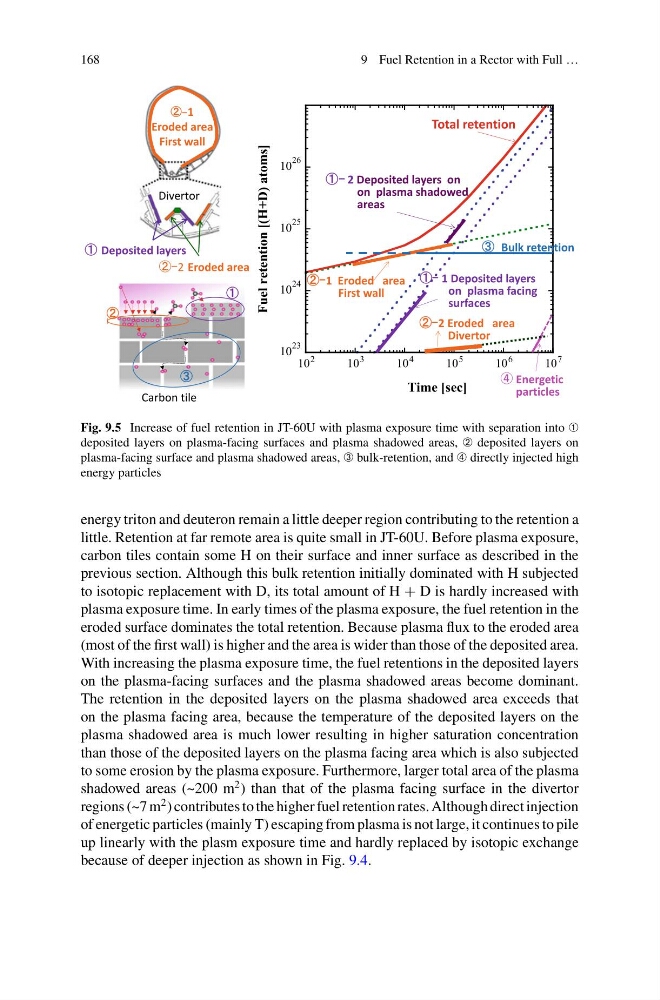
Fig. 9.5 Increase of fuel retention in JT-60U with plasma exposure time with separation into ➀
deposited layers on plasma-facing surfaces and plasma shadowed areas, ➁ deposited layers on
plasma-facing surface and plasma shadowed areas, ➂ bulk-retention, and ➃ directly injected high
energy particles
energy triton and deuteron remain a little deeper region contributing to the retention a
little. Retention at far remote area is quite small in JT-60U. Before plasma exposure,
carbon tiles contain some H on their surface and inner surface as described in the
previous section. Although this bulk retention initially dominated with H subjected
to isotopic replacement with D, its total amount of H + D is hardly increased with
plasma exposure time. In early times of the plasma exposure, the fuel retention in the
eroded surface dominates the total retention. Because plasma flux to the eroded area
(most of the first wall) is higher and the area is wider than those of the deposited area.
With increasing the plasma exposure time, the fuel retentions in the deposited layers
on the plasma-facing surfaces and the plasma shadowed areas become dominant.
The retention in the deposited layers on the plasma shadowed area exceeds that
on the plasma facing area, because the temperature of the deposited layers on the
plasma shadowed area is much lower resulting in higher saturation concentration
than those of the deposited layers on the plasma facing area which is also subjected
to some erosion by the plasma exposure. Furthermore, larger total area of the plasma
shadowed areas (~200 m
2 ) than that of the plasma facing surface in the divertor
regions (~7 m
2 ) contributes to the higher fuel retention rates. Although direct injection
of energetic particles (mainly T) escaping from plasma is not large, it continues to pile
up linearly with the plasm exposure time and hardly replaced by isotopic exchange
because of deeper injection as shown in Fig. 9.4.
9 Fuel Retention in a Rector with Full …
Carbon tile
Deposited layers
2 Eroded area
1
Eroded area
First wall
Divertor
10
23
10
24
10
25
10
26
10
2
10
3
10
4
10
5
10
6
10
7
1 Eroded area
First wall
Fuel retention [(H+D) atoms]
Time [sec]
1 Deposited layers
on plasma facing
surfaces
2 Deposited layers on
on plasma shadowed
areas
Total retention
Bulk retention
2 Eroded area
Divertor
Energetic
particles
Fig. 9.5 Increase of fuel retention in JT-60U with plasma exposure time with separation into ➀
deposited layers on plasma-facing surfaces and plasma shadowed areas, ➁ deposited layers on
plasma-facing surface and plasma shadowed areas, ➂ bulk-retention, and ➃ directly injected high
energy particles
energy triton and deuteron remain a little deeper region contributing to the retention a
little. Retention at far remote area is quite small in JT-60U. Before plasma exposure,
carbon tiles contain some H on their surface and inner surface as described in the
previous section. Although this bulk retention initially dominated with H subjected
to isotopic replacement with D, its total amount of H + D is hardly increased with
plasma exposure time. In early times of the plasma exposure, the fuel retention in the
eroded surface dominates the total retention. Because plasma flux to the eroded area
(most of the first wall) is higher and the area is wider than those of the deposited area.
With increasing the plasma exposure time, the fuel retentions in the deposited layers
on the plasma-facing surfaces and the plasma shadowed areas become dominant.
The retention in the deposited layers on the plasma shadowed area exceeds that
on the plasma facing area, because the temperature of the deposited layers on the
plasma shadowed area is much lower resulting in higher saturation concentration
than those of the deposited layers on the plasma facing area which is also subjected
to some erosion by the plasma exposure. Furthermore, larger total area of the plasma
shadowed areas (~200 m
2 ) than that of the plasma facing surface in the divertor
regions (~7 m
2 ) contributes to the higher fuel retention rates. Although direct injection
of energetic particles (mainly T) escaping from plasma is not large, it continues to pile
up linearly with the plasm exposure time and hardly replaced by isotopic exchange
because of deeper injection as shown in Fig. 9.4.