

166
9 Fuel Retention in a Rector with Full …
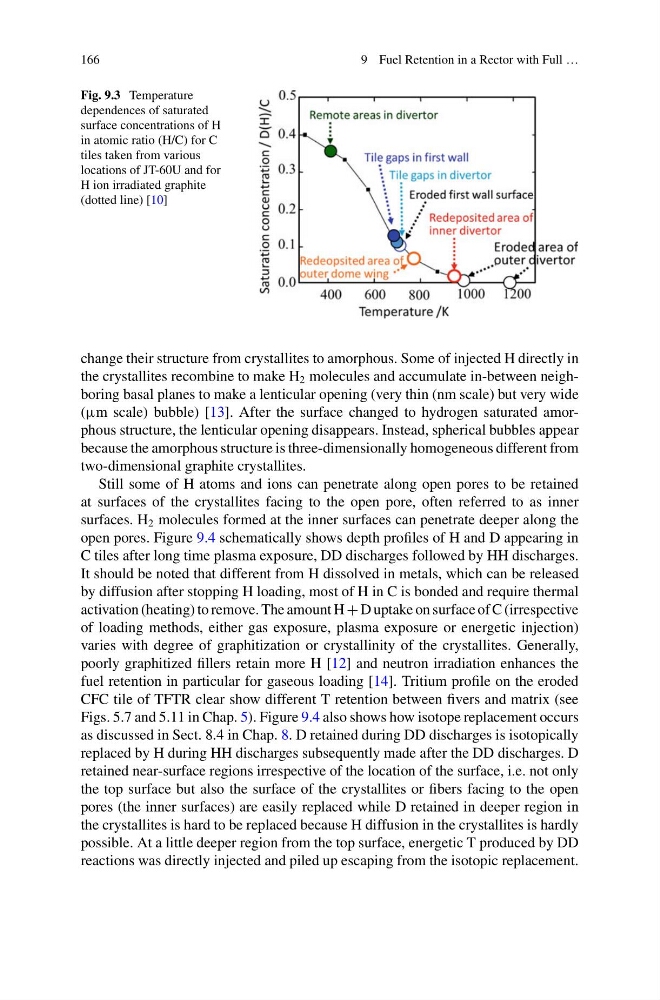
Fig. 9.3 Temperature
dependences of saturated
surface concentrations of H
in atomic ratio (H/C) for C
tiles taken from various
locations of JT-60U and for
H ion irradiated graphite
(dotted line) [10]
change their structure from crystallites to amorphous. Some of injected H directly in
the crystallites recombine to make H 2 molecules and accumulate in-between neighboring basal planes to make a lenticular opening (very thin (nm scale) but very wide
(μm scale) bubble) [13]. After the surface changed to hydrogen saturated amorphous structure, the lenticular opening disappears. Instead, spherical bubbles appear
because the amorphous structure is three-dimensionally homogeneous different from
two-dimensional graphite crystallites.
Still some of H atoms and ions can penetrate along open pores to be retained
at surfaces of the crystallites facing to the open pore, often referred to as inner
surfaces. H 2 molecules formed at the inner surfaces can penetrate deeper along the
open pores. Figure 9.4 schematically shows depth profiles of H and D appearing in
C tiles after long time plasma exposure, DD discharges followed by HH discharges.
It should be noted that different from H dissolved in metals, which can be released
by diffusion after stopping H loading, most of H in C is bonded and require thermal
activation (heating) to remove. The amount H + D uptake on surface of C (irrespective
of loading methods, either gas exposure, plasma exposure or energetic injection)
varies with degree of graphitization or crystallinity of the crystallites. Generally,
poorly graphitized fillers retain more H [12] and neutron irradiation enhances the
fuel retention in particular for gaseous loading [14]. Tritium profile on the eroded
CFC tile of TFTR clear show different T retention between fivers and matrix (see
Figs. 5.7 and 5.11 in Chap. 5). Figure 9.4 also shows how isotope replacement occurs
as discussed in Sect. 8.4 in Chap. 8. D retained during DD discharges is isotopically
replaced by H during HH discharges subsequently made after the DD discharges. D
retained near-surface regions irrespective of the location of the surface, i.e. not only
the top surface but also the surface of the crystallites or fibers facing to the open
pores (the inner surfaces) are easily replaced while D retained in deeper region in
the crystallites is hard to be replaced because H diffusion in the crystallites is hardly
possible. At a little deeper region from the top surface, energetic T produced by DD
reactions was directly injected and piled up escaping from the isotopic replacement.
9 Fuel Retention in a Rector with Full …
Fig. 9.3 Temperature
dependences of saturated
surface concentrations of H
in atomic ratio (H/C) for C
tiles taken from various
locations of JT-60U and for
H ion irradiated graphite
(dotted line) [10]
change their structure from crystallites to amorphous. Some of injected H directly in
the crystallites recombine to make H 2 molecules and accumulate in-between neighboring basal planes to make a lenticular opening (very thin (nm scale) but very wide
(μm scale) bubble) [13]. After the surface changed to hydrogen saturated amorphous structure, the lenticular opening disappears. Instead, spherical bubbles appear
because the amorphous structure is three-dimensionally homogeneous different from
two-dimensional graphite crystallites.
Still some of H atoms and ions can penetrate along open pores to be retained
at surfaces of the crystallites facing to the open pore, often referred to as inner
surfaces. H 2 molecules formed at the inner surfaces can penetrate deeper along the
open pores. Figure 9.4 schematically shows depth profiles of H and D appearing in
C tiles after long time plasma exposure, DD discharges followed by HH discharges.
It should be noted that different from H dissolved in metals, which can be released
by diffusion after stopping H loading, most of H in C is bonded and require thermal
activation (heating) to remove. The amount H + D uptake on surface of C (irrespective
of loading methods, either gas exposure, plasma exposure or energetic injection)
varies with degree of graphitization or crystallinity of the crystallites. Generally,
poorly graphitized fillers retain more H [12] and neutron irradiation enhances the
fuel retention in particular for gaseous loading [14]. Tritium profile on the eroded
CFC tile of TFTR clear show different T retention between fivers and matrix (see
Figs. 5.7 and 5.11 in Chap. 5). Figure 9.4 also shows how isotope replacement occurs
as discussed in Sect. 8.4 in Chap. 8. D retained during DD discharges is isotopically
replaced by H during HH discharges subsequently made after the DD discharges. D
retained near-surface regions irrespective of the location of the surface, i.e. not only
the top surface but also the surface of the crystallites or fibers facing to the open
pores (the inner surfaces) are easily replaced while D retained in deeper region in
the crystallites is hard to be replaced because H diffusion in the crystallites is hardly
possible. At a little deeper region from the top surface, energetic T produced by DD
reactions was directly injected and piled up escaping from the isotopic replacement.