

124
7 Fundamentals of Hydrogen Recycling
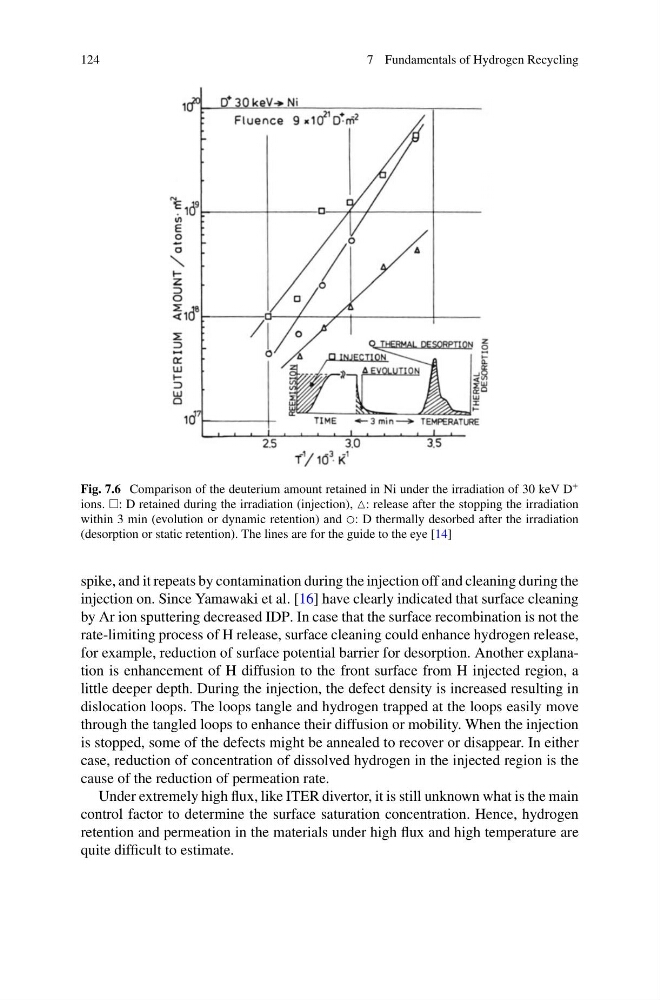
Fig. 7.6 Comparison of the deuterium amount retained in Ni under the irradiation of 30 keV D +
ions. : D retained during the irradiation (injection), : release after the stopping the irradiation
within 3 min (evolution or dynamic retention) and ◯: D thermally desorbed after the irradiation
(desorption or static retention). The lines are for the guide to the eye [14]
spike, and it repeats by contamination during the injection off and cleaning during the
injection on. Since Yamawaki et al. [16] have clearly indicated that surface cleaning
by Ar ion sputtering decreased IDP. In case that the surface recombination is not the
rate-limiting process of H release, surface cleaning could enhance hydrogen release,
for example, reduction of surface potential barrier for desorption. Another explanation is enhancement of H diffusion to the front surface from H injected region, a
little deeper depth. During the injection, the defect density is increased resulting in
dislocation loops. The loops tangle and hydrogen trapped at the loops easily move
through the tangled loops to enhance their diffusion or mobility. When the injection
is stopped, some of the defects might be annealed to recover or disappear. In either
case, reduction of concentration of dissolved hydrogen in the injected region is the
cause of the reduction of permeation rate.
Under extremely high flux, like ITER divertor, it is still unknown what is the main
control factor to determine the surface saturation concentration. Hence, hydrogen
retention and permeation in the materials under high flux and high temperature are
quite difficult to estimate.
7 Fundamentals of Hydrogen Recycling
Fig. 7.6 Comparison of the deuterium amount retained in Ni under the irradiation of 30 keV D +
ions. : D retained during the irradiation (injection), : release after the stopping the irradiation
within 3 min (evolution or dynamic retention) and ◯: D thermally desorbed after the irradiation
(desorption or static retention). The lines are for the guide to the eye [14]
spike, and it repeats by contamination during the injection off and cleaning during the
injection on. Since Yamawaki et al. [16] have clearly indicated that surface cleaning
by Ar ion sputtering decreased IDP. In case that the surface recombination is not the
rate-limiting process of H release, surface cleaning could enhance hydrogen release,
for example, reduction of surface potential barrier for desorption. Another explanation is enhancement of H diffusion to the front surface from H injected region, a
little deeper depth. During the injection, the defect density is increased resulting in
dislocation loops. The loops tangle and hydrogen trapped at the loops easily move
through the tangled loops to enhance their diffusion or mobility. When the injection
is stopped, some of the defects might be annealed to recover or disappear. In either
case, reduction of concentration of dissolved hydrogen in the injected region is the
cause of the reduction of permeation rate.
Under extremely high flux, like ITER divertor, it is still unknown what is the main
control factor to determine the surface saturation concentration. Hence, hydrogen
retention and permeation in the materials under high flux and high temperature are
quite difficult to estimate.