

7.6 Isotope Effects
125
Reduction by surface cleaning
or enhanced release
Surface contamination/
re-oxidation by residual gas
or defect annealing
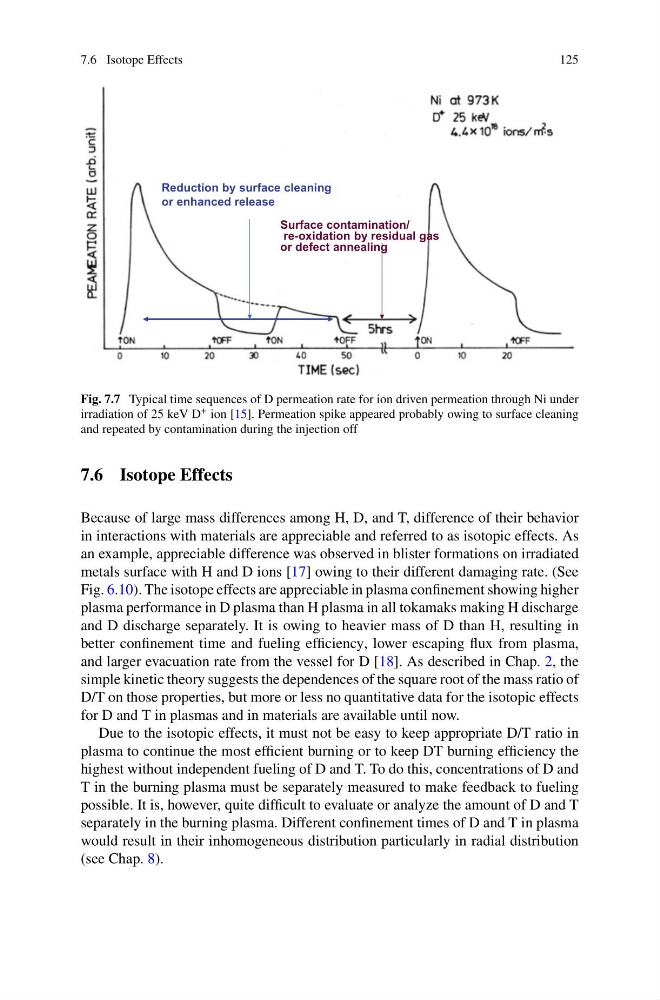
Fig. 7.7 Typical time sequences of D permeation rate for ion driven permeation through Ni under
irradiation of 25 keV D + ion [15]. Permeation spike appeared probably owing to surface cleaning
and repeated by contamination during the injection off
7.6 Isotope Effects
Because of large mass differences among H, D, and T, difference of their behavior
in interactions with materials are appreciable and referred to as isotopic effects. As
an example, appreciable difference was observed in blister formations on irradiated
metals surface with H and D ions [17] owing to their different damaging rate. (See
Fig. 6.10). The isotope effects are appreciable in plasma confinement showing higher
plasma performance in D plasma than H plasma in all tokamaks making H discharge
and D discharge separately. It is owing to heavier mass of D than H, resulting in
better confinement time and fueling efficiency, lower escaping flux from plasma,
and larger evacuation rate from the vessel for D [18]. As described in Chap. 2, the
simple kinetic theory suggests the dependences of the square root of the mass ratio of
D/T on those properties, but more or less no quantitative data for the isotopic effects
for D and T in plasmas and in materials are available until now.
Due to the isotopic effects, it must not be easy to keep appropriate D/T ratio in
plasma to continue the most efficient burning or to keep DT burning efficiency the
highest without independent fueling of D and T. To do this, concentrations of D and
T in the burning plasma must be separately measured to make feedback to fueling
possible. It is, however, quite difficult to evaluate or analyze the amount of D and T
separately in the burning plasma. Different confinement times of D and T in plasma
would result in their inhomogeneous distribution particularly in radial distribution
(see Chap. 8).
125
Reduction by surface cleaning
or enhanced release
Surface contamination/
re-oxidation by residual gas
or defect annealing
Fig. 7.7 Typical time sequences of D permeation rate for ion driven permeation through Ni under
irradiation of 25 keV D + ion [15]. Permeation spike appeared probably owing to surface cleaning
and repeated by contamination during the injection off
7.6 Isotope Effects
Because of large mass differences among H, D, and T, difference of their behavior
in interactions with materials are appreciable and referred to as isotopic effects. As
an example, appreciable difference was observed in blister formations on irradiated
metals surface with H and D ions [17] owing to their different damaging rate. (See
Fig. 6.10). The isotope effects are appreciable in plasma confinement showing higher
plasma performance in D plasma than H plasma in all tokamaks making H discharge
and D discharge separately. It is owing to heavier mass of D than H, resulting in
better confinement time and fueling efficiency, lower escaping flux from plasma,
and larger evacuation rate from the vessel for D [18]. As described in Chap. 2, the
simple kinetic theory suggests the dependences of the square root of the mass ratio of
D/T on those properties, but more or less no quantitative data for the isotopic effects
for D and T in plasmas and in materials are available until now.
Due to the isotopic effects, it must not be easy to keep appropriate D/T ratio in
plasma to continue the most efficient burning or to keep DT burning efficiency the
highest without independent fueling of D and T. To do this, concentrations of D and
T in the burning plasma must be separately measured to make feedback to fueling
possible. It is, however, quite difficult to evaluate or analyze the amount of D and T
separately in the burning plasma. Different confinement times of D and T in plasma
would result in their inhomogeneous distribution particularly in radial distribution
(see Chap. 8).