

6.3 Damaging and Degradation of PFM
107
Grazing Incidence
Electron Microscope
(GIEM) image
Bulk surface
e -
Non-destrucƟve
observaƟon
GIEM image
H +
D +
1.0 x 10 23 m -2
1.0 x 10 24 m -2
Density increases
No significant change in shape
Density increases
Blisters grow in height & curvature
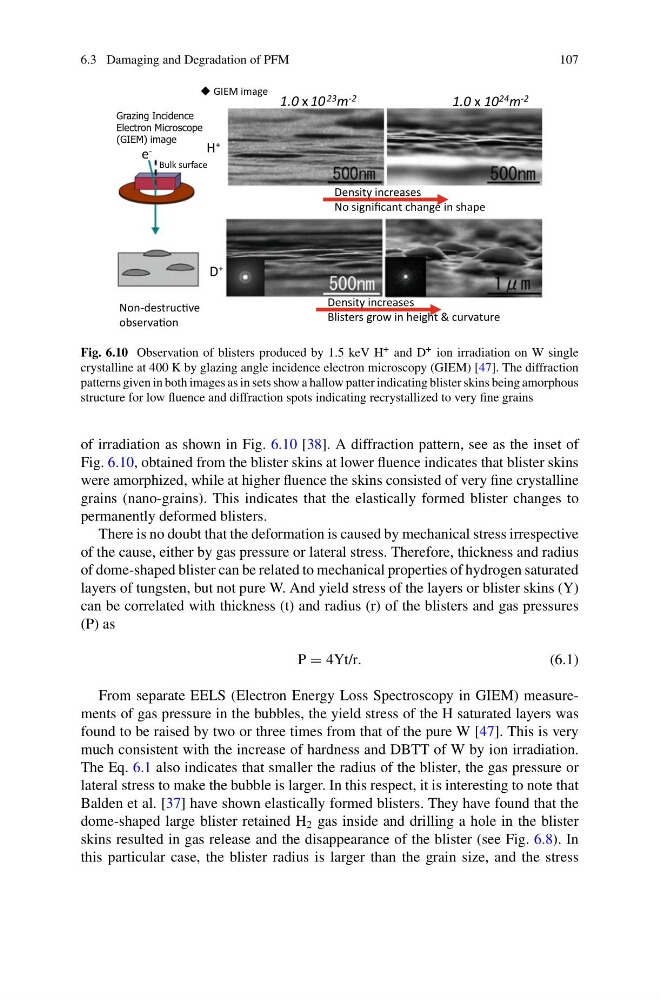
Fig. 6.10 Observation of blisters produced by 1.5 keV H + and D + ion irradiation on W single
crystalline at 400 K by glazing angle incidence electron microscopy (GIEM) [47]. The diffraction
patterns given in both images as in sets show a hallow patter indicating blister skins being amorphous
structure for low fluence and diffraction spots indicating recrystallized to very fine grains
of irradiation as shown in Fig. 6.10 [38]. A diffraction pattern, see as the inset of
Fig. 6.10, obtained from the blister skins at lower fluence indicates that blister skins
were amorphized, while at higher fluence the skins consisted of very fine crystalline
grains (nano-grains). This indicates that the elastically formed blister changes to
permanently deformed blisters.
There is no doubt that the deformation is caused by mechanical stress irrespective
of the cause, either by gas pressure or lateral stress. Therefore, thickness and radius
of dome-shaped blister can be related to mechanical properties of hydrogen saturated
layers of tungsten, but not pure W. And yield stress of the layers or blister skins (Y)
can be correlated with thickness (t) and radius (r) of the blisters and gas pressures
(P) as
P = 4Yt/r.
(6.1)
From separate EELS (Electron Energy Loss Spectroscopy in GIEM) measurements of gas pressure in the bubbles, the yield stress of the H saturated layers was
found to be raised by two or three times from that of the pure W [47]. This is very
much consistent with the increase of hardness and DBTT of W by ion irradiation.
The Eq. 6.1 also indicates that smaller the radius of the blister, the gas pressure or
lateral stress to make the bubble is larger. In this respect, it is interesting to note that
Balden et al. [37] have shown elastically formed blisters. They have found that the
dome-shaped large blister retained H 2 gas inside and drilling a hole in the blister
skins resulted in gas release and the disappearance of the blister (see Fig. 6.8). In
this particular case, the blister radius is larger than the grain size, and the stress
107
Grazing Incidence
Electron Microscope
(GIEM) image
Bulk surface
e -
Non-destrucƟve
observaƟon
GIEM image
H +
D +
1.0 x 10 23 m -2
1.0 x 10 24 m -2
Density increases
No significant change in shape
Density increases
Blisters grow in height & curvature
Fig. 6.10 Observation of blisters produced by 1.5 keV H + and D + ion irradiation on W single
crystalline at 400 K by glazing angle incidence electron microscopy (GIEM) [47]. The diffraction
patterns given in both images as in sets show a hallow patter indicating blister skins being amorphous
structure for low fluence and diffraction spots indicating recrystallized to very fine grains
of irradiation as shown in Fig. 6.10 [38]. A diffraction pattern, see as the inset of
Fig. 6.10, obtained from the blister skins at lower fluence indicates that blister skins
were amorphized, while at higher fluence the skins consisted of very fine crystalline
grains (nano-grains). This indicates that the elastically formed blister changes to
permanently deformed blisters.
There is no doubt that the deformation is caused by mechanical stress irrespective
of the cause, either by gas pressure or lateral stress. Therefore, thickness and radius
of dome-shaped blister can be related to mechanical properties of hydrogen saturated
layers of tungsten, but not pure W. And yield stress of the layers or blister skins (Y)
can be correlated with thickness (t) and radius (r) of the blisters and gas pressures
(P) as
P = 4Yt/r.
(6.1)
From separate EELS (Electron Energy Loss Spectroscopy in GIEM) measurements of gas pressure in the bubbles, the yield stress of the H saturated layers was
found to be raised by two or three times from that of the pure W [47]. This is very
much consistent with the increase of hardness and DBTT of W by ion irradiation.
The Eq. 6.1 also indicates that smaller the radius of the blister, the gas pressure or
lateral stress to make the bubble is larger. In this respect, it is interesting to note that
Balden et al. [37] have shown elastically formed blisters. They have found that the
dome-shaped large blister retained H 2 gas inside and drilling a hole in the blister
skins resulted in gas release and the disappearance of the blister (see Fig. 6.8). In
this particular case, the blister radius is larger than the grain size, and the stress