

108
6 Material Modification by High-Power Load …
to produce the blister must be much less than that for small blisters observed on
the single crystal. In another word, the lateral stress or gas pressure overcomes the
bonding force between grains to form such large size blister.
A question arises; why hydrogen can stay in bubbles or blisters with quite high
pressure in spite of large diffusion coefficient as discussed previously. It is reasonable
that during the energetic H injection, H fugacity could be in the GPa range and be in
equilibrium with the H 2 gas pressure in bubbles and blisters. However, the H fugacity
must decrease at the termination of the injection. Therefore, there is no reason to keep
H 2 gas pressure in the blisters high. H 2 gas could be released by permeation, except
for permanently deformed blisters. One possible answer is impurity deposition or
accumulation on the inner surface of the blister skin to prohibit H release from the
blister inside. The observation by Shimada et al. [48] states that coexisting carbon in
hydrogen plasma significantly enhance blister formation that suggests suppression
of hydrogen release by surface carbon or carbide layers. This could potentially also
happen on bubble surface preventing hydrogen in bubbles from escape by some
impurities covering their inside surfaces. Another possibility is that once hydrogen
concentration in W is raised above a certain level making the H saturated layers,
hydrogen diffusion in it is likely suppressed. Considering all observations described
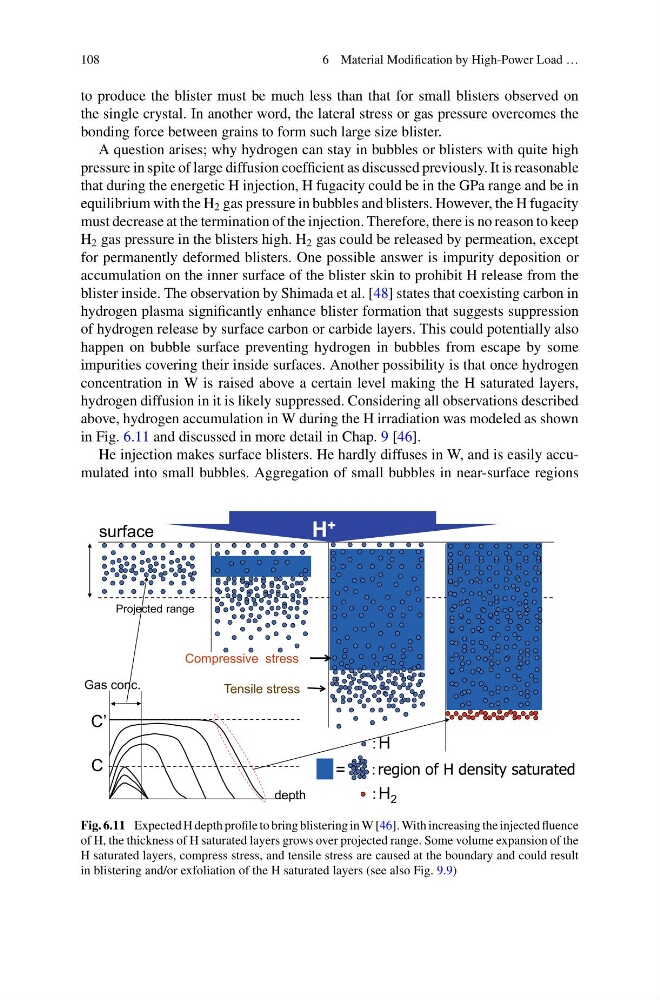
above, hydrogen accumulation in W during the H irradiation was modeled as shown
in Fig. 6.11 and discussed in more detail in Chap. 9 [46].
He injection makes surface blisters. He hardly diffuses in W, and is easily accumulated into small bubbles. Aggregation of small bubbles in near-surface regions
Fig. 6.11 Expected H depth profile to bring blistering in W [46]. With increasing the injected fluence
of H, the thickness of H saturated layers grows over projected range. Some volume expansion of the
H saturated layers, compress stress, and tensile stress are caused at the boundary and could result
in blistering and/or exfoliation of the H saturated layers (see also Fig. 9.9)
6 Material Modification by High-Power Load …
to produce the blister must be much less than that for small blisters observed on
the single crystal. In another word, the lateral stress or gas pressure overcomes the
bonding force between grains to form such large size blister.
A question arises; why hydrogen can stay in bubbles or blisters with quite high
pressure in spite of large diffusion coefficient as discussed previously. It is reasonable
that during the energetic H injection, H fugacity could be in the GPa range and be in
equilibrium with the H 2 gas pressure in bubbles and blisters. However, the H fugacity
must decrease at the termination of the injection. Therefore, there is no reason to keep
H 2 gas pressure in the blisters high. H 2 gas could be released by permeation, except
for permanently deformed blisters. One possible answer is impurity deposition or
accumulation on the inner surface of the blister skin to prohibit H release from the
blister inside. The observation by Shimada et al. [48] states that coexisting carbon in
hydrogen plasma significantly enhance blister formation that suggests suppression
of hydrogen release by surface carbon or carbide layers. This could potentially also
happen on bubble surface preventing hydrogen in bubbles from escape by some
impurities covering their inside surfaces. Another possibility is that once hydrogen
concentration in W is raised above a certain level making the H saturated layers,
hydrogen diffusion in it is likely suppressed. Considering all observations described
above, hydrogen accumulation in W during the H irradiation was modeled as shown
in Fig. 6.11 and discussed in more detail in Chap. 9 [46].
He injection makes surface blisters. He hardly diffuses in W, and is easily accumulated into small bubbles. Aggregation of small bubbles in near-surface regions
Fig. 6.11 Expected H depth profile to bring blistering in W [46]. With increasing the injected fluence
of H, the thickness of H saturated layers grows over projected range. Some volume expansion of the
H saturated layers, compress stress, and tensile stress are caused at the boundary and could result
in blistering and/or exfoliation of the H saturated layers (see also Fig. 9.9)