

102
6 Material Modification by High-Power Load …
Thus, modification of C would not be significant giving little influence on
boundary plasma, except carbon blooms which radiates lots and could be beneficial for edge cooling. Nevertheless, because of the concern on large T retention, C is
not used in ITER. However, C could be used as plasma-facing armor tiles in a reactor
[26], which is discussed in Chap. 10.
6.3.2 Tungsten (W)
6.3.2.1 Surface Damage by High-Power Load (Melting,
Recrystallization, and Cracking)
Different from C, very small hydrogen solubility in W does not allow hydrogen
accumulation except near-surface region, where hydrogen trapping is significant.
Because of damages introduced by energetic hydrogen injection and lattice distortion
given by injected hydrogen themselves, hydrogen in near-surface region accumulate
to make bubbles and consequently they coalesce to make blisters. Large diffusion
coefficient promotes hydrogen penetration in deep. Grain boundaries seem to attract
hydrogen and exfoliation or slip of the grain boundaries are caused by the hydrogen
accumulation resulting in large blisters or cleavage of small grains. This looks like
hydrogen embrittlement, although the hydrogen embrittlement of W with hydrogen
gas has not been ostensively shown.
Very high heat load causes temperature escalation resulting in grain growth.
Consequently, heat influenced zone near the surface can be clearly distinguished
from the original crystalline structure, as shown in Fig. 6.2B. Once the boundary
between the heat influence zone and original one is formed, it easily triggers crack
and some particles or layers are exfoliated. Only single pulsed power load even below
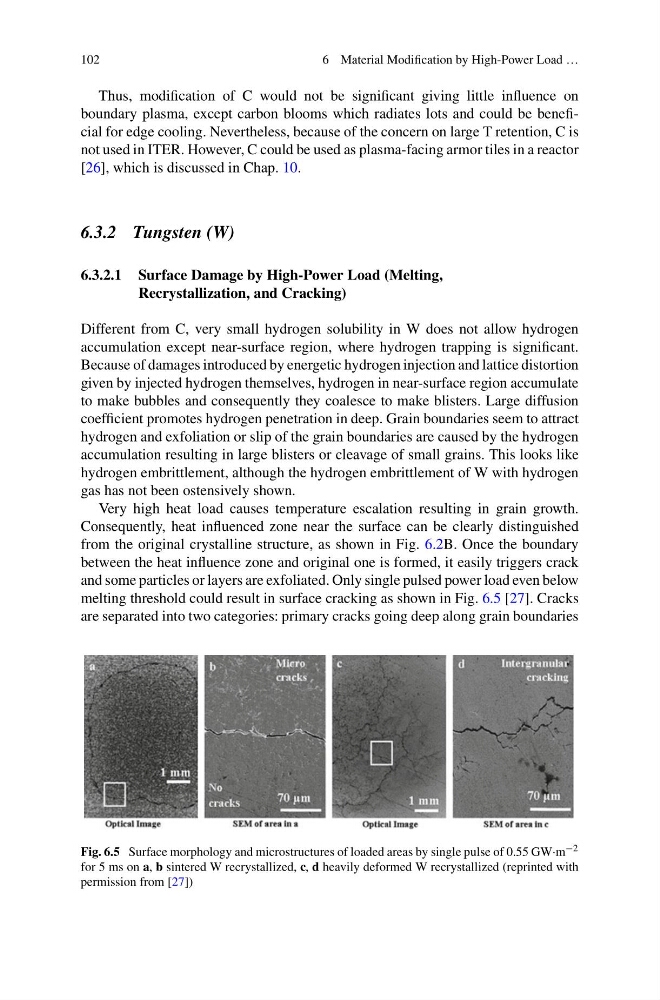
melting threshold could result in surface cracking as shown in Fig. 6.5 [27]. Cracks
are separated into two categories: primary cracks going deep along grain boundaries
Fig. 6.5 Surface morphology and microstructures of loaded areas by single pulse of 0.55 GW·m −2
for 5 ms on a, b sintered W recrystallized, c, d heavily deformed W recrystallized (reprinted with
permission from [27])
6 Material Modification by High-Power Load …
Thus, modification of C would not be significant giving little influence on
boundary plasma, except carbon blooms which radiates lots and could be beneficial for edge cooling. Nevertheless, because of the concern on large T retention, C is
not used in ITER. However, C could be used as plasma-facing armor tiles in a reactor
[26], which is discussed in Chap. 10.
6.3.2 Tungsten (W)
6.3.2.1 Surface Damage by High-Power Load (Melting,
Recrystallization, and Cracking)
Different from C, very small hydrogen solubility in W does not allow hydrogen
accumulation except near-surface region, where hydrogen trapping is significant.
Because of damages introduced by energetic hydrogen injection and lattice distortion
given by injected hydrogen themselves, hydrogen in near-surface region accumulate
to make bubbles and consequently they coalesce to make blisters. Large diffusion
coefficient promotes hydrogen penetration in deep. Grain boundaries seem to attract
hydrogen and exfoliation or slip of the grain boundaries are caused by the hydrogen
accumulation resulting in large blisters or cleavage of small grains. This looks like
hydrogen embrittlement, although the hydrogen embrittlement of W with hydrogen
gas has not been ostensively shown.
Very high heat load causes temperature escalation resulting in grain growth.
Consequently, heat influenced zone near the surface can be clearly distinguished
from the original crystalline structure, as shown in Fig. 6.2B. Once the boundary
between the heat influence zone and original one is formed, it easily triggers crack
and some particles or layers are exfoliated. Only single pulsed power load even below
melting threshold could result in surface cracking as shown in Fig. 6.5 [27]. Cracks
are separated into two categories: primary cracks going deep along grain boundaries
Fig. 6.5 Surface morphology and microstructures of loaded areas by single pulse of 0.55 GW·m −2
for 5 ms on a, b sintered W recrystallized, c, d heavily deformed W recrystallized (reprinted with
permission from [27])