

6.3 Damaging and Degradation of PFM
101
alteration of material properties of C by loaded hydrogen is limited within nearsurface regions. Because of very high particle flux, formation of hydrogen saturated
layers is immediate after the plasma exposure and afterwards response to plasma
power load would become steady.
Released hydrocarbons by chemical sputtering and small C clusters by RES
strongly influenced boundary plasma. Even though their significant part returns
PFS by the prompt deposition, some of ionized hydrocarbons and carbon clusters
enter boundary plasma and are broken up into excited/ionized hydrogen atoms, and
excited/ionized carbon which in turn radiated large power. In JET and TFTR with
carbon PFM, significant radiation caused by carbon was observed and referred to as
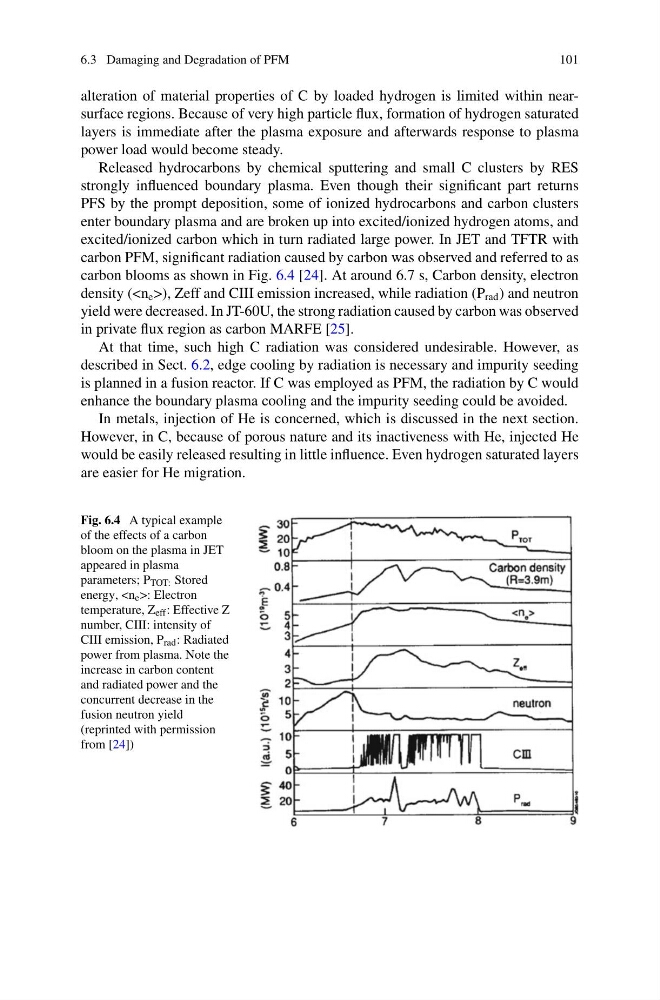
carbon blooms as shown in Fig. 6.4 [24]. At around 6.7 s, Carbon density, electron
density (), Zeff and CIII emission increased, while radiation (P rad ) and neutron
yield were decreased. In JT-60U, the strong radiation caused by carbon was observed
in private flux region as carbon MARFE [25].
At that time, such high C radiation was considered undesirable. However, as
described in Sect. 6.2, edge cooling by radiation is necessary and impurity seeding
is planned in a fusion reactor. If C was employed as PFM, the radiation by C would
enhance the boundary plasma cooling and the impurity seeding could be avoided.
In metals, injection of He is concerned, which is discussed in the next section.
However, in C, because of porous nature and its inactiveness with He, injected He
would be easily released resulting in little influence. Even hydrogen saturated layers
are easier for He migration.
Fig. 6.4 A typical example
of the effects of a carbon
bloom on the plasma in JET
appeared in plasma
parameters; P TOT: Stored
energy,: Electron
temperature, Z eff : Effective Z
number, CIII: intensity of
CIII emission, P rad : Radiated
power from plasma. Note the
increase in carbon content
and radiated power and the
concurrent decrease in the
fusion neutron yield
(reprinted with permission
from [24])
101
alteration of material properties of C by loaded hydrogen is limited within nearsurface regions. Because of very high particle flux, formation of hydrogen saturated
layers is immediate after the plasma exposure and afterwards response to plasma
power load would become steady.
Released hydrocarbons by chemical sputtering and small C clusters by RES
strongly influenced boundary plasma. Even though their significant part returns
PFS by the prompt deposition, some of ionized hydrocarbons and carbon clusters
enter boundary plasma and are broken up into excited/ionized hydrogen atoms, and
excited/ionized carbon which in turn radiated large power. In JET and TFTR with
carbon PFM, significant radiation caused by carbon was observed and referred to as
carbon blooms as shown in Fig. 6.4 [24]. At around 6.7 s, Carbon density, electron
density (
yield were decreased. In JT-60U, the strong radiation caused by carbon was observed
in private flux region as carbon MARFE [25].
At that time, such high C radiation was considered undesirable. However, as
described in Sect. 6.2, edge cooling by radiation is necessary and impurity seeding
is planned in a fusion reactor. If C was employed as PFM, the radiation by C would
enhance the boundary plasma cooling and the impurity seeding could be avoided.
In metals, injection of He is concerned, which is discussed in the next section.
However, in C, because of porous nature and its inactiveness with He, injected He
would be easily released resulting in little influence. Even hydrogen saturated layers
are easier for He migration.
Fig. 6.4 A typical example
of the effects of a carbon
bloom on the plasma in JET
appeared in plasma
parameters; P TOT: Stored
energy,
temperature, Z eff : Effective Z
number, CIII: intensity of
CIII emission, P rad : Radiated
power from plasma. Note the
increase in carbon content
and radiated power and the
concurrent decrease in the
fusion neutron yield
(reprinted with permission
from [24])