

The cost of (a) may limit the application. It is obvious that the extraction of CO 2
from the ground for such operation means a net increase of the emission to the
atmosphere, while if captured CO 2 is used, considering that part of it remains in the
well, the net emission into the atmosphere would be reduced. Some technical
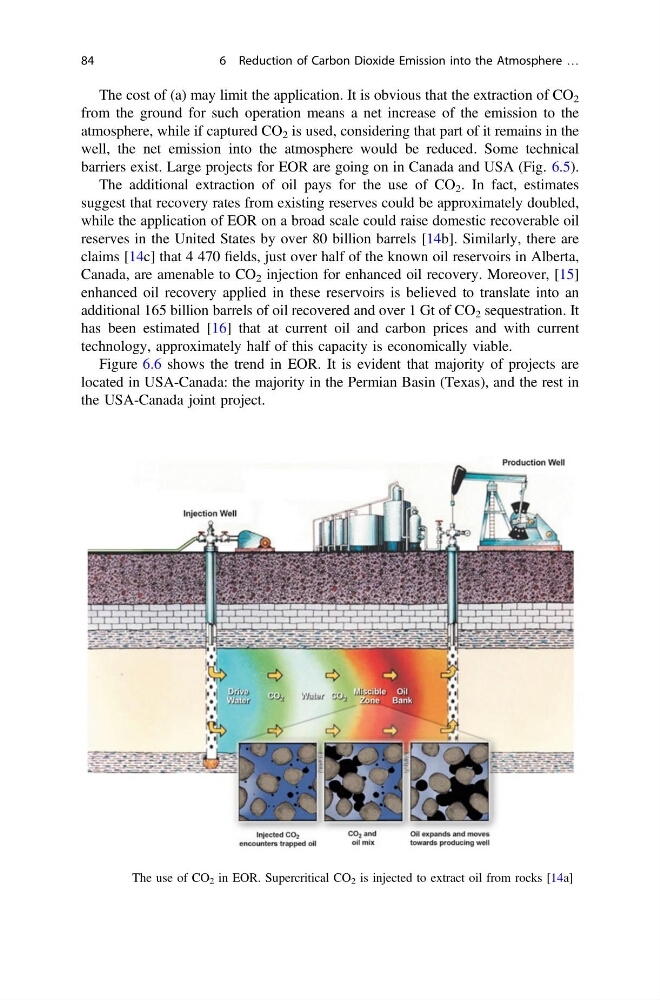
barriers exist. Large projects for EOR are going on in Canada and USA (Fig. 6.5).
The additional extraction of oil pays for the use of CO 2 . In fact, estimates
suggest that recovery rates from existing reserves could be approximately doubled,
while the application of EOR on a broad scale could raise domestic recoverable oil
reserves in the United States by over 80 billion barrels [14b]. Similarly, there are
claims [14c] that 4 470 fields, just over half of the known oil reservoirs in Alberta,
Canada, are amenable to CO 2 injection for enhanced oil recovery. Moreover, [15]
enhanced oil recovery applied in these reservoirs is believed to translate into an
additional 165 billion barrels of oil recovered and over 1 Gt of CO 2 sequestration. It
has been estimated [16] that at current oil and carbon prices and with current
technology, approximately half of this capacity is economically viable.
Figure 6.6 shows the trend in EOR. It is evident that majority of projects are
located in USA-Canada: the majority in the Permian Basin (Texas), and the rest in
the USA-Canada joint project.
Fig. 6.5 The use of CO 2 in EOR. Supercritical CO 2 is injected to extract oil from rocks [14a]
84
6 Reduction of Carbon Dioxide Emission into the Atmosphere …
from the ground for such operation means a net increase of the emission to the
atmosphere, while if captured CO 2 is used, considering that part of it remains in the
well, the net emission into the atmosphere would be reduced. Some technical
barriers exist. Large projects for EOR are going on in Canada and USA (Fig. 6.5).
The additional extraction of oil pays for the use of CO 2 . In fact, estimates
suggest that recovery rates from existing reserves could be approximately doubled,
while the application of EOR on a broad scale could raise domestic recoverable oil
reserves in the United States by over 80 billion barrels [14b]. Similarly, there are
claims [14c] that 4 470 fields, just over half of the known oil reservoirs in Alberta,
Canada, are amenable to CO 2 injection for enhanced oil recovery. Moreover, [15]
enhanced oil recovery applied in these reservoirs is believed to translate into an
additional 165 billion barrels of oil recovered and over 1 Gt of CO 2 sequestration. It
has been estimated [16] that at current oil and carbon prices and with current
technology, approximately half of this capacity is economically viable.
Figure 6.6 shows the trend in EOR. It is evident that majority of projects are
located in USA-Canada: the majority in the Permian Basin (Texas), and the rest in
the USA-Canada joint project.
Fig. 6.5 The use of CO 2 in EOR. Supercritical CO 2 is injected to extract oil from rocks [14a]
84
6 Reduction of Carbon Dioxide Emission into the Atmosphere …